

Guitar Buying Guide
How to Choose the Right Electric Guitar: A Complete Guide for Beginners and Serious Players
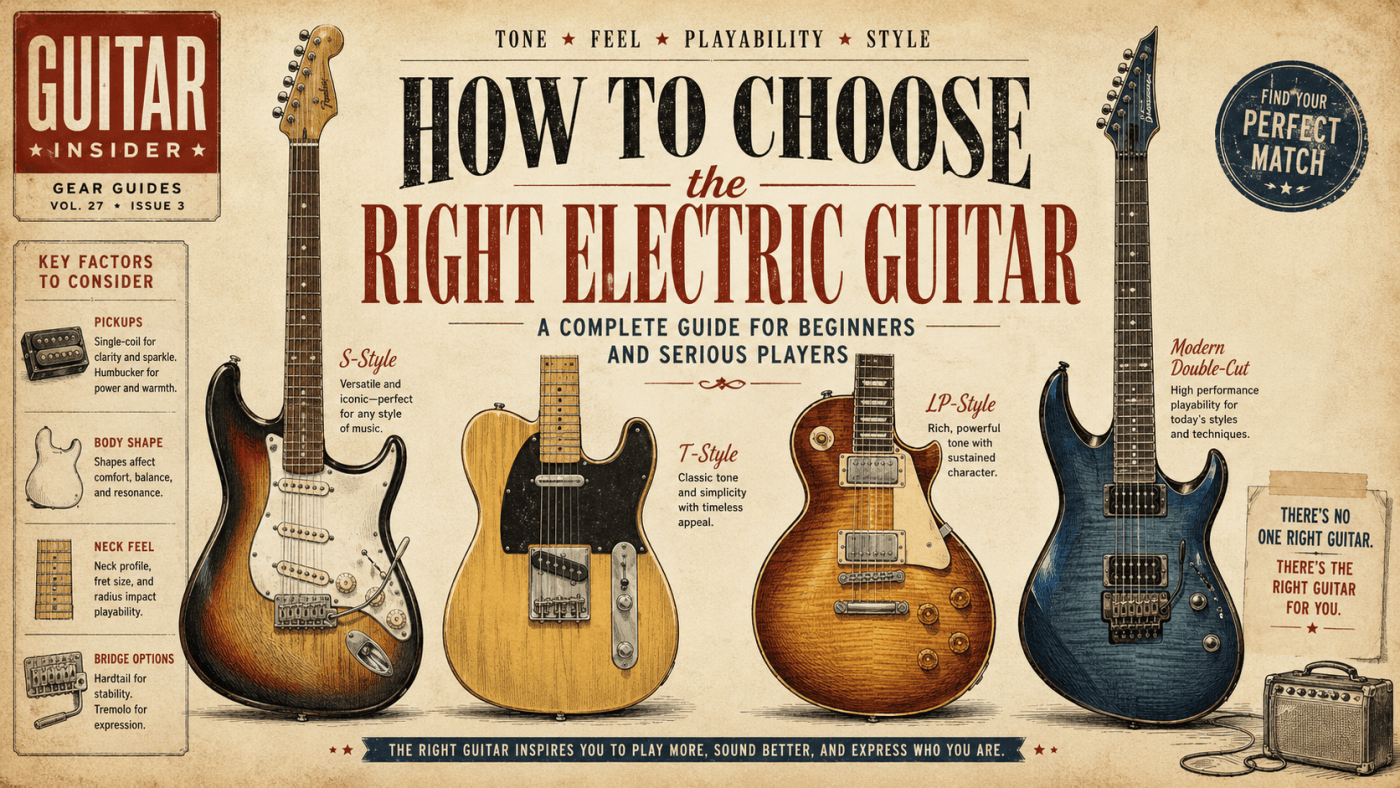
Choosing the right electric guitar can feel exciting, confusing, and overwhelming at the same time. There are many body shapes, woods, pickups, neck profiles, bridges, scale lengths, finishes, and price levels to consider. For a new player, it may be hard to know where to start. For an experienced player, the challenge is often knowing which details truly matter for your playing style.
The truth is simple: the best electric guitar is not always the most expensive one. It is the guitar that fits your music, your hands, your tone preference, and the way you want to play.
This complete electric guitar buying guide will help you understand what to look for before choosing your next guitar. Whether you are buying your first instrument, upgrading from a beginner guitar, or planning a custom build, this guide will help you make a more confident decision.
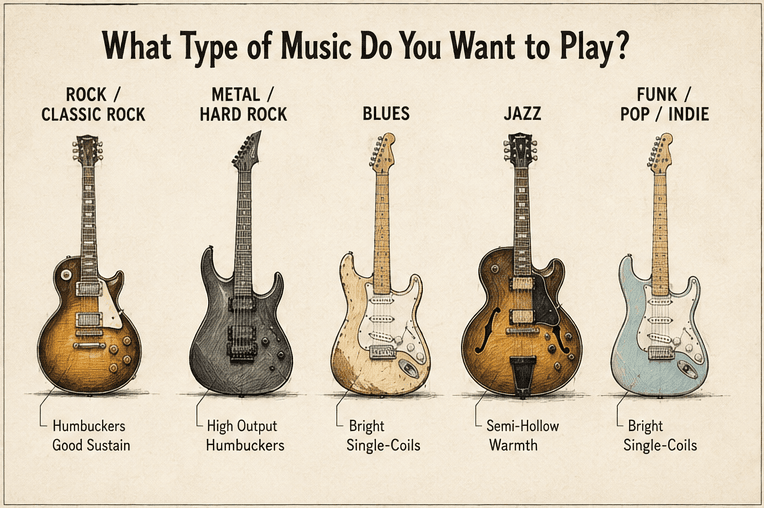
What Type of Music Do You Want to Play?
Before looking at body shapes, pickups, or wood types, the first question is:
What kind of music do you want to play?
Different electric guitars are designed with different sounds and playing styles in mind. While many guitars can be used across multiple genres, some designs naturally fit certain styles better than others.
For example, a guitar built for metal may have high-output humbuckers, a thinner neck, better upper fret access, and a stable bridge system. A guitar designed for blues or classic rock may focus more on warmth, sustain, and dynamic response. A guitar for funk or indie may need brighter pickups and strong note clarity.
For rock and classic rock
Look for a guitar with a strong midrange, good sustain, and humbucker pickups. Mahogany bodies, maple tops, set neck construction, and dual humbuckers are common choices.
Good features to consider:
- Humbucker pickups
- Medium to thick body tone
- Comfortable neck
- Good sustain
- Fixed bridge or tune-o-matic style bridge
For metal and hard rock
Metal players often need tight low-end response, high-output pickups, fast playability, and stable tuning.
Good features to consider:
- High-output humbuckers
- Thin or fast neck profile
- 24 frets
- Longer scale length for tighter low strings
- Fixed bridge or locking tremolo
- Basswood, mahogany, alder, or maple combinations
For blues
Blues players usually value expression, warmth, sustain, and touch sensitivity. The guitar should respond well to picking dynamics and volume control changes.
Good features to consider:
- Single coils, P90s, or vintage-style humbuckers
- Comfortable neck profile
- Warm tonewood choices
- Smooth sustain
- Simple control layout
For jazz
Jazz players often prefer warm, rounded tones with less harsh treble. Semi-hollow and hollow body guitars are popular, but solid body guitars can also work well.
Good features to consider:
- Humbuckers or P90s
- Warm body woods
- Semi-hollow or hollow body construction
- Smooth neck feel
- Clean tone clarity
For funk, pop, and indie
These styles often need clear, bright, articulate tones. Note separation and clean response are important.
Good features to consider:
- Single coil pickups
- Alder or ash body
- Bolt-on neck
- 25.5” scale length
- Lightweight body
- Clean tone versatility
The right electric guitar should support the kind of sound you hear in your head. Start with your music style, then choose the features that help you get there.
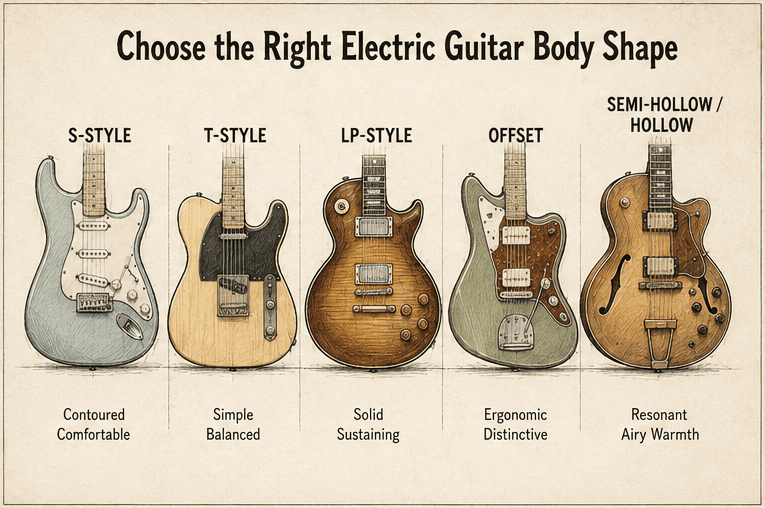
Choose the Right Electric Guitar Body Shape
The body shape of an electric guitar affects more than appearance. It also influences comfort, balance, weight, upper fret access, and how the guitar feels when sitting or standing.
Some players choose a guitar based on looks alone, but comfort should always matter. A beautiful guitar that feels awkward to play may not inspire you in the long run.
S-Style Guitars
S-style guitars are among the most versatile electric guitar designs. They are usually lightweight, comfortable, and easy to play for many styles.
They often feature double cutaways, body contours, and excellent upper fret access. Many S-style guitars use single coil pickups or HSS configurations, making them suitable for clean tones, blues, rock, pop, funk, and fusion.
Best for:
- Players who want versatility
- Clean and bright tones
- Funk, pop, blues, rock, and fusion
- Comfortable long playing sessions
T-Style Guitars
T-style guitars are simple, direct, and highly responsive. They are known for their clear attack, strong midrange, and excellent note definition.
They are popular in country, blues, rock, indie, worship, and studio playing. Their straightforward design makes them reliable and expressive.
Best for:
- Players who like simple, responsive guitars
- Bright and articulate tones
- Country, indie, blues, rock, and pop
- Strong rhythm playing
LP-Style Guitars
LP-style guitars usually have a thicker body, shorter scale length, set neck construction, and humbucker pickups. They are known for warmth, sustain, and powerful midrange.
They often feel more substantial in the hands and are popular for rock, blues, hard rock, and classic lead tones.
Best for:
- Warm, thick tones
- Rock, blues, hard rock, and jazz
- Players who want sustain
- Lead guitar and expressive bends
Offset Guitars
Offset guitars have unique body shapes and a different visual personality. They are popular in alternative, indie, shoegaze, punk, and experimental music.
They often provide a comfortable seated playing position and a distinctive stage look.
Best for:
- Indie, alternative, and experimental players
- Unique visual style
- Players who want something different
- Textural clean and overdriven tones
Hollow Body and Semi-Hollow Guitars
Hollow and semi-hollow guitars offer a more open, resonant tone compared with solid body guitars. Semi-hollow guitars are more feedback-resistant than full hollow bodies and can work well for blues, jazz, rock, and fusion.
Best for:
- Warm clean tones
- Blues, jazz, classic rock, and fusion
- Players who want acoustic-like resonance
- Expressive dynamic playing
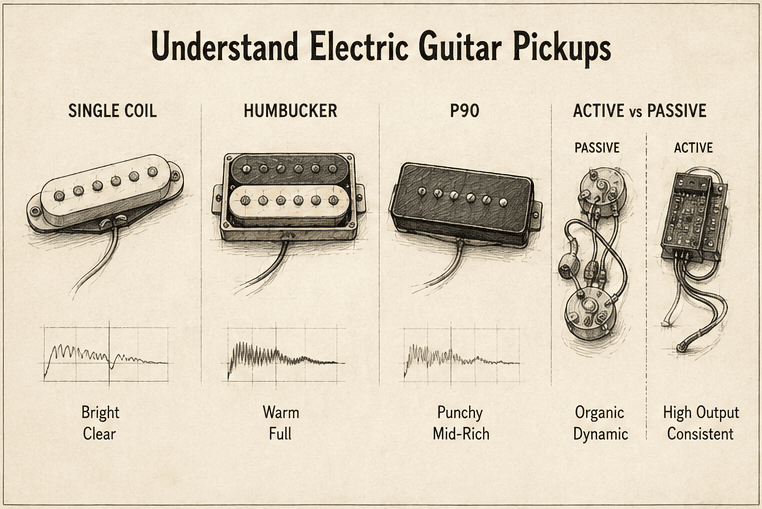
Understand Electric Guitar Pickups
Pickups are one of the most important parts of an electric guitar’s sound. They convert string vibration into an electrical signal, which is then shaped by your amp, pedals, and playing technique.
Choosing the right pickups can make a huge difference in tone.
Single Coil Pickups
Single coil pickups are bright, clear, and articulate. They are known for clean tone sparkle and strong note separation.
They work well for funk, blues, country, pop, indie, and classic rock. However, traditional single coils can produce some hum, especially with high gain.
Tone character:
- Bright
- Clear
- Crisp
- Dynamic
- Articulate
Best for:
- Clean tones
- Funk
- Blues
- Country
- Indie
- Pop
Humbucker Pickups
Humbuckers are thicker, warmer, and more powerful than single coils. They are designed to reduce hum and produce a fuller sound.
They are commonly used for rock, hard rock, metal, blues, jazz, and heavier styles.
Tone character:
- Warm
- Thick
- Powerful
- Smooth
- Lower noise
Best for:
- Rock
- Metal
- Blues
- Jazz
- High-gain tones
- Lead playing
P90 Pickups
P90 pickups sit somewhere between single coils and humbuckers. They have more midrange and body than a traditional single coil, but more bite and rawness than a humbucker.
They are great for blues, rock, punk, garage rock, and vintage-inspired tones.
Tone character:
- Raw
- Punchy
- Mid-focused
- Dynamic
- Gritty
Best for:
- Blues rock
- Classic rock
- Punk
- Garage rock
- Vintage tone
Active Pickups vs Passive Pickups
Passive pickups are the traditional choice and usually feel more dynamic and organic. Active pickups use a battery-powered circuit to produce a stronger, cleaner, and more compressed signal.
Active pickups are popular in metal because they offer tight low end and consistent output. Passive pickups are often preferred for players who want more natural response and touch sensitivity.
Choose passive pickups if you want:
- More dynamic response
- Traditional tone
- Natural feel
- Better volume knob interaction
Choose active pickups if you want:
- High output
- Tight low end
- Low noise
- Consistent heavy tone
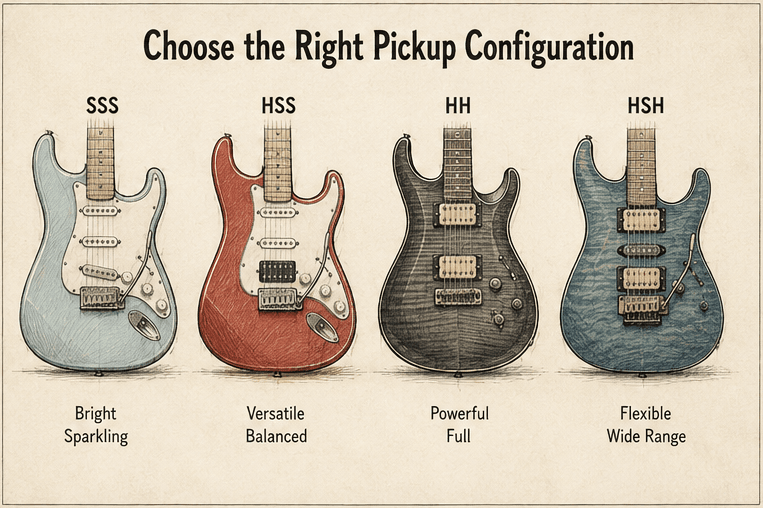
Choose the Right Pickup Configuration
Pickup configuration refers to how many pickups a guitar has and what types they are.
Common configurations include:
SSS
Three single coils.
This is a classic setup for bright, clean, expressive tones. It works well for blues, funk, pop, country, and classic rock.
Best for:
- Clean tones
- Bright articulation
- Versatility in lighter genres
HSS
One humbucker in the bridge and two single coils.
This is one of the most versatile configurations because it gives you powerful rock tones from the bridge pickup and clean single coil tones from the middle and neck pickups.
Best for:
- Players who need one guitar for many styles
- Rock, pop, funk, blues, fusion
- Clean and distorted tones
HH
Two humbuckers.
This setup is ideal for thicker, warmer, and more powerful tones. It is common in rock, metal, blues, jazz, and modern guitar styles.
Best for:
- Rock and metal
- Warm lead tones
- High-gain playing
- Lower noise
HSH
Humbucker, single coil, humbucker.
This setup offers a wide tonal range. It can handle heavy rhythm tones, smooth leads, and cleaner single coil-style sounds.
Best for:
- Fusion
- Progressive rock
- Session players
- Players who want maximum flexibility
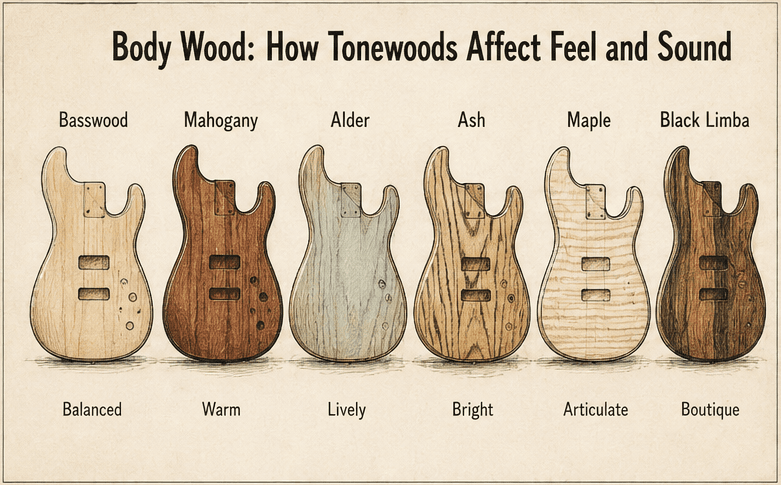
Body Wood: How Tonewoods Affect Feel and Sound
Tonewood is not the only factor in electric guitar tone, but it can influence resonance, weight, response, and the overall character of the instrument.
The effect of wood works together with pickups, bridge, neck construction, scale length, and build quality.
Basswood
Basswood is lightweight, balanced, and smooth. It has a softer mid-focused sound that works well with high-output pickups.
Best for:
- Metal
- Shred
- Modern rock
- Players who want comfort and balance
Mahogany
Mahogany is warm, full, and rich. It is often associated with strong sustain, thick mids, and a smooth high end.
Best for:
- Blues
- Rock
- Jazz
- Warm lead tones
- Players who want depth and sustain
Alder
Alder is balanced, lively, and versatile. It offers clear highs, defined lows, and a slightly scooped midrange.
Best for:
- Pop
- Rock
- Funk
- Indie
- All-around playing
Ash
Ash is bright, resonant, and visually striking. It often has strong grain and clear note response.
Best for:
- Clean tones
- Funk
- Country
- Players who want clarity and snap
Maple
Maple is bright, hard, and articulate. It is commonly used for necks, fretboards, and tops. A maple top can add clarity and attack to warmer body woods.
Best for:
- Added brightness
- Note definition
- Premium visual tops
- Fast response
Black Limba
Black Limba, also known as Korina, offers warmth with a slightly open and lively character. It is also visually distinctive.
Best for:
- Classic rock
- Blues
- Boutique-style builds
- Warm tone with clarity
When choosing wood, think about both sound and comfort. A heavier wood may offer a solid feel, but a lighter wood may be better for long performances.
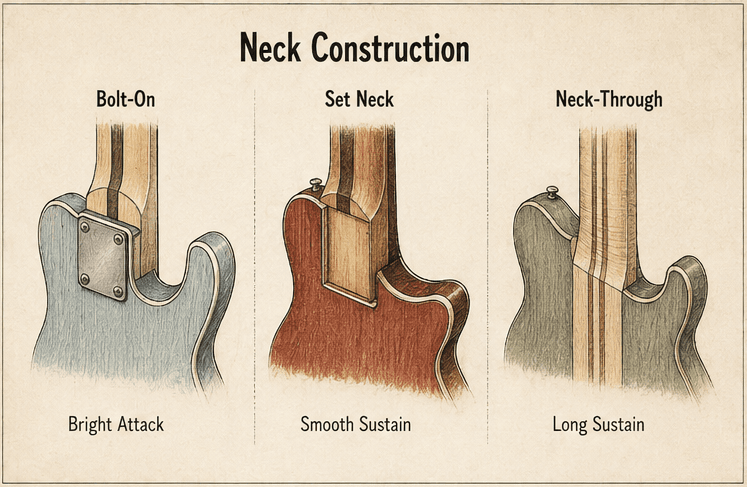
Neck Construction: Bolt-On, Set Neck, or Neck-Through?
Neck construction affects sustain, attack, repairability, and how the guitar feels.
Bolt-On Neck
A bolt-on neck is attached to the body with screws or bolts. This construction is common in S-style and T-style guitars.
It often gives a snappy attack and clear note response. It is also easier to repair or replace.
Best for:
- Bright, articulate tones
- Funk, pop, blues, rock
- Easy maintenance
- Players who like fast response
Set Neck
A set neck is glued into the body. This is common in LP-style guitars.
It often provides smooth sustain and a more connected feel between the neck and body.
Best for:
- Warm sustain
- Rock, blues, jazz
- Smooth lead playing
- Traditional premium feel
Neck-Through
A neck-through guitar has a neck that continues through the body, with body wings attached to the sides.
This construction can provide excellent sustain and upper fret access. It is often used in high-performance guitars.
Best for:
- Modern rock and metal
- Long sustain
- Smooth upper fret access
- Premium custom builds
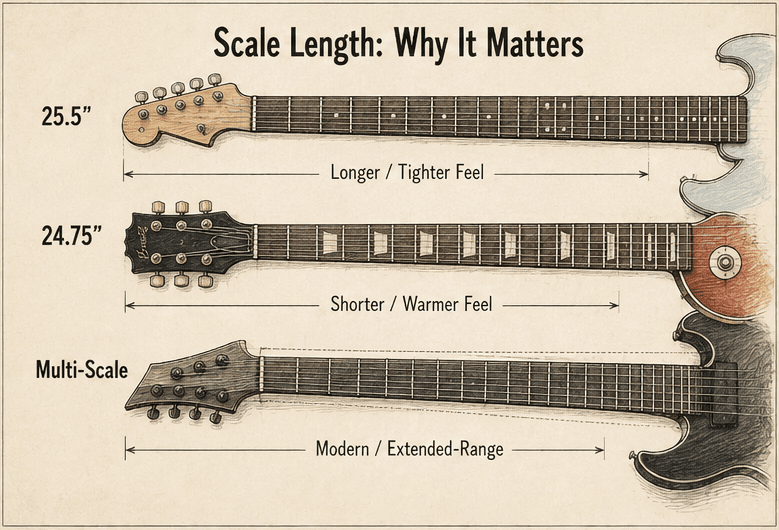
Scale Length: Why It Matters
Scale length is the distance between the nut and the bridge saddle. It affects string tension, feel, brightness, and tuning stability.
25.5” Scale Length
This longer scale length usually feels tighter and brighter. It is common on S-style and T-style guitars.
Best for:
- Clear attack
- Tight low strings
- Funk, pop, rock, metal
- Drop tunings with heavier strings
24.75” Scale Length
This shorter scale length usually feels slightly softer and warmer. It makes bending easier and can feel more relaxed under the fingers.
Best for:
- Blues
- Classic rock
- Warm lead tones
- Players who like easier bends
Multi-Scale or Extended Scale
Multi-scale guitars use different scale lengths across the strings. Extended scale guitars are often used for 7-string, 8-string, or drop-tuned playing.
Best for:
- Metal
- Progressive music
- Low tunings
- Tight string tension
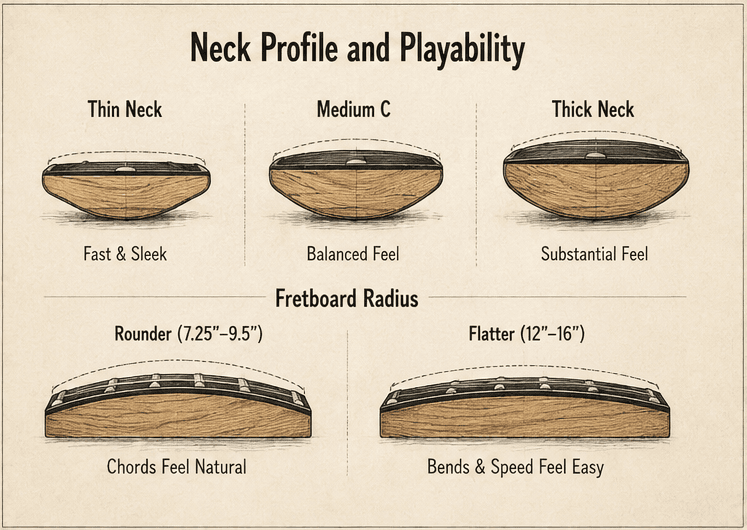
Neck Profile and Playability
The neck is one of the most personal parts of a guitar. Even if a guitar sounds great, you may not enjoy playing it if the neck does not feel right.
Thin Neck
A thin neck can feel fast and easy for technical playing.
Best for:
- Shred
- Metal
- Fusion
- Fast lead playing
Medium C Neck
A medium C shape is one of the most comfortable and versatile neck profiles. It works well for many players.
Best for:
- All-around playing
- Beginners
- Rhythm and lead
- Players who want comfort
Thick Neck
A thicker neck can feel more substantial and supportive. Some players feel it improves grip and resonance.
Best for:
- Blues
- Classic rock
- Jazz
- Players who like a fuller hand feel
Fretboard Radius
Fretboard radius affects how curved or flat the fingerboard feels.
A rounder radius can feel comfortable for chords. A flatter radius can feel better for bending and fast lead playing.
Common choices:
- 7.25” to 9.5”: vintage feel, comfortable chords
- 10” to 12”: balanced modern feel
- 14” to 16”: flatter, better for fast lead playing
- Compound radius: rounder near the nut, flatter near the higher frets
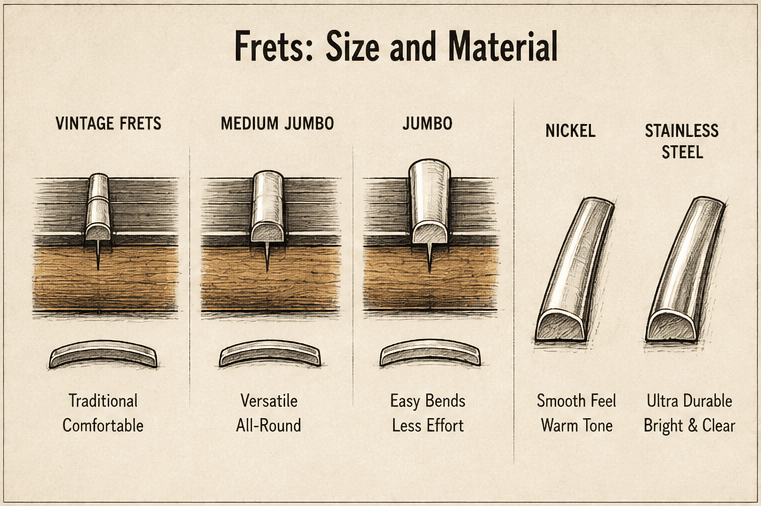
Frets: Size and Material
Frets have a major impact on feel.
Vintage Frets
Vintage frets are smaller and lower. They can feel traditional but may require more finger pressure.
Best for:
- Vintage-style players
- Chord-focused playing
- Traditional feel
Medium Jumbo Frets
Medium jumbo frets are versatile and comfortable. They are a popular choice for many modern guitars.
Best for:
- Most players
- Balanced rhythm and lead
- General versatility
Jumbo Frets
Jumbo frets are taller and wider. They make bending and vibrato easier but may feel too large for some players.
Best for:
- Lead guitar
- Metal
- Shred
- Players who like effortless bends
Stainless Steel Frets vs Nickel Frets
Nickel frets are traditional and common. Stainless steel frets are harder, smoother, and more durable.
Choose stainless steel frets if you want long-term durability and smooth bending. Choose nickel frets if you prefer a traditional feel and lower cost.
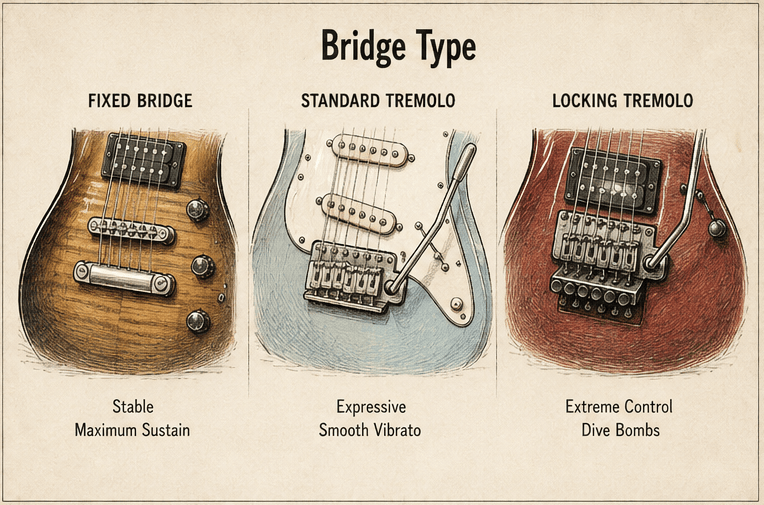
Bridge Type: Fixed Bridge or Tremolo?
The bridge affects tuning stability, sustain, feel, and playing techniques.
Fixed Bridge
A fixed bridge is simple, stable, and reliable. It is often the best choice for beginners and players who value tuning stability.
Best for:
- Rock
- Metal
- Blues
- Rhythm playing
- Drop tunings
- Simple maintenance
Standard Tremolo
A standard tremolo allows pitch movement, usually for subtle vibrato effects. It is common on S-style guitars.
Best for:
- Blues
- Surf
- Rock
- Expressive pitch control
- Players who want flexibility
Locking Tremolo
A locking tremolo, such as a Floyd Rose-style system, allows extreme pitch changes while maintaining tuning stability when set up properly.
However, it is more complex to tune and maintain.
Best for:
- Metal
- Shred
- Dive bombs
- Advanced players
If you are a beginner, a fixed bridge is usually easier. If your style requires expressive tremolo work, choose a tremolo system that matches your needs.
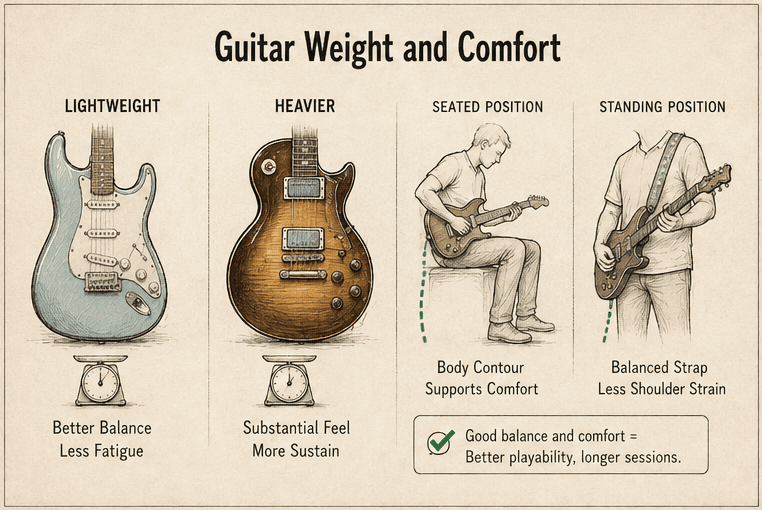
Guitar Weight and Comfort
Weight matters more than many players realize.
A heavy guitar may feel solid and resonant, but it can become tiring during long practice sessions, rehearsals, or live performances. A lightweight guitar can be more comfortable, especially for players who stand while playing.
Consider:
- How long you usually play
- Whether you mostly sit or stand
- Shoulder and back comfort
- Body contours
- Balance on a strap
A guitar should feel comfortable enough that you want to keep playing it.
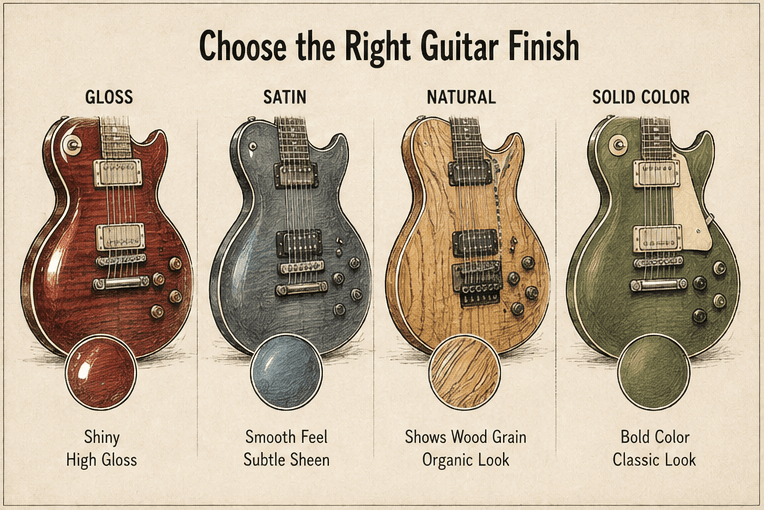
Choose the Right Guitar Finish
The finish affects appearance, feel, and sometimes the way the guitar resonates.
Gloss Finish
Gloss finishes look polished and premium. They are common on many guitars and show colors beautifully.
Best for:
- High-end visual appearance
- Transparent tops
- Burst finishes
- Players who like a shiny look
Satin Finish
Satin finishes feel smoother and less sticky to some players. They are popular on necks and modern guitars.
Best for:
- Fast neck feel
- Modern appearance
- Players who dislike glossy surfaces
Natural Finish
Natural finishes highlight the wood grain. They are great for ash, maple, black limba, walnut, koa, and other visually attractive woods.
Best for:
- Wood-focused designs
- Boutique-style guitars
- Players who love natural materials
Solid Color Finish
Solid colors are great when the wood grain is not the focus. They work well with basswood, alder, and other woods that may have less dramatic grain.
Best for:
- Classic designs
- Modern minimal styles
- Custom color matching
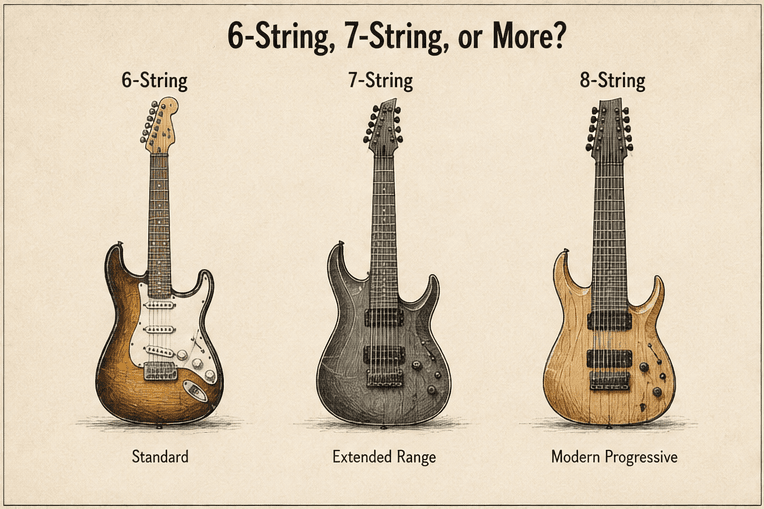
6-String, 7-String, or More?
Most players start with a 6-string electric guitar. It is the standard choice for most genres and is the easiest to learn on.
A 7-string guitar adds a lower string, usually for heavier music, progressive metal, or extended range playing. 8-string guitars go even lower and are more specialized.
Choose a 6-string if:
- You are a beginner
- You play most traditional styles
- You want maximum versatility
Choose a 7-string if:
- You play metal or progressive music
- You need lower tunings
- You want extended range
Choose an 8-string if:
- You specifically need very low range
- You play modern progressive metal
- You are already comfortable with extended-range guitars
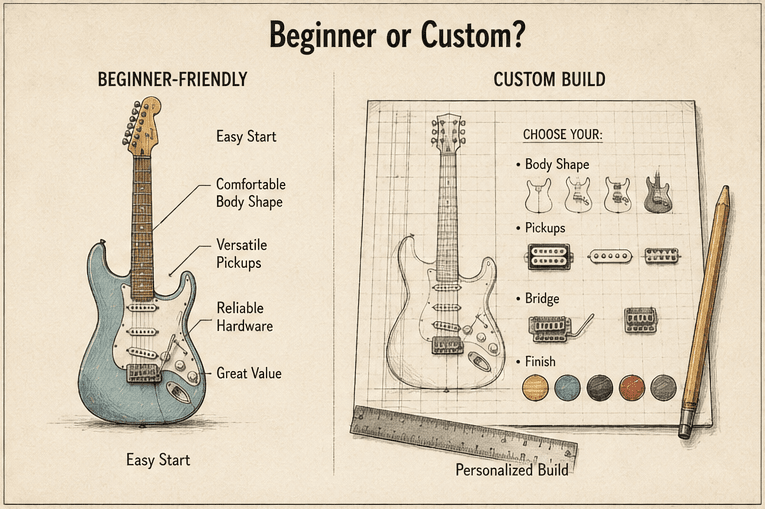
Should Beginners Buy an Expensive Electric Guitar?
A beginner does not need the most expensive electric guitar. However, beginners should avoid extremely poor-quality guitars that are hard to tune, uncomfortable to play, or poorly set up.
A good beginner guitar should have:
- Comfortable neck
- Reliable tuning
- Decent pickups
- Proper fretwork
- Stable bridge
- Good setup
- Reasonable weight
A guitar that is difficult to play can make learning frustrating. A well-made affordable guitar is usually better than a flashy guitar with poor playability.
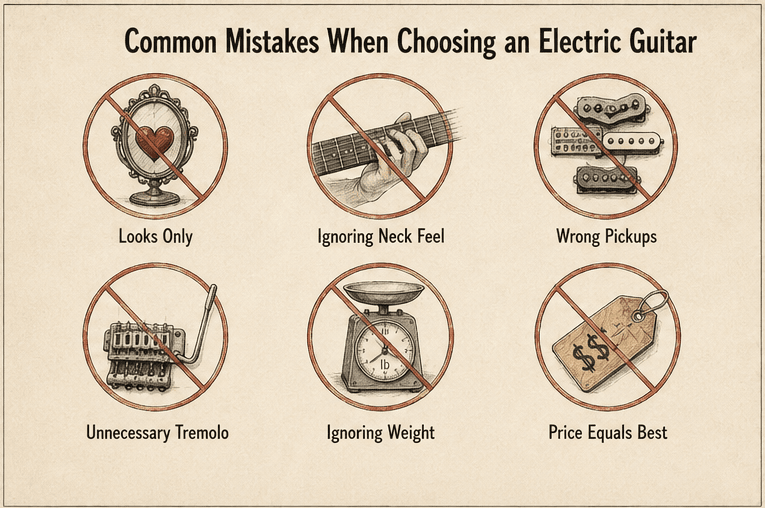
Common Mistakes When Choosing an Electric Guitar
Many players choose a guitar based only on appearance. Looks are important, but they should not be the only factor.
Avoid these common mistakes:
Choosing only by looks
A guitar may look beautiful but feel uncomfortable or sound wrong for your style.
Ignoring neck feel
The neck affects playability more than many beginners expect. Always consider neck shape, fret size, and scale length.
Choosing pickups that do not match your music
Single coils, humbuckers, and P90s all have different personalities. Choose based on the sound you need.
Buying a tremolo bridge you do not need
Locking tremolos are fun but require more maintenance. If you do not need one, a fixed bridge may be better.
Ignoring weight
A guitar that feels too heavy can become uncomfortable over time.
Thinking expensive always means better
Price often reflects materials, labor, brand, and features, but the best guitar is the one that fits you.
Best Electric Guitar Features by Playing Style
Best electric guitar for rock
Look for:
- Humbuckers or P90s
- Mahogany, alder, or basswood body
- Fixed bridge
- Medium neck profile
- Good sustain
Best electric guitar for metal
Look for:
- High-output humbuckers
- Thin neck
- 24 frets
- Stable bridge
- Longer scale length
- Good upper fret access
Best electric guitar for blues
Look for:
- P90s, single coils, or vintage humbuckers
- Comfortable neck
- Warm tone
- Responsive volume controls
- Good sustain
Best electric guitar for jazz
Look for:
- Humbuckers
- Warm body tone
- Semi-hollow or hollow body option
- Smooth neck
- Clean tone clarity
Best electric guitar for funk
Look for:
- Single coils
- Bright tonewood
- 25.5” scale length
- Clear note separation
- Lightweight body
Best electric guitar for beginners
Look for:
- Comfortable body
- Stable tuning
- Versatile pickups
- Fixed bridge or simple tremolo
- Medium neck profile
- Good setup
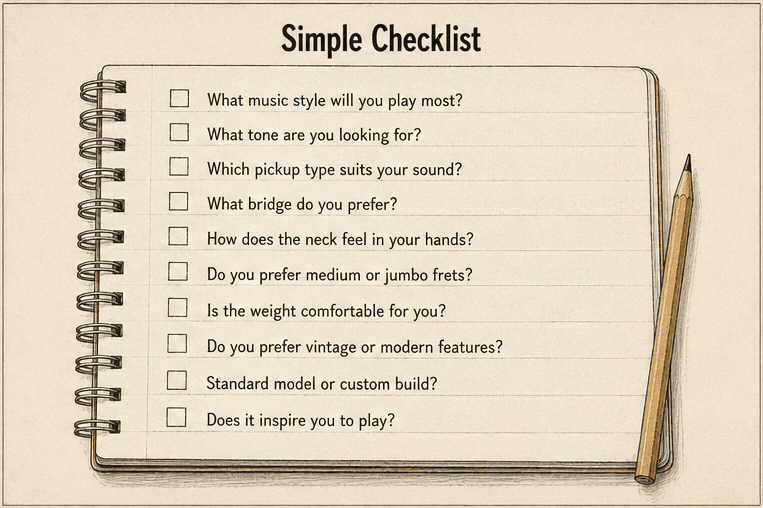
How to Choose the Right Electric Guitar: Simple Checklist
Before buying or ordering an electric guitar, ask yourself these questions:
- What style of music do I play most?
- Do I prefer bright, warm, or balanced tone?
- Do I want single coils, humbuckers, or P90s?
- Do I need a fixed bridge or tremolo?
- Do I prefer a thin, medium, or thick neck?
- Do I want 22 or 24 frets?
- Do I prefer lightweight comfort or heavier sustain?
- Do I care more about vintage tone or modern performance?
- Do I want a standard guitar or a custom build?
- Does the guitar inspire me to play?
The final question may be the most important. A guitar should make you want to pick it up, play longer, and create more music.
The Right Electric Guitar Is Personal
Choosing the right electric guitar is not about finding the “best” guitar in general. It is about finding the best guitar for you.
Your ideal guitar should match your music style, tone preference, hand comfort, playing technique, and visual taste. Some players need a bright and articulate guitar for clean tones. Others need a warm, sustaining guitar for blues and rock. Some want a fast, modern instrument for metal, while others want a classic design with vintage character.
There is no single perfect answer.
The right electric guitar should feel comfortable, sound inspiring, stay reliable, and reflect your identity as a player. Once you understand how body shape, pickups, woods, neck construction, scale length, bridge type, and hardware affect the instrument, choosing the right guitar becomes much easier.
Whether you are buying your first electric guitar or designing your dream custom build, take your time, understand your options, and choose the guitar that helps you express your own sound.