

Hardware & Playability
Guitar Neck Profiles Explained: Complete Guide to Neck Shapes and Playability

When choosing an electric guitar, most players focus first on body shape, pickups, tonewoods, or finish. Those details are important, but one of the most personal parts of any guitar is the neck profile.
The neck is where your hand connects with the instrument. It affects comfort, speed, control, fatigue, chord grip, bending feel, and even how confident you feel when playing. Two guitars can have similar pickups, woods, and hardware, but if the neck feels different, the entire playing experience can change.
That is why understanding guitar neck profiles is so important.
In this complete guide, we will explain what guitar neck profiles are, how different neck shapes feel, who they are best for, and how to choose the right neck profile for your playing style.
What Is a Guitar Neck Profile?
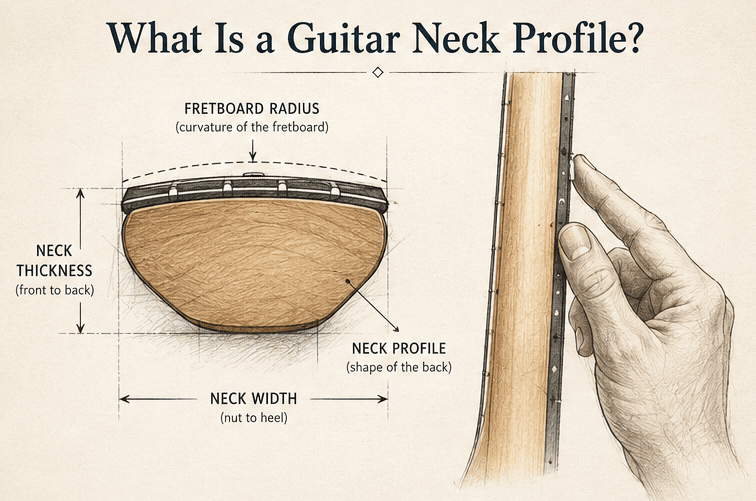
A guitar neck profile refers to the shape of the back of the guitar neck.
It is the part your thumb and palm touch when you hold the guitar. While fretboard radius describes the curve of the fingerboard surface, the neck profile describes the shape behind the neck.
In simple terms:
- Neck profile = shape of the back of the neck
- Fretboard radius = curve of the fretboard surface
- Neck width = how wide the neck feels across the strings
- Neck thickness = how deep the neck feels from front to back
The neck profile has a major effect on how the guitar feels in your hand. A thin neck may feel fast and easy for lead playing. A thicker neck may feel more supportive for chords and bends. A rounded neck may feel comfortable and familiar, while a flatter neck may feel modern and precise.
There is no single “best” guitar neck profile. The best neck profile is the one that fits your hand, technique, and playing style.
Why Guitar Neck Profile Matters
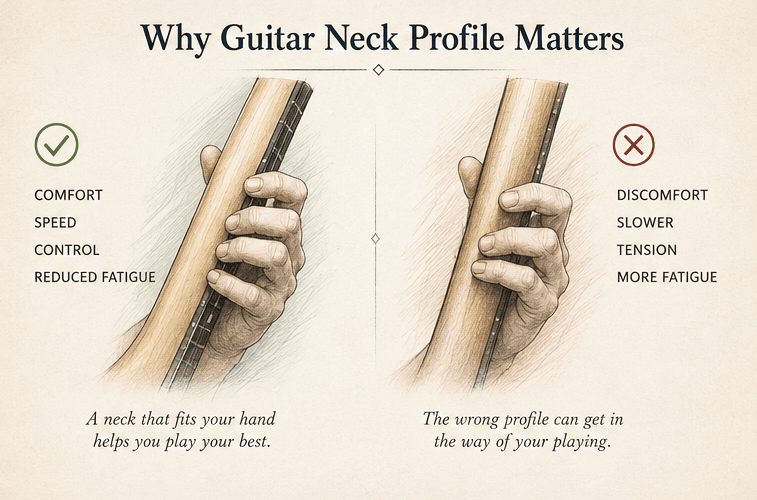
The neck profile affects more than comfort. It can influence the way you play.
A neck that fits your hand well can make playing feel natural. Chords may feel easier. Bends may feel more controlled. Fast runs may feel smoother. Long practice sessions may feel less tiring.
A neck that does not fit you can create problems. Your hand may fatigue quickly. Barre chords may feel difficult. Your thumb may feel cramped. Fast playing may feel awkward. You may find yourself fighting the guitar instead of enjoying it.
A good neck profile can help with:
- Fretting comfort
- Thumb position
- Chord grip
- Lead playing
- String bending
- Vibrato control
- Hand endurance
- Playing confidence
- Overall connection with the guitar
This is why many experienced players care deeply about neck shape. For some players, neck feel is even more important than pickups or body wood.
The Main Types of Guitar Neck Profiles
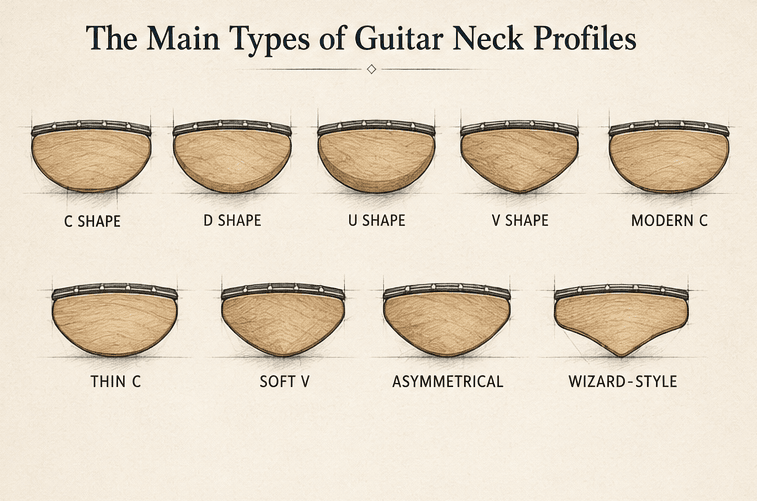
Most guitar neck profiles are described using letters because their cross-section resembles a shape.
The most common guitar neck profiles are:
- C Shape
- D Shape
- U Shape
- V Shape
- Modern C
- Thin C
- Soft V
- Asymmetrical Neck
- Wizard-style Thin Neck
Each profile has a different feel in the hand.
Let’s break them down one by one.
C Shape Neck Profile
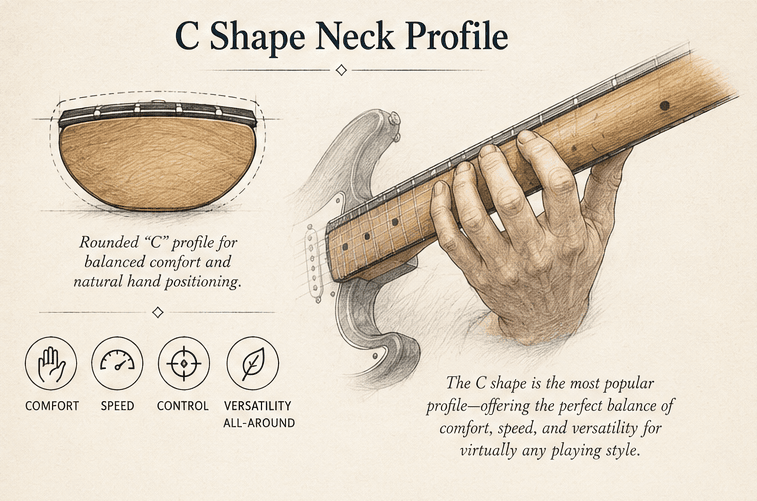
The C shape neck profile is one of the most common and widely loved guitar neck shapes.
It has a smooth, rounded back that feels natural in the hand. The curve is not too deep, not too flat, and not too sharp. Because of this, many players find C shape necks comfortable and easy to adapt to.
A C shape neck is often considered the “safe choice” because it works well for many playing styles.
How a C shape neck feels
A C shape neck usually feels balanced and familiar. It fills the hand enough to feel supportive, but it is not usually so large that it feels bulky.
It works well for players who use a relaxed thumb position behind the neck. It also works for players who occasionally wrap the thumb over the top for blues bends or chord grips.
Best for
- Beginners
- All-around players
- Rhythm guitar
- Lead guitar
- Blues, rock, pop, indie, worship, and country
- Players who want a comfortable, versatile neck
Possible drawbacks
Some players who prefer very fast or technical playing may find a standard C profile slightly thicker than they want. On the other hand, players who love large vintage necks may find it too moderate.
Still, for most players, a C shape neck is one of the easiest profiles to enjoy.
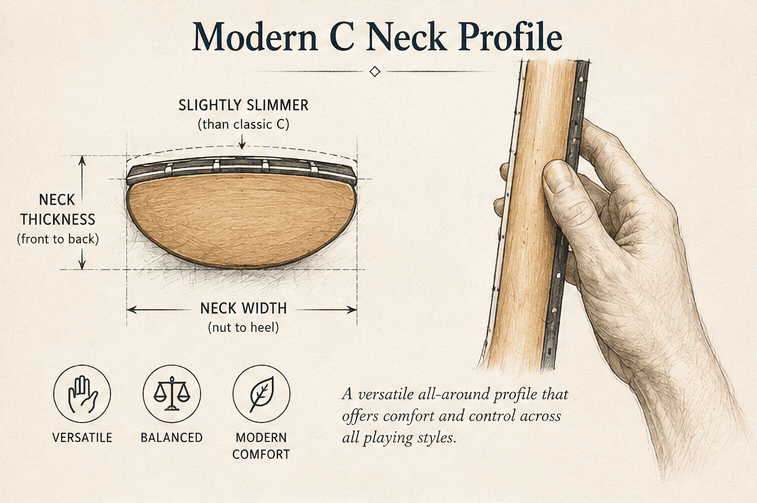
Modern C Neck Profile
The Modern C neck profile is a slightly updated version of the traditional C shape.
It is usually a little slimmer, smoother, and more performance-oriented. Many modern guitars use some version of a Modern C because it feels comfortable to a wide range of players.
How a Modern C neck feels
A Modern C neck feels rounded but not bulky. It often provides a good balance between chord comfort and lead playability.
It is not as thin as some shred-style necks, but it is faster-feeling than many vintage-style necks.
Best for
- Players who want versatility
- Beginners and intermediate players
- Pop, rock, blues, funk, fusion, and worship
- Players who switch between chords and lead lines
- Players who want a comfortable modern feel
Possible drawbacks
A Modern C may not satisfy players who want either extreme: very thick vintage feel or ultra-thin technical speed.
However, for a general-purpose electric guitar, Modern C is one of the most practical choices.
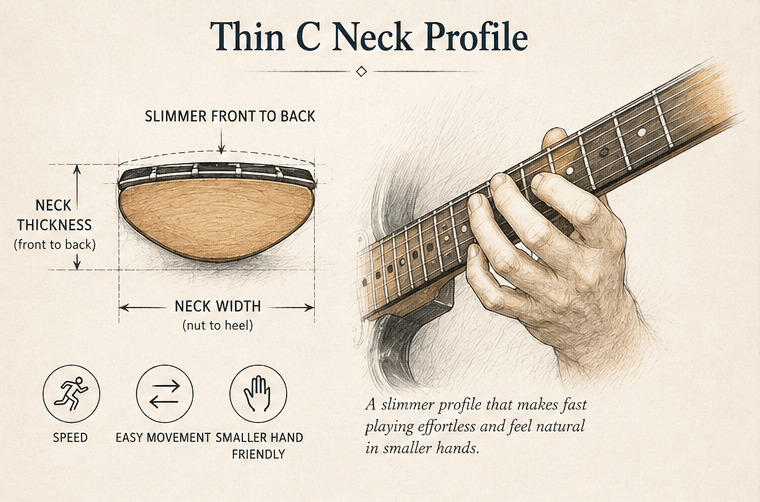
Thin C Neck Profile
A Thin C neck profile keeps the rounded feel of a C shape but reduces the depth.
It is popular among players who want a comfortable neck that still feels fast and easy to move around.
How a Thin C neck feels
A Thin C feels slimmer from front to back. It allows the fretting hand to move quickly, especially for lead lines, scale runs, and modern playing.
It can also feel less tiring for players with smaller hands, although this depends on neck width and fretboard radius as well.
Best for
- Fast lead playing
- Modern rock
- Metal
- Fusion
- Players with smaller hands
- Players who dislike bulky necks
Possible drawbacks
A thin neck may feel less supportive for some players during long chord work or strong bending. Players with larger hands may feel like there is not enough neck to hold onto.
Some players also feel that very thin necks encourage more hand tension if they grip too hard.
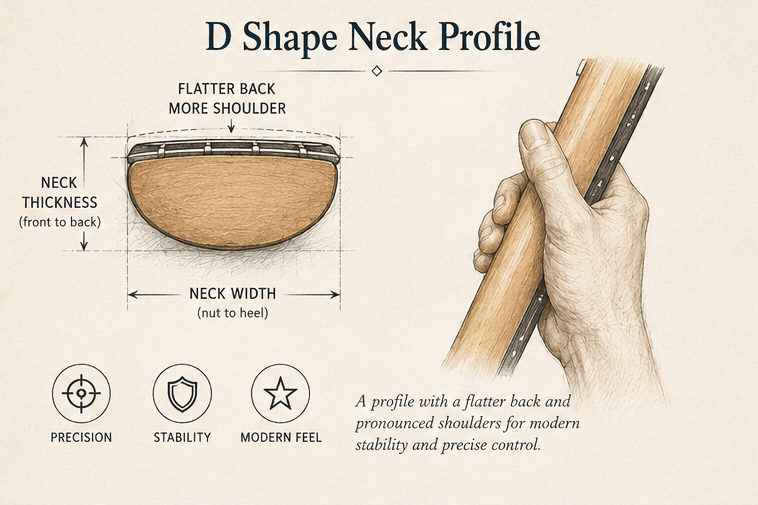
D Shape Neck Profile
The D shape neck profile has a flatter back and more defined shoulders than a C shape.
The “shoulders” are the sides of the neck where the back curve transitions toward the fretboard edges. A D shape tends to feel wider and flatter in the hand.
How a D shape neck feels
A D shape neck often feels modern, stable, and precise. It gives the thumb a flatter surface to rest against, which can help technical players keep consistent hand position.
Compared with a C shape, a D shape may feel less rounded and more structured.
Best for
- Modern rock
- Metal
- Progressive playing
- Technical lead work
- Players who keep the thumb behind the neck
- Players who like a flatter, wider feel
Possible drawbacks
Some players find D shape necks less comfortable for thumb-over playing. If you often wrap your thumb around the neck for blues-style bends or chord grips, a D shape may feel less natural than a C or soft V.
The shoulders can also feel bulky to some players, even if the neck is not especially thick.
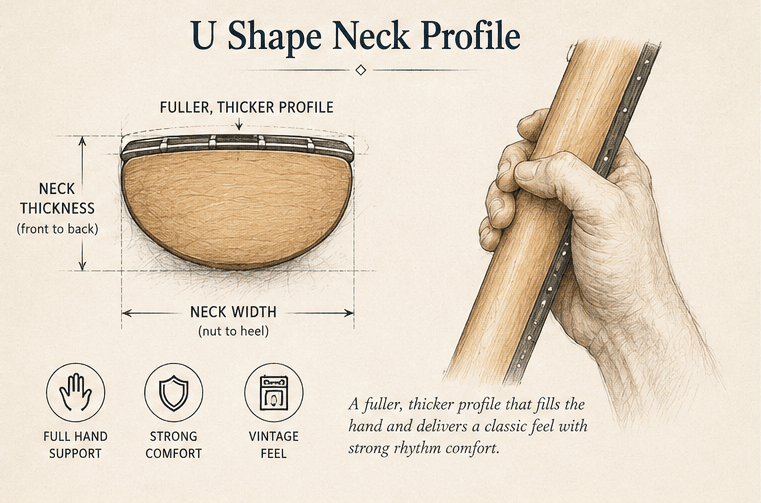
U Shape Neck Profile
The U shape neck profile is usually thicker and deeper than C or D shapes.
It has large shoulders and a fuller back, creating a neck that fills the hand more completely. U shape necks are often associated with vintage-style instruments.
How a U shape neck feels
A U shape neck feels substantial. It gives your hand a lot to hold onto and can feel very supportive for players who like fuller necks.
Some players describe it as stable, powerful, or “baseball bat” style, depending on thickness.
Best for
- Players with larger hands
- Vintage-style playing
- Blues and classic rock
- Rhythm guitar
- Players who like a strong grip
- Players who dislike thin necks
Possible drawbacks
A U shape neck may feel too large for players with smaller hands. It may also feel slower for fast technical playing if you prefer a lighter touch.
That said, many players love thick U necks because they feel solid, comfortable, and confidence-inspiring.
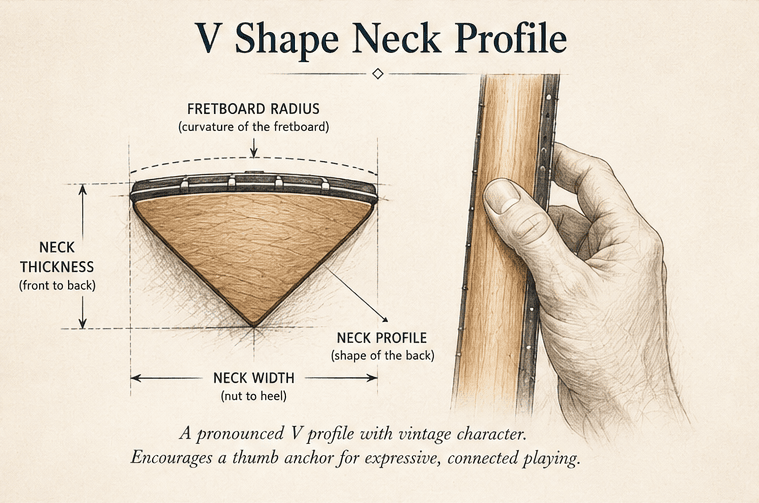
V Shape Neck Profile
The V shape neck profile has a ridge along the back of the neck, forming a shape that feels more pointed than C, D, or U profiles.
V necks are usually divided into two main types:
- Soft V
- Hard V
A Soft V has a gentle ridge. A Hard V has a more pronounced ridge.
How a V shape neck feels
A V shape neck can feel very comfortable if your thumb naturally rests along the center of the back of the neck. The ridge gives your thumb a clear reference point.
Many blues, country, and vintage-style players enjoy V necks because they can support thumb-over playing and expressive bends.
Best for
- Blues
- Country
- Vintage-style playing
- Players who use thumb-over technique
- Players who like a clear thumb anchor
- Chord-based playing with expressive bends
Possible drawbacks
V shape necks are not for everyone. Some players find the ridge uncomfortable, especially if they use classical-style thumb placement or play fast modern lines.
A Hard V can feel especially sharp or restrictive if it does not match your hand position.
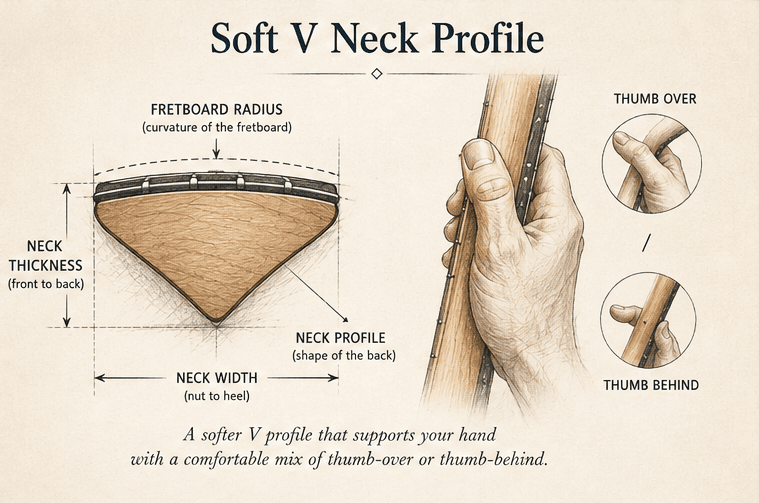
Soft V Neck Profile
The Soft V neck profile is a more comfortable and less aggressive version of the V shape.
It gives a subtle ridge without feeling too sharp. For many players, Soft V is easier to adapt to than Hard V.
How a Soft V neck feels
Soft V feels supportive without being extreme. It can feel excellent for players who switch between thumb-behind and thumb-over playing.
It often works well for blues bends, open chords, and rhythm playing.
Best for
- Blues
- Country
- Classic rock
- Vintage-inspired guitars
- Players who like thumb support
- Players who want something different from a standard C shape
Possible drawbacks
Players who prefer very flat or very thin modern necks may not enjoy the center ridge, even if it is subtle.
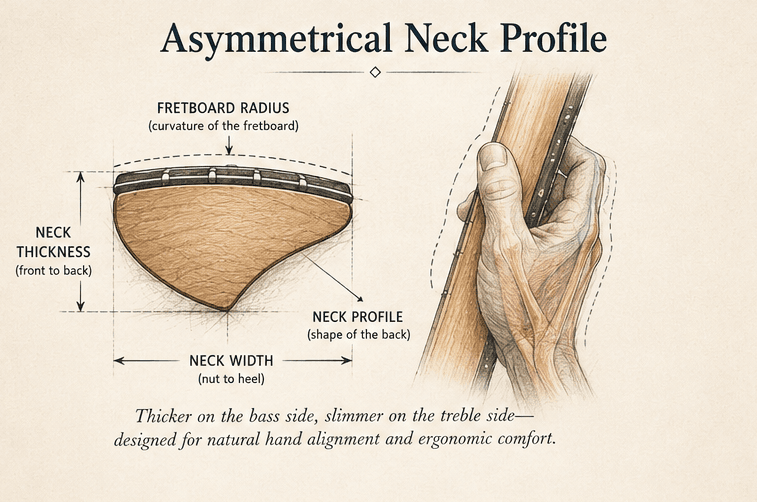
Asymmetrical Neck Profile
An asymmetrical neck profile is shaped differently on the bass side and treble side.
The bass side may be fuller to support the thumb, while the treble side may be slimmer for easier reach. This design attempts to match the natural shape of the hand more closely.
How an asymmetrical neck feels
An asymmetrical neck can feel ergonomic and natural once you get used to it. It may feel especially good when moving between chords and lead lines.
Because the profile changes across the back, it can support the thumb without making the entire neck feel too thick.
Best for
- Modern players
- Fusion
- Progressive rock
- Players who want ergonomic comfort
- Long practice sessions
- Custom guitar builds
Possible drawbacks
Some players need time to adjust. If you are used to traditional C or U profiles, an asymmetrical neck may feel unusual at first.
It is also more personal. Some players love it; others prefer a more traditional symmetrical shape.

Wizard-Style Thin Neck
A Wizard-style neck generally refers to an ultra-thin, flat, fast neck profile often associated with high-performance guitars.
These necks are designed for speed, technical playing, and easy upper-fret access.
How a Wizard-style neck feels
It feels very thin from front to back, often with a flatter back and wider fretboard. This can make fast runs, sweeps, tapping, and technical playing feel easier.
Best for
- Metal
- Shred
- Progressive guitar
- Fusion
- Technical lead playing
- Players who prefer very low hand resistance
Possible drawbacks
Ultra-thin necks are not always comfortable for everyone. Some players feel they lack support for rhythm playing or strong bends. Players with larger hands may experience hand fatigue if the neck encourages too much gripping pressure.
A fast neck is useful, but it still needs to feel comfortable for your hand.

Neck Thickness vs Neck Profile: What’s the Difference?
Neck profile and neck thickness are related, but they are not the same thing.
A neck can have the same profile shape but different thickness measurements.
For example:
- A thick C neck feels rounded and full.
- A thin C neck feels rounded but slimmer.
- A thick D neck feels flat-backed but substantial.
- A thin D neck feels flat-backed and fast.
Neck thickness is usually measured from the fretboard surface to the back of the neck, often at the 1st fret and 12th fret.
A neck may feel thicker as it moves toward the higher frets. This gradual increase is called taper.
Why thickness matters
A thicker neck can feel more supportive and substantial. A thinner neck can feel faster and easier to move around. However, too thin or too thick can both cause discomfort depending on your hand size and technique.
When choosing a guitar, do not look only at the profile name. A “C shape” can feel very different depending on its thickness and shoulder shape.
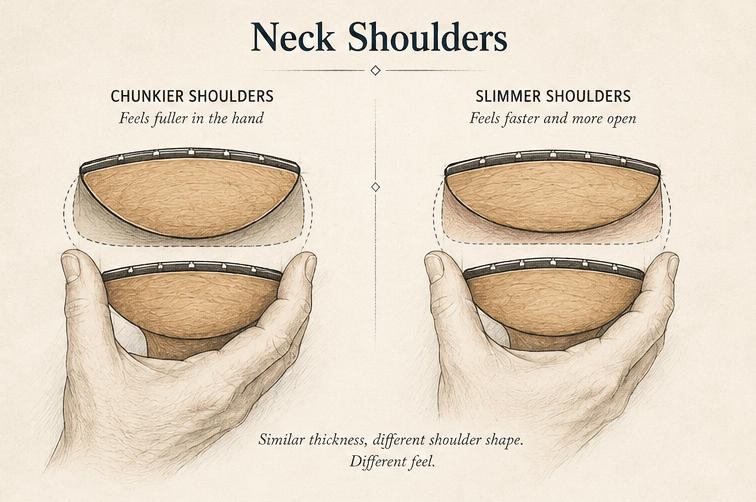
Neck Shoulders: The Hidden Detail That Changes Everything
One of the most overlooked parts of neck feel is the shoulder.
The shoulders are the areas on the sides of the neck profile. They affect how big or small the neck feels in your hand.
A neck with large shoulders can feel fuller even if it is not extremely thick. A neck with reduced shoulders can feel slimmer even if the depth measurement is moderate.
Example
Two necks may both measure similar thickness, but:
- One with large shoulders may feel chunky.
- One with soft shoulders may feel fast and comfortable.
This is why measurements do not tell the whole story. The shape of the shoulders can dramatically change the feel.
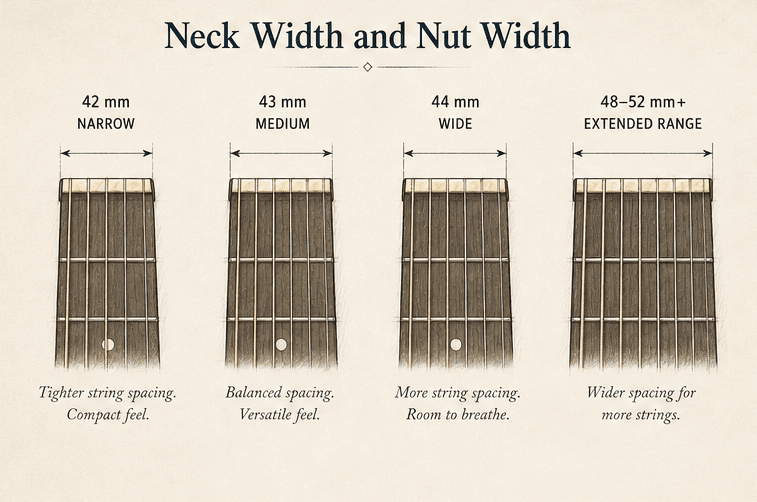
Neck Width and Nut Width
Neck profile describes the back shape, but nut width affects how wide the strings feel near the headstock.
Common electric guitar nut widths include:
- Around 42 mm
- Around 43 mm
- Around 44 mm
- Wider widths for 7-string and extended-range guitars
A wider nut gives more space between strings, which may help fingerstyle, complex chords, or players with larger hands. A narrower nut can feel easier for smaller hands and faster chord transitions.
Narrower necks may feel better for
- Smaller hands
- Fast chord changes
- Beginners
- Players who like compact feel
Wider necks may feel better for
- Larger hands
- Fingerstyle electric playing
- Technical playing
- Extended-range guitars
- Players who want more string spacing
Nut width works together with neck profile. A thin neck with a wide nut can still feel large. A thicker neck with a narrow nut can still feel manageable.

Fretboard Radius vs Neck Profile
Many players confuse neck profile with fretboard radius, but they are different.
The neck profile is the back shape of the neck.
The fretboard radius is the curvature of the fretboard surface.
Rounder fretboard radius
A rounder fretboard radius can feel comfortable for chords. It is often found on vintage-style guitars.
Flatter fretboard radius
A flatter fretboard radius can feel better for bends, low action, and fast lead playing. It is often found on modern guitars.
Compound radius
A compound radius changes gradually from rounder near the nut to flatter near the higher frets. This gives comfortable chords in lower positions and easier bends higher up the neck.
How it works with neck profile
A thick neck with a round radius may feel vintage and chord-friendly.
A thin neck with a flat radius may feel modern and fast.
A medium C neck with a compound radius may feel balanced and versatile.
To understand the full feel of a guitar, consider both neck profile and fretboard radius.

Neck Profile and Playing Style
Different neck profiles support different techniques.
There are no strict rules, but certain profiles tend to work better for certain playing styles.
Best Neck Profile for Beginners
For most beginners, a Modern C or Medium C neck is usually the best choice.
These profiles are comfortable, familiar, and versatile. They are not too thick, not too thin, and not too specialized.
Beginners are still discovering their preferences, so it is usually better to start with a balanced neck rather than an extreme shape.
Recommended beginner neck profiles
- Modern C
- Medium C
- Thin C if the player has smaller hands
- Soft V only if it feels comfortable
Avoid for beginners
- Extremely thick U necks, unless the player prefers a fuller grip
- Ultra-thin shred necks, unless the player specifically wants metal or technical styles
- Hard V necks, unless the player already knows they like that feel

Best Neck Profile for Small Hands
Players with smaller hands often prefer necks that are not too thick and not too wide.
A Thin C, Modern C, or slim D profile can work well. However, small hands do not automatically mean you need the thinnest neck possible.
A neck that is too thin can sometimes cause players to grip too hard, leading to tension.
Good choices for small hands
- Thin C
- Modern C
- Slim D
- Medium C with soft shoulders
- Narrower nut width
What to watch for
- Avoid very large shoulders
- Avoid very wide nut widths unless needed
- Avoid thick U profiles if they cause strain
- Make sure the neck does not force your wrist into an uncomfortable angle
Comfort matters more than the profile name.

Best Neck Profile for Large Hands
Players with larger hands may prefer a neck that offers more support.
A neck that is too thin may feel cramped or unstable. A medium-to-thick C, U, or fuller D shape may feel more comfortable.
Good choices for large hands
- Medium C
- Thick C
- U shape
- Full D shape
- Wider nut width
- Asymmetrical necks
What to watch for
Large hands do not always require a huge neck. Some players with large hands still enjoy thin necks for speed. The key is whether the neck gives your hand enough support without creating tension.

Best Neck Profile for Fast Playing
Fast playing often benefits from a thinner neck, flatter fretboard radius, and smooth upper fret access.
Common choices include:
- Thin C
- Slim D
- Wizard-style neck
- Asymmetrical neck
- Modern C with flatter radius
These profiles allow the hand to move quickly and reduce the feeling of resistance.
However, speed is not only about neck thinness. A comfortable setup, low action, good fretwork, and proper technique matter just as much.
A neck should feel fast without making your hand tense.
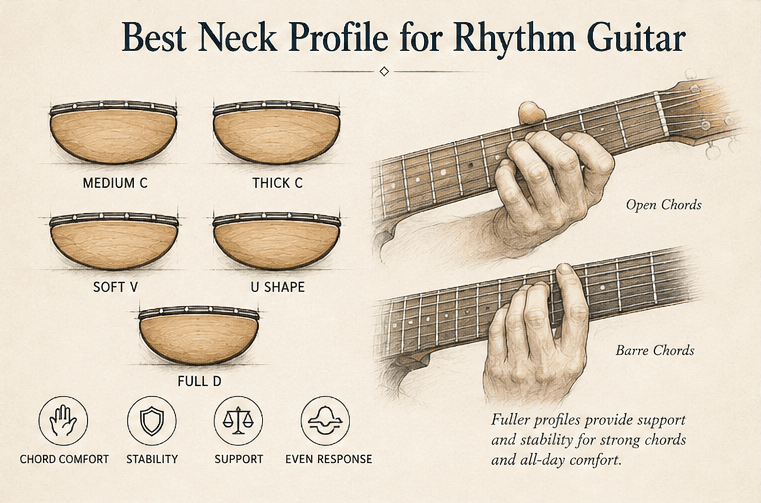
Best Neck Profile for Rhythm Guitar
Rhythm players often need comfort, stability, and chord support.
A medium or fuller neck can feel better for long chord sessions because it gives the hand something solid to grip.
Good rhythm neck profiles include:
- Medium C
- Thick C
- Soft V
- U shape
- Full D shape
If you play a lot of barre chords, open chords, and rhythm parts, do not choose a neck only because it is fast. Choose one that feels comfortable for repeated chord work.

Best Neck Profile for Blues
Blues players often use bends, vibrato, double-stops, and thumb-over techniques.
Many blues players enjoy:
- Medium C
- Thick C
- Soft V
- U shape
- Vintage-style necks
A slightly fuller neck can help with control during bends and vibrato. A Soft V can also support thumb placement for expressive playing.
However, modern blues players may prefer a slimmer neck. The best choice depends on whether you play with a traditional or modern technique.

Best Neck Profile for Metal
Metal players often prefer speed, precision, low action, and easy upper fret access.
Popular choices include:
- Thin C
- Slim D
- Wizard-style neck
- Asymmetrical neck
- Modern C
A flatter fretboard radius and jumbo frets often pair well with metal-oriented neck profiles.
However, some metal rhythm players prefer a slightly thicker neck for stability, especially with lower tunings and heavier strings.
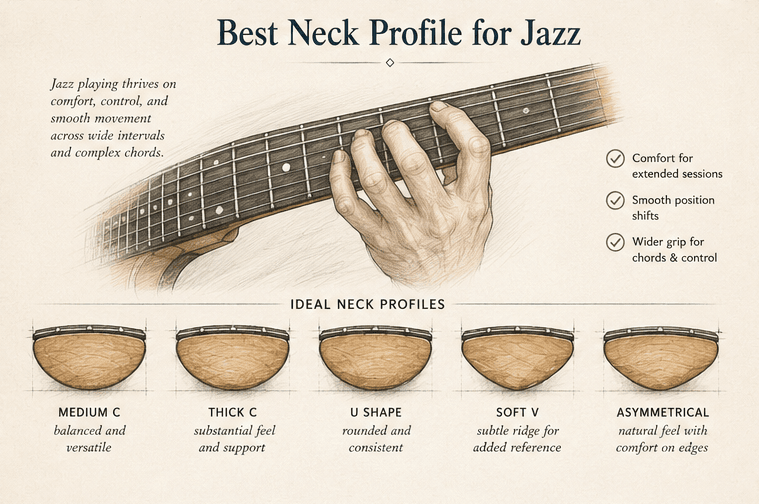
Best Neck Profile for Jazz
Jazz players often value comfort for complex chords, smooth movement, and warm expressive playing.
Good choices include:
- Medium C
- Thick C
- U shape
- Soft V
- Asymmetrical neck
Jazz players who play extended chords may also prefer a slightly wider nut width for more string spacing.
A neck that supports relaxed hand position is more important than extreme speed.
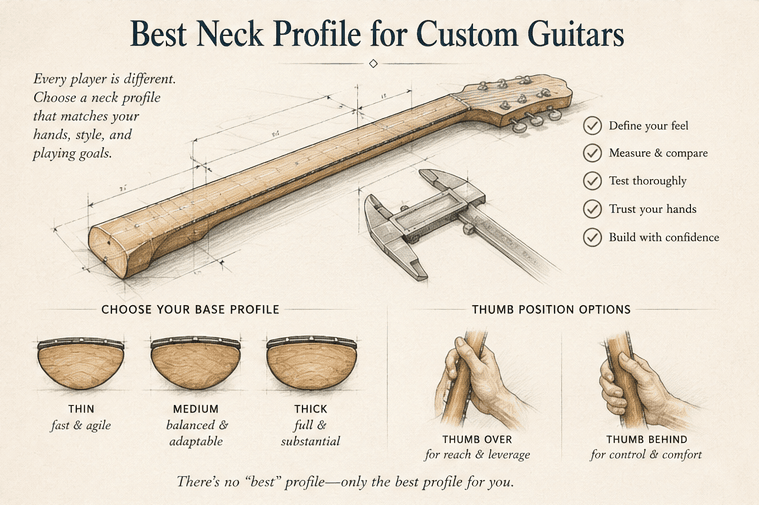
Best Neck Profile for Custom Guitars
When ordering a custom guitar, neck profile is one of the most important choices.
Many players focus heavily on the top wood, finish, pickups, and hardware, but the neck profile determines how the guitar feels every time you play it.
For a custom build, ask yourself:
- Do I prefer thin, medium, or thick necks?
- Do I wrap my thumb over the top?
- Do I keep my thumb behind the neck?
- Do I play mostly rhythm, lead, or both?
- Do I prefer vintage or modern feel?
- Do I have small, medium, or large hands?
- Do I play long sessions?
- Do I want comfort, speed, or support?
- Do I prefer round shoulders or flatter shoulders?
If you already own a guitar that feels perfect, use it as a reference. Measuring that neck can help you choose the right profile for your custom guitar.
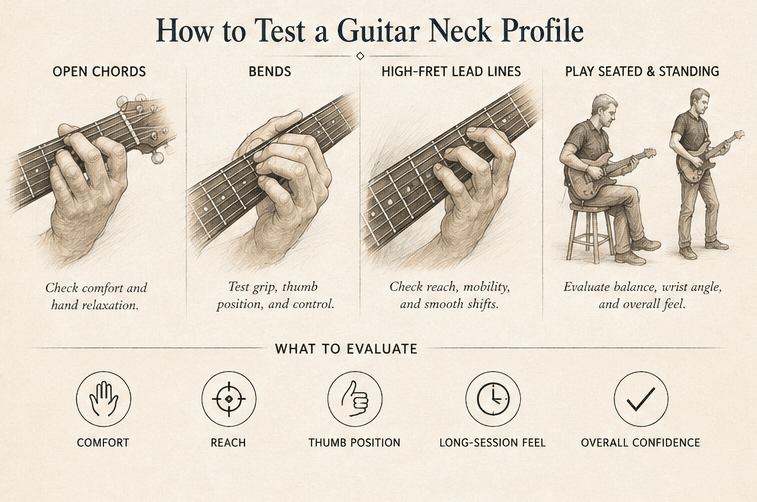
How to Test a Guitar Neck Profile
When trying a guitar, do not only play one riff. Test the neck in different ways.
Try:
- Open chords
- Barre chords
- Power chords
- String bends
- Vibrato
- Fast scale runs
- High-fret lead lines
- Thumb-over bends
- Seated playing
- Standing playing with a strap
Pay attention to your hand and wrist.
Ask yourself:
- Does my hand feel relaxed?
- Does the neck feel too thin or too thick?
- Do my fingers reach comfortably?
- Does my thumb have a natural place to rest?
- Do chords feel easy?
- Do bends feel controlled?
- Does my wrist feel strained?
- Could I play this neck for one hour comfortably?
A neck may feel exciting for 30 seconds but tiring after 30 minutes. Long-term comfort is what matters.
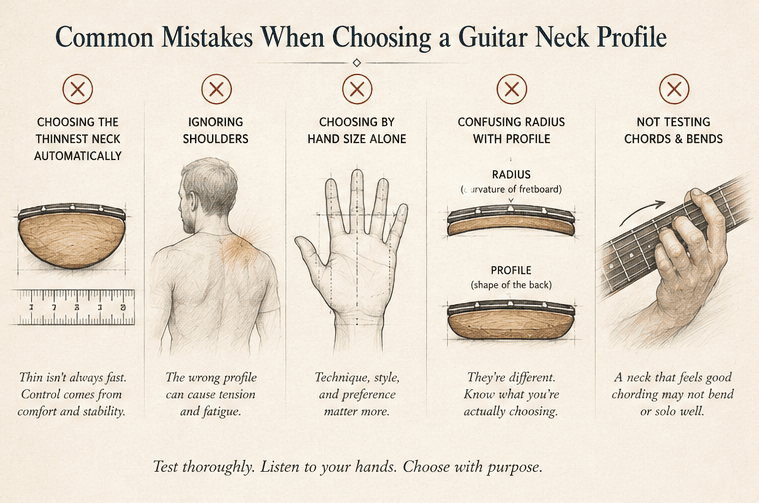
Common Mistakes When Choosing a Guitar Neck Profile
Choosing the thinnest neck because you think it is faster
Thin necks can feel fast, but they are not automatically better. If a thin neck causes your hand to tense up, it may actually slow you down.
Ignoring neck shoulders
Two necks with the same thickness can feel completely different because of shoulder shape.
Choosing based only on hand size
Small hands do not always need ultra-thin necks. Large hands do not always need huge necks. Technique matters too.
Confusing fretboard radius with neck profile
A guitar can have a thin neck and round radius, or a thick neck and flat radius. They are separate features.
Forgetting about playing style
A jazz player, metal player, blues player, and beginner may all benefit from different neck shapes.
Not testing chords and bends
Some players test only fast lead lines. Others test only chords. A good neck should work for the way you actually play.
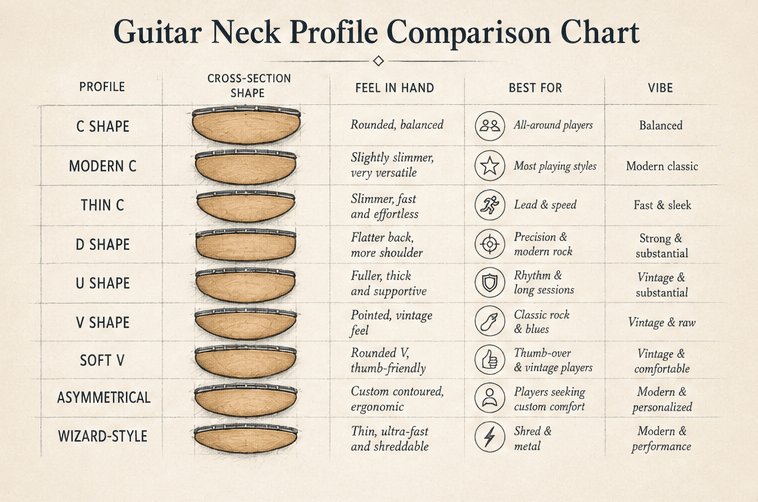
Guitar Neck Profile Comparison Chart
Neck Profile | Feel | Best For | Possible Drawback |
|---|---|---|---|
C Shape | Rounded and balanced | Most players, all-around use | May feel too average for players who want extremes |
Modern C | Slimmer rounded feel | Beginners, versatile players | Not ultra-thin or vintage-thick |
Thin C | Slim and fast | Small hands, lead, modern styles | Less support for some players |
D Shape | Flatter back, more shoulders | Technical playing, modern styles | Can feel wide or less natural for thumb-over |
U Shape | Thick and full | Large hands, vintage feel, rhythm | May feel bulky |
V Shape | Center ridge | Blues, country, thumb-over players | Ridge may feel uncomfortable |
Soft V | Gentle V support | Vintage-style blues and rhythm | Not ideal for everyone |
Asymmetrical | Ergonomic uneven shape | Custom builds, long sessions | Takes time to adjust |
Wizard-style | Very thin and fast | Metal, shred, technical playing | May feel too thin or unsupported |
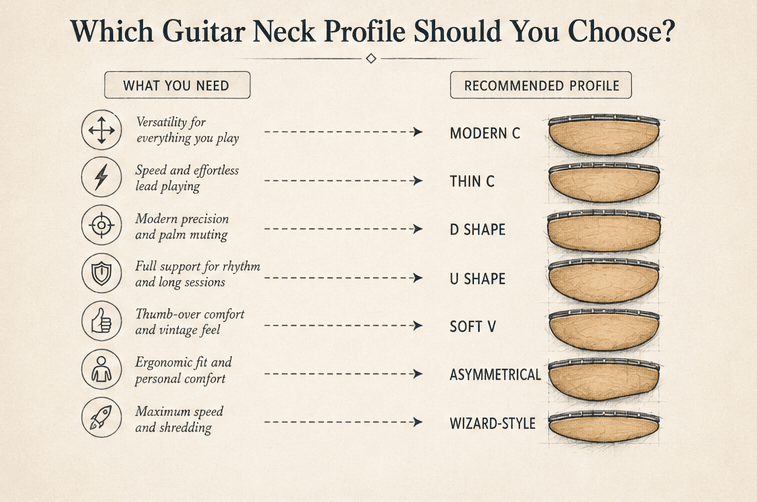
Which Guitar Neck Profile Should You Choose?
The best neck profile depends on your hand, your technique, and your musical style.
Here is a simple way to choose:
Choose a Modern C if you want the safest and most versatile neck.
Choose a Thin C if you want a slimmer, faster feel.
Choose a D Shape if you prefer a flatter, more modern neck with strong thumb support.
Choose a U Shape if you like a thick, vintage, full-hand feel.
Choose a Soft V if you like thumb-over playing and vintage character.
Choose an Asymmetrical Neck if you want ergonomic support and a modern custom feel.
Choose a Wizard-style Thin Neck if you play fast technical music and want maximum speed.
If you are unsure, start with a Medium C or Modern C. These profiles work well for the widest range of players.
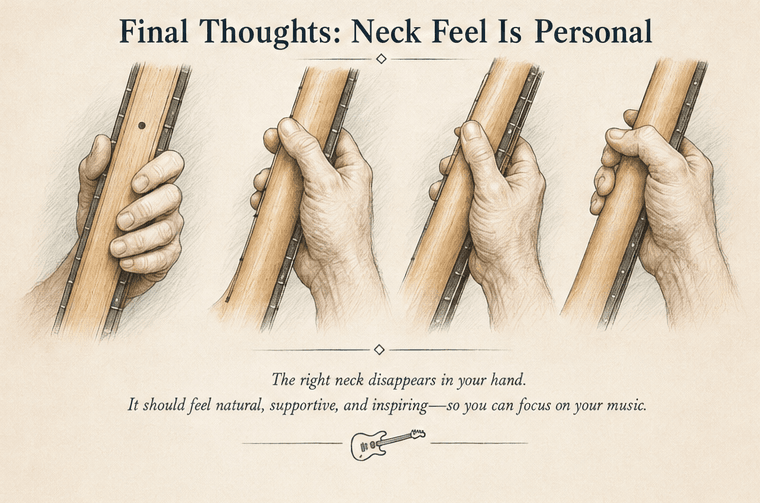
Final Thoughts: Neck Feel Is Personal
Guitar neck profiles are not just technical specifications. They shape the way you connect with the instrument.
A great neck should feel natural in your hand. It should support your playing style, reduce fatigue, and make you want to play longer. Whether you prefer a slim modern neck, a chunky vintage profile, a soft V, or an ergonomic asymmetrical design, the right choice is the one that helps you play with confidence.
When choosing a guitar, do not focus only on pickups, wood, finish, or hardware. Pay close attention to the neck. It is one of the most important parts of the instrument, and it can make the difference between a guitar that looks good and a guitar you truly love to play.