

Guitar Buying Guide, Hardware & Playability
Bolt-On vs Set Neck vs Neck-Through: Complete Guitar Neck Construction Guide

When choosing an electric guitar, most players focus on pickups, body shape, tonewoods, hardware, or finish. Those details are important, but one part of guitar construction has a major influence on feel, response, sustain, repairability, and overall playing experience:
the neck joint.
The way the neck connects to the body affects how the guitar feels in your hands and how it responds when you play. The three most common electric guitar neck construction types are:
Bolt-On Neck
Set Neck
Neck-Through
Each construction method has its own strengths. A bolt-on neck is practical, snappy, and easy to service. A set neck feels smooth, traditional, and sustain-focused. A neck-through design offers excellent upper fret access and a continuous, premium construction feel.
There is no single best option for every player. The right choice depends on your playing style, tone preference, budget, comfort needs, and whether you value easy maintenance or premium construction.
In this guide, we will explain the difference between bolt-on, set neck, and neck-through guitars, how each one feels, how they affect tone and sustain, and which one you should choose for your next electric guitar or custom build.
What Is Guitar Neck Construction?
Guitar neck construction refers to the way the guitar neck is attached to the body.
On an electric guitar, the neck and body must work together as one instrument. The strings run from the tuners, across the nut and fretboard, over the pickups, and down to the bridge. Because the neck carries string tension and supports the fretboard, the neck joint plays an important role in stability, comfort, and vibration transfer.
The three main types of electric guitar neck construction are:
Neck Construction | Basic Design | Common Character |
|---|---|---|
Bolt-On Neck | Neck is attached to the body with screws or bolts | Snappy, clear, practical |
Set Neck | Neck is glued into the body | Smooth, warm, traditional |
Neck-Through | Neck runs through the entire body | Long sustain, smooth access, premium feel |
Although players often talk about neck construction as a tone factor, it is only one part of the complete guitar design. Pickups, bridge, scale length, strings, fretwork, body wood, neck wood, and build quality also matter.
Still, neck construction can strongly influence how the guitar feels and how it responds.
Why Neck Construction Matters
The neck joint affects several important parts of the guitar experience.
A good neck joint can improve stability, comfort, and confidence. A poorly made neck joint can cause problems with tuning, sustain, action, alignment, or upper fret access.
Neck construction can influence:
- Attack
- Sustain
- Resonance
- Upper fret access
- Repairability
- Manufacturing cost
- Body feel
- Neck stability
- Long-term maintenance
- Overall playing comfort
For custom guitars, neck construction is one of the most important design decisions because it affects not only sound, but also how the guitar is built, repaired, and experienced over time.
What Is a Bolt-On Neck Guitar?
A bolt-on neck guitar has a neck that is attached to the body using screws or bolts. The neck sits inside a pocket routed into the body, and a metal neck plate or individual ferrules usually secure it from the back.
Despite the name, many bolt-on guitars actually use screws rather than machine bolts. However, “bolt-on” is the common term used in the guitar world.
Bolt-on construction is widely associated with S-style and T-style electric guitars. It is one of the most common and practical neck construction methods.
How a bolt-on neck is built
A bolt-on neck usually includes:
- A routed neck pocket in the body
- A separate guitar neck
- Screws or bolts holding the neck in place
- A neck plate or ferrules
- Possible micro-tilt or shim adjustment on some guitars
The neck and body are separate parts, which makes production, adjustment, repair, and replacement easier.
Bolt-On Neck Tone and Feel
Bolt-on guitars are often described as having a snappy attack, clear note definition, and fast response.
Because the neck and body are separate pieces joined tightly together, many players associate bolt-on construction with a more immediate and percussive feel. Notes often seem to “jump out” quickly, especially on clean tones.
Common tonal character of bolt-on guitars:
- Bright attack
- Clear note separation
- Snappy response
- Strong articulation
- Tight low end
- Defined clean tone
- More percussive feel
This is one reason bolt-on guitars are popular for funk, country, pop, blues, indie, and clean rhythm playing.
However, tone is not created by neck construction alone. A bolt-on guitar with humbuckers and mahogany can sound thick, while a set-neck guitar with bright pickups can sound sharp and clear.
Advantages of Bolt-On Neck Construction
Bolt-on neck construction has many practical advantages.
Easy repair and replacement
One of the biggest advantages of a bolt-on neck is serviceability. If the neck is damaged, warped, or needs replacement, it is usually easier to remove than a glued-in neck.
This is especially useful for touring musicians, repair shops, and players who want long-term flexibility.
Easier manufacturing
Bolt-on guitars are generally easier and less expensive to build than set-neck or neck-through guitars. The neck and body can be finished separately and assembled later.
This can make bolt-on guitars more affordable without necessarily making them lower quality.
Adjustable neck angle
Some bolt-on guitars can be adjusted with shims or micro-tilt systems. This can help fine-tune action and bridge geometry.
Clear and snappy tone
Many players love bolt-on guitars for their direct response, especially for clean rhythm playing and articulate lead work.
Great for modular custom builds
Bolt-on construction works well for custom guitars because neck and body choices can be more flexible.
Disadvantages of Bolt-On Neck Construction
Bolt-on necks also have some possible drawbacks.
Neck heel can affect upper fret access
Traditional bolt-on guitars often have a square neck heel. This can make upper frets slightly less comfortable to reach compared with a set neck or neck-through design.
Modern contoured heels improve this greatly, but traditional designs may still feel blocky.
Perceived as less premium by some buyers
Some players associate bolt-on construction with lower-cost guitars because many affordable guitars use this method. However, this is not always fair. Many high-end guitars also use bolt-on necks.
Build quality matters more than the construction label.
Neck pocket quality matters
A poorly fitted neck pocket can reduce stability and affect feel. A high-quality bolt-on guitar should have a tight, clean neck pocket and proper alignment.
Best Uses for Bolt-On Neck Guitars
Bolt-on neck guitars are excellent for players who want clarity, comfort, practicality, and easy maintenance.
Bolt-on necks are especially good for:
- Clean tones
- Funk
- Country
- Pop
- Indie
- Blues
- Classic rock
- Session playing
- Players who want snappy attack
- Players who value repairability
- Custom guitars with modular design
If you want a guitar that feels responsive, articulate, and easy to maintain, bolt-on construction is a strong choice.
What Is a Set Neck Guitar?
A set neck guitar has a neck that is glued into a fitted pocket or joint in the body. Instead of being screwed on, the neck is permanently attached with wood glue.
Set neck construction is commonly associated with LP-style guitars, semi-hollow guitars, hollow body guitars, and many traditional electric guitar designs.
A well-made set neck creates a strong connection between the neck and body, giving the guitar a smooth and integrated feel.
How a set neck is built
A set neck usually includes:
- A precisely cut neck joint
- A fitted pocket or mortise-and-tenon joint
- Wood glue
- Careful neck angle alignment
- Body and neck finishing as a joined unit
Because the neck is glued into place, the angle and fit must be accurate during construction. Mistakes are harder to correct later compared with bolt-on designs.
Set Neck Tone and Feel
Set neck guitars are often described as having a warmer, smoother, and more sustaining response.
Many players feel that set neck construction gives the guitar a more connected sound, especially for lead playing. Notes may feel less percussive than a bolt-on and more rounded or singing.
Common tonal character of set neck guitars:
- Warm response
- Smooth sustain
- Thick midrange
- Rounded attack
- Connected feel
- Singing lead tone
- Strong resonance
This is why set-neck guitars are popular for rock, blues, jazz, classic rock, and lead playing.
A set neck does not automatically mean more sustain than every bolt-on guitar, but it often supports a smoother and more traditional playing feel.
Advantages of Set Neck Construction
Set neck construction offers several important benefits.
Smooth and connected feel
Many players enjoy the way a set-neck guitar feels like one integrated instrument. The neck and body connection can feel solid and natural.
Good sustain
Set neck guitars are often associated with strong sustain, especially when combined with mahogany bodies, maple caps, fixed bridges, and humbuckers.
Traditional premium construction
Set neck construction is often used on classic and higher-end guitars. Many players see it as more premium than a basic bolt-on design.
Comfortable neck heel options
Set-neck guitars can have smoother heel transitions than traditional bolt-on guitars, although this depends on the design.
Great for warm and expressive tones
Set necks work very well for blues, rock, jazz, and lead playing where sustain and smoothness matter.
Disadvantages of Set Neck Construction
Set neck guitars also have some disadvantages.
Harder to repair
Because the neck is glued into the body, major neck repairs are more difficult. A damaged set neck usually requires professional work.
Neck angle must be correct
If the neck angle is wrong, the guitar may have action or bridge height problems. Fixing this can be much more difficult than shimming a bolt-on neck.
More expensive to build
Set-neck construction requires more careful fitting, gluing, alignment, and finishing. This often increases production cost.
Less modular
You cannot easily swap the neck for a different profile, scale length, or wood type.
Best Uses for Set Neck Guitars
Set neck guitars are excellent for players who want warmth, sustain, and a traditional premium feel.
Set necks are especially good for:
- Blues
- Classic rock
- Hard rock
- Jazz
- Lead guitar
- Warm clean tones
- Singing sustain
- Players who like thicker tones
- Players who prefer traditional guitar construction
- LP-style and semi-hollow designs
If you want a guitar that feels smooth, sustaining, and connected, set neck construction is a great option.
What Is a Neck-Through Guitar?
A neck-through guitar, also called neck-thru, has a neck that runs through the entire length of the body. The body sides, often called wings, are attached to the sides of the central neck piece.
Instead of the neck stopping at the body joint, the neck continues under the pickups and bridge area.
This construction method is often used in high-performance guitars, bass guitars, modern metal guitars, boutique builds, and instruments designed for maximum upper fret access.
How a neck-through guitar is built
A neck-through guitar usually includes:
- A long central neck blank
- Body wings glued to both sides
- Continuous wood running from headstock to bridge area
- No traditional bolt-on or set-neck heel
- Sculpted body transitions
- Often multi-laminate neck construction for stability
Because the neck runs through the body, construction must be extremely precise from the beginning.
Neck-Through Tone and Feel
Neck-through guitars are often described as having long sustain, smooth response, and excellent upper fret access.
Because the neck continues through the body, many players feel that the instrument responds evenly across the fretboard. The transition from neck to body is usually very smooth, making high fret playing easier.
Common tonal character of neck-through guitars:
- Long sustain
- Smooth response
- Even resonance
- Strong note continuity
- Less abrupt attack
- Full-body vibration
- Excellent upper fret access
Neck-through designs are especially popular among players who need fast access to high frets, such as metal, fusion, progressive rock, and technical lead players.
Advantages of Neck-Through Construction
Neck-through construction has several major strengths.
Excellent upper fret access
This is one of the biggest reasons players choose neck-through guitars. Because there is no traditional bulky neck joint, the heel can be carved smoothly.
This makes high fret playing much easier.
Strong sustain
Many neck-through guitars are known for long sustain because the neck structure runs continuously through the body.
Premium construction feel
Neck-through guitars often feel high-end and carefully built. They are common in boutique and custom instruments.
Stability from multi-piece neck construction
Many neck-through guitars use laminated necks made from multiple wood strips. This can improve stability and reduce movement.
Great for modern and technical playing
Neck-through designs often pair well with extended fret access, 24 frets, high-output pickups, and modern body shapes.
Disadvantages of Neck-Through Construction
Neck-through guitars are not perfect for everyone.
Difficult and expensive to repair
If the neck is damaged, repairs can be very difficult because the neck is the central structure of the guitar. Unlike bolt-on guitars, you cannot simply replace the neck.
More expensive to build
Neck-through construction requires more material, precision, planning, and labor. This often makes these guitars more expensive.
Less traditional feel
Some players prefer the snap and attack of a bolt-on guitar or the classic feel of a set neck. Neck-through guitars can feel smoother and less percussive.
Design flexibility is limited after construction
Because the neck runs through the body, many construction choices must be decided early. Later changes are harder.
Best Uses for Neck-Through Guitars
Neck-through guitars are ideal for players who prioritize smooth access, sustain, and premium construction.
Neck-through guitars are especially good for:
- Metal
- Progressive rock
- Fusion
- Shred
- Technical lead playing
- Extended-range guitars
- 24-fret guitars
- Players who need smooth upper fret access
- Custom high-performance builds
If your playing involves frequent high fret work and you want a smooth, premium feel, neck-through construction can be an excellent choice.
Bolt-On vs Set Neck vs Neck-Through: Main Differences
The main differences between these three neck constructions are attachment method, feel, sustain, repairability, and cost.
Feature | Bolt-On | Set Neck | Neck-Through |
|---|---|---|---|
Neck attachment | Screwed or bolted to body | Glued into body | Neck runs through body |
Feel | Snappy and direct | Smooth and connected | Seamless and continuous |
Attack | Fast and clear | Rounded and warm | Smooth and even |
Sustain | Good | Very good | Often excellent |
Upper fret access | Depends on heel design | Usually good | Usually excellent |
Repairability | Easiest | More difficult | Most difficult |
Cost | Usually most affordable | Mid to high | Usually highest |
Common styles | S-style, T-style | LP-style, semi-hollow | Modern, metal, boutique |
Best for | Clarity and practicality | Warmth and sustain | Access and premium feel |
A simple way to think about it:
Bolt-On = snap, clarity, easy repair
Set Neck = warmth, sustain, traditional feel
Neck-Through = smooth access, long sustain, premium construction
Does Neck Construction Affect Tone?
Yes, but it is not the only factor.
Neck construction can influence how the guitar responds, how notes attack, and how vibrations travel through the instrument. However, pickups, bridge type, strings, scale length, body wood, neck wood, fretwork, and amplifier choice can have equal or greater impact.
For example:
A bolt-on guitar with high-output humbuckers can sound heavy and thick.
A set-neck guitar with bright pickups can sound clear and articulate.
A neck-through guitar with low-output pickups can sound open and dynamic.
So, neck construction matters, but it should not be treated as the only tone factor.
General tonal tendencies
Bolt-on guitars often feel:
- Snappier
- Brighter
- More immediate
- More percussive
Set neck guitars often feel:
- Warmer
- Smoother
- More sustaining
- More connected
Neck-through guitars often feel:
- More even
- More sustaining
- More seamless
- Smoother in high positions
These are tendencies, not strict rules.
Which Neck Construction Has the Best Sustain?
Many players believe neck-through guitars have the best sustain, followed by set necks, then bolt-ons.
In many cases, neck-through and set-neck guitars can offer excellent sustain because of their strong neck-to-body connection. However, sustain depends on more than the neck joint.
Sustain is affected by:
- Bridge type
- Nut quality
- Fretwork
- String gauge
- Pickup height
- Wood density
- Neck stiffness
- Body construction
- Hardware quality
- Overall build quality
A well-built bolt-on guitar can sustain extremely well. A poorly built neck-through guitar is not automatically better.
If sustain is your main goal, focus on total build quality, not just neck construction.
Which Neck Construction Has the Best Upper Fret Access?
Neck-through construction usually offers the best upper fret access because the neck transition can be carved very smoothly.
Set neck guitars can also offer excellent upper fret access, especially with a sculpted heel.
Traditional bolt-on guitars may have more restricted access due to the square heel and neck plate, but modern bolt-on designs with contoured heels can be very comfortable.
Upper fret access ranking in general
Best access:
Neck-Through → Sculpted Set Neck → Contoured Bolt-On → Traditional Bolt-On
If you often play above the 17th fret, upper fret access should be a major consideration.
Which Neck Construction Is Easiest to Repair?
Bolt-on necks are usually the easiest to repair or replace.
If a bolt-on neck is damaged, it can often be removed and replaced. If the neck angle needs adjustment, a shim may solve the problem. If the frets are worn or the neck is warped, replacing the neck may be possible.
Set necks are harder to repair because they are glued in. A neck reset or major repair requires professional work.
Neck-through guitars are the hardest to repair because the neck is part of the entire body structure.
Repairability ranking
Easiest:
Bolt-On → Set Neck → Neck-Through
For players who tour heavily, modify guitars, or want long-term service flexibility, bolt-on construction has a major advantage.
Which Neck Construction Is Best for Beginners?
For beginners, bolt-on neck guitars are often a very practical choice.
They are usually more affordable, easier to service, and widely available. Many beginner-friendly guitars use bolt-on construction because it keeps the cost reasonable while still offering great playability.
However, beginners can also enjoy set-neck or neck-through guitars if the instrument is comfortable and well set up.
Best beginner choice
A good beginner guitar should have:
- Comfortable neck
- Stable tuning
- Good fretwork
- Reasonable weight
- Reliable bridge
- Proper setup
- Pickups that match the player’s music
The construction type is less important than comfort and playability.
If unsure, a bolt-on guitar is usually the safest and most practical starting point.
Which Neck Construction Is Best for Rock?
Rock works well with all three construction types.
Bolt-on for rock
Good for bright, punchy rock tones, classic rhythm sounds, indie rock, alternative, and articulate leads.
Set neck for rock
Excellent for thick classic rock tones, strong sustain, warm leads, and heavy rhythm playing.
Neck-through for rock
Great for modern rock, progressive rock, and players who want smooth access and sustain.
For classic rock and hard rock, set neck guitars are especially popular. For modern rock and technical styles, neck-through guitars can be excellent. For indie and alternative rock, bolt-on guitars are often a strong choice.
Which Neck Construction Is Best for Metal?
Metal players often choose neck-through or set-neck guitars because of sustain, upper fret access, and high-performance design.
However, many bolt-on metal guitars also perform extremely well, especially with modern contoured heels, stable bridges, and high-output pickups.
Best metal options
Choose bolt-on if you want:
- Tight attack
- Clear note definition
- Easy repair
- Fast response
Choose set neck if you want:
- Thick rhythm tone
- Smooth sustain
- Strong midrange
- Traditional heavy sound
Choose neck-through if you want:
- Maximum upper fret access
- Long sustain
- Premium modern feel
- Smooth technical playing
For extended-range guitars, 24-fret guitars, and shred-focused instruments, neck-through is often very appealing.
Which Neck Construction Is Best for Blues and Jazz?
Blues and jazz players often prefer set-neck guitars because of their warmth, sustain, and smooth response.
A set-neck guitar with humbuckers or P90s can create rich clean tones and expressive lead sounds.
However, bolt-on guitars are also excellent for blues, especially if you want a brighter, more dynamic tone. Many blues players love bolt-on guitars for their snap and touch response.
Neck-through guitars can work for jazz and blues too, especially if the player wants smooth access and sustain, but they are less traditional in these genres.
Good choices
For blues:
- Bolt-on for bright, dynamic blues
- Set neck for warm, sustaining blues
- P90 or humbucker set neck for classic blues rock
For jazz:
- Set neck for warm and rounded tone
- Semi-hollow set neck for traditional jazz feel
- Neck-through for modern fusion-style jazz
Neck Construction and Custom Guitars
If you are ordering a custom guitar, neck construction should match the purpose of the instrument.
Ask yourself:
- Do I want a snappy or smooth response?
- Do I play mostly rhythm, lead, or both?
- Do I often play high frets?
- Do I need easy repair or replacement options?
- Do I prefer traditional or modern construction?
- Is sustain a major priority?
- Is budget a major factor?
- Do I want a modular guitar or a permanent premium build?
Choose bolt-on for a custom guitar if:
- You want clear attack
- You want easy neck serviceability
- You like S-style or T-style designs
- You want a practical and flexible build
- You want easier future modification
Choose set neck for a custom guitar if:
- You want warm sustain
- You like LP-style or semi-hollow designs
- You want a traditional premium feel
- You prefer smooth lead tone
- You want a glued-in construction
Choose neck-through for a custom guitar if:
- You want maximum upper fret access
- You want long sustain
- You like modern high-performance guitars
- You want premium boutique construction
- You are comfortable with harder repairability
Custom guitars allow you to choose the construction method that truly fits your playing style.
Common Myths About Guitar Neck Construction
Myth 1: Bolt-on guitars are cheap or low quality
This is not true. Many professional, boutique, and high-end guitars use bolt-on necks. A well-made bolt-on neck can be extremely stable, resonant, and reliable.
Myth 2: Set necks always have better sustain
Set necks often sustain well, but sustain depends on the entire guitar. A great bolt-on can sustain better than a poorly built set-neck guitar.
Myth 3: Neck-through guitars are always the best
Neck-through guitars are premium and excellent for certain players, but they are not automatically better for every style. Some players prefer the attack and simplicity of bolt-on guitars.
Myth 4: Neck construction determines tone by itself
Neck construction matters, but pickups, bridge, strings, setup, scale length, and amp choice are also extremely important.
Myth 5: More expensive construction always means better sound
Neck-through and set-neck guitars often cost more because they require more labor, not because they are always better for every player.
How to Choose the Right Neck Construction
The best way to choose is to focus on how you play.
Choose Bolt-On if you want:
- Clear attack
- Snappy response
- Easy repair
- Lower cost
- Bright clean tones
- Modular construction
- Practical long-term maintenance
- S-style or T-style designs
Choose Set Neck if you want:
- Warm tone
- Smooth sustain
- Traditional premium feel
- Strong midrange
- Classic rock or blues character
- LP-style or semi-hollow designs
- A more connected neck-body feel
Choose Neck-Through if you want:
- Excellent upper fret access
- Long sustain
- Smooth high-fret playing
- Modern performance feel
- Premium construction
- Technical lead comfort
- Boutique or extended-range designs
If you are unsure, think about your main priority:
Clarity and practicality? Choose bolt-on.
Warmth and sustain? Choose set neck.
Access and premium performance? Choose neck-through.
Final Thoughts: Which Neck Construction Is Best?
Bolt-on, set neck, and neck-through guitars all have their place.
A bolt-on guitar can be clear, reliable, practical, and professional. A set-neck guitar can be warm, smooth, sustaining, and classic. A neck-through guitar can be sleek, powerful, seamless, and high-performance.
The best choice depends on what matters most to you.
If you want a guitar that is easy to maintain, articulate, and versatile, a bolt-on neck is a great option. If you want a more traditional feel with warmth and sustain, a set neck may be the right choice. If you want maximum upper fret access and a premium modern construction, neck-through may be ideal.
In the end, construction is only one part of the guitar. The best guitar is the one that feels comfortable, sounds inspiring, stays reliable, and supports the way you actually play.
Choose the neck construction that helps you play more confidently, more comfortably, and more creatively.
SEO Title
Bolt-On vs Set Neck vs Neck-Through: Complete Guitar Neck Construction Guide
Meta Description
Learn the difference between bolt-on, set neck, and neck-through guitar construction, including tone, sustain, upper fret access, repairability, cost, and which one to choose.
Suggested URL Slug
/bolt-on-vs-set-neck-vs-neck-through/
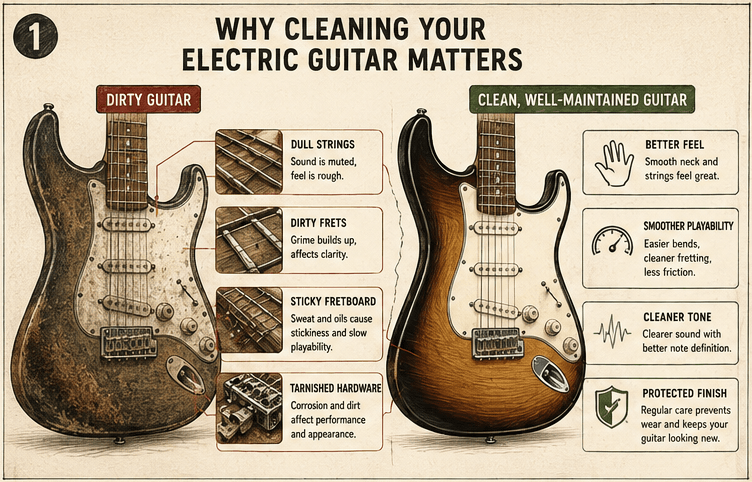
Why Cleaning Your Electric Guitar Matters
Many players only clean their guitar when it starts to look dirty. However, regular cleaning is more than just cosmetic.
Every time you play, your hands leave behind sweat, oil, dirt, and moisture. Over time, this buildup can affect the way your guitar feels and performs. Strings become dull. Frets lose their shine. The fretboard becomes sticky or dry. Hardware can begin to tarnish or corrode. Dust can collect around pickups, bridge saddles, switches, and control knobs.
Cleaning your guitar helps protect:
- The guitar finish
- The fretboard surface
- Frets and hardware
- Strings
- Pickup covers and screws
- Bridge and saddles
- Tuning machines
- Overall playability
A well-maintained guitar feels better in your hands and encourages you to play more often.