

Pickups & Electronics
Single Coil vs Humbucker Pickups: Complete Guitar Pickup Guide

When choosing an electric guitar, pickups are one of the most important factors that shape your sound. Body wood, neck construction, bridge type, scale length, and playing technique all matter, but the pickups are what directly capture the vibration of the strings and send that signal to your amplifier.
Among all electric guitar pickup types, the two most common are single coil pickups and humbucker pickups.
Single coils are known for their bright, clear, and articulate sound. Humbuckers are known for their thicker, warmer, and more powerful tone. Both have been used on countless recordings, and neither one is automatically better than the other.
The right choice depends on your playing style, the tone you want, how much gain you use, and how you want the guitar to respond under your fingers.
In this guide, we’ll explain the difference between single coil and humbucker pickups, how they sound, what music styles they suit best, and how to choose the right pickup type for your guitar.

What Is a Single Coil Pickup?
A single coil pickup is one of the earliest and most classic electric guitar pickup designs. As the name suggests, it uses a single coil of wire wrapped around magnets or magnetic pole pieces.
When the guitar strings vibrate, the pickup senses those vibrations and converts them into an electrical signal.
Single coil pickups are famous for their bright, clean, crisp, and detailed sound. They are often associated with classic S-style and T-style guitars and are widely used in blues, country, funk, pop, indie, surf, and classic rock.
Single coil tone characteristics
Single coils usually sound:
- Bright
- Clear
- Crisp
- Open
- Dynamic
- Articulate
- Sparkly
- Responsive to touch
They are excellent for clean tones because they preserve note separation very well. Chords sound clear, and individual notes are easy to hear.
This is why single coil pickups are popular with players who want strong clarity and definition.

What Is a Humbucker Pickup?
A humbucker pickup uses two coils instead of one. The design was created to reduce the electrical hum that single coil pickups naturally produce.
The word “humbucker” comes from the idea of “bucking the hum.” By using two coils wired in a specific way, humbuckers cancel much of the unwanted noise while producing a stronger and fuller signal.
Humbuckers are famous for their warm, thick, powerful, and smooth tone. They are commonly found on LP-style guitars, modern rock guitars, metal guitars, jazz guitars, and many custom builds.
Humbucker tone characteristics
Humbuckers usually sound:
- Warm
- Thick
- Full
- Smooth
- Powerful
- Mid-focused
- Lower noise
- Stronger output
Compared with single coils, humbuckers often have more body and more output. They also work especially well with overdrive and distortion.
This makes them popular for rock, hard rock, metal, blues lead, jazz, and heavier music styles.

Single Coil vs Humbucker: The Main Difference
The main difference between single coil and humbucker pickups is their construction, output, tone, and noise level.
A single coil uses one coil and produces a brighter, clearer tone, but it can pick up more electrical hum.
A humbucker uses two coils and produces a thicker, warmer tone with less noise.
Here is the simple comparison:
Feature | Single Coil | Humbucker |
|---|---|---|
Construction | One coil | Two coils |
Tone | Bright, clear, crisp | Warm, thick, full |
Output | Usually lower | Usually higher |
Noise | More hum | Less hum |
Clean sound | Sparkly and articulate | Smooth and rounded |
Distortion sound | Sharp and defined | Thick and powerful |
Best for | Funk, blues, country, pop, indie | Rock, metal, jazz, blues lead |
Feel | Dynamic and touch-sensitive | Compressed and strong |
Both pickup types are extremely useful. The question is not which one is better, but which one fits your sound.

How Single Coil Pickups Sound
Single coil pickups are known for their clarity. They allow the natural attack of the string to come through clearly, especially when playing clean or lightly overdriven tones.
When you play chords with single coils, each note tends to stay more separated. This makes them great for rhythm playing, funk strumming, arpeggios, clean pop parts, country picking, and expressive blues.
Single coils also respond strongly to picking dynamics. If you pick softly, they sound gentle and glassy. If you pick harder, they become sharper and more aggressive.
Best qualities of single coil pickups
Single coils are great when you want:
- Clear note separation
- Bright clean tones
- Dynamic response
- Strong pick attack
- Sparkle and chime
- Expressive volume control response
- Classic vintage-style tones
A good single coil can make a guitar feel very alive and responsive.
How Humbucker Pickups Sound
Humbuckers usually sound thicker and smoother than single coils. Because they use two coils, they often produce more output and a fuller frequency response.
They tend to emphasize mids and low mids more than single coils. This gives the guitar a stronger, heavier sound that works well for distorted tones and lead playing.
With overdrive or distortion, humbuckers sound powerful and controlled. They can produce smooth sustain, thick rhythm tones, and singing lead lines.
Best qualities of humbucker pickups
Humbuckers are great when you want:
- Thick rhythm tone
- Warm lead tone
- More sustain
- Higher output
- Lower noise
- Smooth distortion
- Stronger midrange
- Powerful rock or metal sound
A good humbucker can make a guitar sound bigger, heavier, and more controlled.

Clean Tone Comparison
For clean tones, single coils and humbuckers behave very differently.
Single coil clean tone
Single coils usually produce a bright, open, and sparkly clean tone. They are excellent for styles where clarity matters.
They work especially well for:
- Funk rhythm
- Country picking
- Clean pop guitar
- Indie guitar
- Surf guitar
- Blues clean tones
- Chord arpeggios
Single coils can sound very “glassy” and detailed, especially in neck and middle positions.
Humbucker clean tone
Humbuckers produce a warmer and rounder clean tone. They usually have less sparkle than single coils, but more body and smoothness.
They work especially well for:
- Jazz clean tones
- Warm blues
- Soulful lead lines
- Smooth rhythm guitar
- Clean passages that need fullness
A neck humbucker can produce a soft, rich, rounded clean tone that many jazz and blues players love.

Distortion and High-Gain Comparison
When using distortion, the difference becomes even more obvious.
Single coils with distortion
Single coils can sound sharp, raw, and cutting with overdrive. They are excellent for blues rock, garage rock, punk, classic rock, and indie rock.
However, because they usually have lower output and more hum, they may not always be ideal for very high-gain metal tones unless they are specifically designed for that purpose.
Single coils with distortion can sound:
- Raw
- Bright
- Gritty
- Clear
- Cutting
- Open
They are great when you want bite and attitude.
Humbuckers with distortion
Humbuckers are usually better suited for heavier distortion. Their higher output pushes the amp harder, and their hum-canceling design helps keep noise under control.
Humbuckers with distortion can sound:
- Thick
- Heavy
- Smooth
- Tight
- Powerful
- Sustaining
This is why humbuckers are so common in rock, hard rock, and metal guitars.

Noise and Hum: Why Single Coils Can Be Noisier
One of the biggest drawbacks of traditional single coil pickups is noise.
Single coils can pick up electrical interference from lights, amps, computers, power supplies, and other electronics. This often creates a background hum or buzz.
This noise is especially noticeable when using high gain or standing near noisy electrical sources.
Humbuckers were designed to reduce this problem. Their two-coil design cancels much of the hum, making them quieter and more controlled.
If you play clean or low gain
Single coil hum may not be a major issue.
If you play high gain
Humbuckers are usually easier to manage.
If you record often
Noise can matter more because unwanted hum becomes more obvious in recordings.

Output Level: Which Pickup Is More Powerful?
Humbuckers generally have higher output than single coils.
Higher output means the pickup sends a stronger signal to the amp. This can make the guitar sound louder, thicker, and more compressed. It can also push an amp into overdrive more easily.
Single coils usually have lower output, which gives them more openness and dynamic range. They may feel more sensitive to picking strength and volume knob changes.
Lower output pickups tend to feel:
- More open
- More dynamic
- Cleaner
- More touch-sensitive
Higher output pickups tend to feel:
- More powerful
- More compressed
- More aggressive
- Easier to distort
Neither is better. Lower output can feel expressive. Higher output can feel strong and controlled.

Single Coil vs Humbucker for Different Music Styles
Different genres often benefit from different pickup types. These are not strict rules, but they are helpful starting points.
Best pickups for rock
For rock, both single coils and humbuckers can work.
Choose single coils if you want classic rock bite, cleaner rhythm tones, or raw overdrive.
Choose humbuckers if you want thicker power chords, stronger sustain, and a heavier sound.
Best choice for most rock players:
Humbuckers or HSS configuration
Best pickups for metal
For metal, humbuckers are usually the better choice.
Metal often requires tight low end, high output, low noise, and strong distortion performance. Humbuckers handle these needs very well.
Best choice:
High-output humbuckers or active humbuckers
Best pickups for blues
Blues can work beautifully with single coils, humbuckers, or P90s.
Single coils give you bright, expressive, touch-sensitive blues tones. Humbuckers give you warm, thick, sustaining lead tones.
Best choice:
Single coils for clarity and snap
Humbuckers for warmth and sustain
Best pickups for jazz
Jazz players often prefer warm, smooth, rounded tones. Humbuckers are very popular for this reason, especially neck humbuckers.
Best choice:
Low-output or vintage-style humbuckers
Best pickups for funk
Funk usually needs clean, bright, percussive tone with excellent note separation.
Single coils are usually the best choice.
Best choice:
Single coils
Best pickups for country
Country guitar often needs twang, snap, clarity, and strong attack.
Single coils are usually the traditional choice.
Best choice:
Single coils, especially T-style bridge pickups
Best pickups for indie and alternative
Indie and alternative players use many pickup types. Single coils are great for clean, jangly, and textured tones. Humbuckers are great for thicker drive and darker sounds.
Best choice:
Single coils, P90s, or lower-output humbuckers depending on the sound

Single Coil vs Humbucker for Beginners
Beginners often ask which pickup type is better for a first electric guitar.
The answer depends on what music you want to play.
If you like clean tones, pop, funk, blues, indie, or country, a single coil guitar can be a great choice.
If you like rock, metal, hard rock, or heavier music, a humbucker guitar may be easier to use.
For many beginners, the most versatile option is an HSS pickup configuration. This gives you a humbucker in the bridge position for rock and heavier tones, plus single coils for clean and bright sounds.
Best beginner pickup choices
- SSS for clean, bright, classic tones
- HH for rock, metal, and heavier tones
- HSS for the most versatility
If you are unsure, HSS is often the safest option.

Pickup Positions: Neck, Middle, and Bridge
Pickup type matters, but pickup position also changes the sound.
Bridge pickup
The bridge pickup sounds brighter, tighter, and more aggressive. It is often used for rhythm guitar, rock riffs, country twang, funk attack, and metal distortion.
A bridge single coil sounds sharp and cutting.
A bridge humbucker sounds powerful and tight.
Neck pickup
The neck pickup sounds warmer, fuller, and smoother. It is often used for blues leads, jazz tones, warm clean parts, and expressive solos.
A neck single coil sounds round but still clear.
A neck humbucker sounds thick, smooth, and warm.
Middle pickup
The middle pickup is common on S-style guitars. It provides a balanced tone and is often used in combination with the neck or bridge pickup for classic clean sounds.

Common Pickup Configurations Explained
Pickup configuration affects how versatile a guitar is.
SSS
Three single coil pickups.
Best for:
- Clean tones
- Funk
- Blues
- Country
- Pop
- Classic S-style sounds
SSS guitars are bright, clear, and expressive, but they may be noisier with high gain.
HH
Two humbuckers.
Best for:
- Rock
- Metal
- Jazz
- Blues lead
- Hard rock
- High-gain tones
HH guitars are powerful, warm, and lower noise, but they may not have the same sparkle as single coil guitars.
HSS
One humbucker in the bridge and two single coils in the middle and neck.
Best for:
- Versatile players
- Beginners
- Rock and pop
- Clean and distorted tones
- Players who want one guitar for many styles
HSS is one of the most practical pickup layouts because it combines single coil clarity with humbucker power.
HSH
Humbucker, single coil, humbucker.
Best for:
- Fusion
- Progressive rock
- Session players
- Maximum flexibility
- Modern custom guitars
HSH guitars offer a wide range of tones, especially when paired with coil split wiring.

What Is Coil Splitting?
Coil splitting is a wiring option that allows a humbucker to use only one of its two coils.
This gives the humbucker a brighter, thinner sound that is closer to a single coil tone.
However, a split humbucker usually does not sound exactly like a true single coil. It can be useful, but it may not have the same sparkle, openness, or response as a traditional single coil.
Coil split is useful if you want:
- More tonal variety
- Cleaner sounds from a humbucker guitar
- Brighter rhythm tones
- A more versatile custom build
For players who want one guitar to cover many styles, coil splitting is a very useful feature.

What Is Coil Tapping?
Coil tapping is often confused with coil splitting, but it is different.
A true coil tap uses a pickup winding with an extra connection point. This allows the pickup to operate at a lower output by using fewer windings.
Coil tapping is less common than coil splitting. Many people say “coil tap” when they actually mean “coil split.”
Simple difference
- Coil split: turns off one coil of a humbucker
- Coil tap: uses part of a pickup winding for lower output
For most modern guitar buyers, coil split is the feature they are more likely to encounter.

Are Noiseless Single Coils a Good Option?
Noiseless single coils are designed to reduce hum while keeping a single coil-style tone.
They can be a great option for players who love single coil clarity but need less noise for recording, live playing, or higher gain settings.
However, noiseless single coils may sound slightly different from traditional single coils. Some players feel they are a little smoother, less raw, or less airy.
Choose noiseless single coils if:
- You want bright single coil tone with less hum
- You record often
- You play live under noisy stage lighting
- You use moderate gain
- You want cleaner performance
Traditional single coils may still be preferred by players who want the most vintage and open response.

Passive vs Active Pickups
Both single coils and humbuckers can be passive or active, though active humbuckers are more common in metal guitars.
Passive pickups
Passive pickups do not require a battery. They are traditional, dynamic, and responsive.
Best for:
- Blues
- Rock
- Jazz
- Funk
- Classic tones
- Touch-sensitive playing
Active pickups
Active pickups require a battery. They usually have higher output, lower noise, and a more compressed response.
Best for:
- Metal
- High-gain rock
- Modern heavy tones
- Tight low end
- Consistent output
Active pickups can be excellent for heavy music, but some players prefer passive pickups for their natural feel.
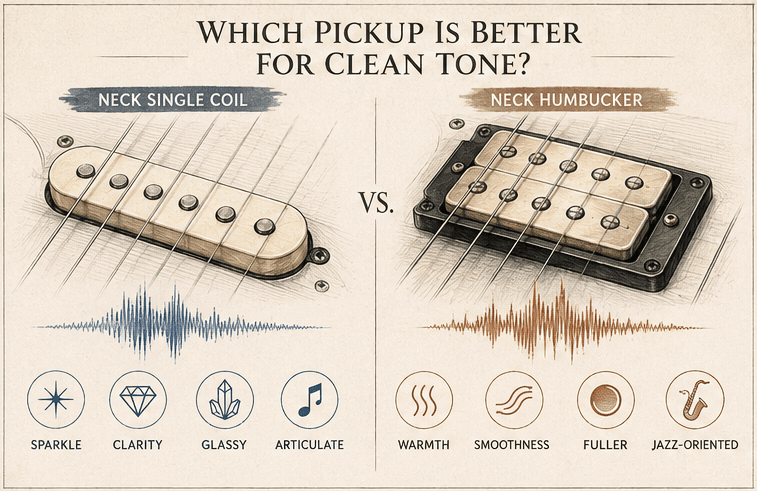
Which Pickup Is Better for Clean Tone?
For bright, glassy, and articulate clean tones, single coils are usually the better choice.
They provide excellent note separation and sparkle.
For warm, smooth, and full clean tones, humbuckers are better.
A neck humbucker can produce a beautiful jazz clean tone, while a single coil neck pickup can produce a clear blues or pop clean tone.
Choose single coil clean tone if you want:
- Sparkle
- Chime
- Brightness
- Clarity
- Funky rhythm sound
Choose humbucker clean tone if you want:
- Warmth
- Smoothness
- Fullness
- Jazz tone
- Rounded lead sound

Which Pickup Is Better for Distortion?
For thick, powerful distortion, humbuckers are usually better.
They provide stronger output, lower noise, and a fuller distorted tone.
Single coils can still sound excellent with overdrive, especially for blues, punk, classic rock, and indie. But for modern high-gain tones, humbuckers are usually the easier choice.
Choose single coil distortion if you want:
- Raw bite
- Grit
- Clear attack
- Vintage overdrive
- Garage rock energy
Choose humbucker distortion if you want:
- Heavy riffs
- Smooth sustain
- Tight rhythm tone
- Metal power
- Lower noise

Can One Guitar Have Both Single Coils and Humbuckers?
Yes. Many guitars combine both pickup types.
The most common example is HSS, which has a bridge humbucker and two single coils.
This gives the player both humbucker power and single coil clarity.
Another option is HSH, which has humbuckers in the bridge and neck positions, with a single coil in the middle.
For custom guitars, mixed pickup configurations are very useful because they let you design the guitar around your real playing needs.

Single Coil vs Humbucker: Which One Should You Choose?
Choose single coil pickups if you want:
- Bright tone
- Clean clarity
- Sparkle and chime
- Strong note separation
- Touch-sensitive response
- Funk, country, pop, blues, indie, or classic clean tones
Choose humbucker pickups if you want:
- Warm tone
- Thicker sound
- More output
- Less noise
- Smooth sustain
- Rock, metal, jazz, hard rock, or heavy lead tones
Choose HSS or coil split humbuckers if you want:
- Maximum versatility
- Both clean and distorted tones
- One guitar for many genres
- Custom build flexibility
The best pickup choice depends on the sound you want to hear when you plug in.

Common Mistakes When Choosing Pickups
Choosing pickups only by genre
Genres can guide you, but they should not completely decide for you. Many great rock tones use single coils, and many clean tones use humbuckers.
Thinking higher output is always better
Higher output can be powerful, but it may reduce clarity and dynamics. Lower output pickups can sound more open and expressive.
Ignoring pickup position
A bridge humbucker and neck humbucker sound very different. Position matters as much as pickup type.
Forgetting about your amp
Your amp and pedals shape the final sound. A pickup that sounds dark through one amp may sound perfect through another.
Expecting coil split to sound exactly like a true single coil
Coil split is useful, but it is not always the same as a real single coil pickup.
Choosing based only on appearance
Pickup covers, colors, and layout matter visually, but tone and function should come first.

Best Pickup Setup for a Custom Guitar
If you are designing a custom guitar, think about your main playing style first.
For maximum versatility
Choose HSS or HSH with coil splitting.
For classic clean tones
Choose SSS or lower-output single coils.
For rock and blues
Choose HH, HSS, or vintage-style humbuckers.
For metal
Choose high-output humbuckers, active humbuckers, or tight passive humbuckers.
For jazz
Choose a warm neck humbucker or lower-output humbuckers.
For indie and alternative
Choose single coils, P90s, or lower-output humbuckers depending on how bright or thick you want the guitar to sound.
A custom guitar gives you the chance to choose not only the pickup type, but also the exact layout, wiring, switching, and control options.

Single Coil or Humbucker?
Single coil and humbucker pickups both have their own strengths.
Single coils are bright, clear, dynamic, and expressive. They are perfect for players who want clean sparkle, strong note separation, and touch-sensitive response.
Humbuckers are warm, thick, powerful, and quieter. They are ideal for players who want smooth sustain, strong distortion, lower noise, and a fuller sound.
Neither one is better for everyone.
The best pickup is the one that matches your music, your playing style, your amp, and the sound you want to create.
If you want clarity and sparkle, choose single coils. If you want power and warmth, choose humbuckers. If you want both, consider an HSS or HSH guitar with smart switching options.
Your pickups are the voice of your electric guitar. Choose the voice that inspires you to play more.