

Pickups & Electronics
Active Pickups vs Passive Pickups: What’s the Difference?

When choosing an electric guitar, pickups are one of the biggest factors that shape your sound. Pickups convert string vibration into an electrical signal, and that signal is what your amp, pedals, and effects process into your final tone.
Most electric guitar pickups fall into two main categories: active pickups and passive pickups.
Both can sound excellent, but they feel and respond differently. Passive pickups are more traditional, dynamic, and organic. Active pickups are more powerful, consistent, and noise-controlled. The right choice depends on your playing style, music genre, tone preference, and how much control you want from your guitar.

What Are Passive Pickups?
Passive pickups are the traditional type of electric guitar pickup. They do not need a battery. They use magnets and copper wire coils to sense string vibration and create an electrical signal naturally.
Most classic electric guitar tones were created with passive pickups. Single coils, humbuckers, and P90s are usually passive unless specifically designed as active models.
Passive pickups are known for their natural response. They react strongly to your picking strength, volume knob changes, guitar wood, and playing technique.
Common passive pickup characteristics:
- Natural and organic feel
- Strong dynamic response
- More touch-sensitive
- Traditional electric guitar tone
- Works well with volume and tone controls
- No battery required
- Available in many output levels
Passive pickups can be bright and clear, warm and vintage, thick and powerful, or raw and aggressive depending on the design.

What Are Active Pickups?
Active pickups use a built-in preamp powered by a battery, usually a 9V battery. The pickup itself often has lower natural output, but the internal preamp boosts and shapes the signal before it leaves the guitar.
Active pickups are known for strong output, low noise, and consistent performance. They are especially popular in metal, modern rock, and high-gain music because they stay tight and controlled under heavy distortion.
Common active pickup characteristics:
- Higher output
- Lower noise
- More compressed response
- Tight low end
- Clear signal under high gain
- Consistent tone
- Requires a battery
- Often used in modern performance guitars
Active pickups are designed to deliver a strong, clean, controlled signal to your amp.

Active Pickups vs Passive Pickups: Main Difference
The biggest difference is power and response.
A passive pickup creates its signal naturally through magnets and coils. An active pickup uses a battery-powered preamp to boost and control the signal.
Here is the simple comparison:
Feature | Passive Pickups | Active Pickups |
|---|---|---|
Power | No battery needed | Requires battery |
Output | Low to high, depending on model | Usually high and consistent |
Noise | More noise possible | Usually quieter |
Feel | Dynamic and organic | Controlled and compressed |
Tone | Traditional and expressive | Modern and precise |
Best for | Blues, rock, jazz, funk, classic tones | Metal, hard rock, modern high gain |
Volume knob response | Very expressive | More consistent |
Maintenance | Low | Battery replacement needed |
Simple summary:
Passive pickups = natural feel and dynamic tone
Active pickups = power, clarity, and low noise

How Passive Pickups Sound
Passive pickups usually sound more open and expressive. They respond very clearly to how hard or soft you play.
If you pick lightly, the tone becomes softer and cleaner. If you pick harder, the sound becomes more aggressive. This makes passive pickups very useful for players who rely on touch, dynamics, and volume knob control.
Passive pickups are often described as:
- Open
- Warm
- Dynamic
- Organic
- Expressive
- Vintage
- Responsive
- Natural
A low-output passive pickup can sound clear and detailed. A high-output passive humbucker can sound powerful and aggressive while still keeping some natural dynamics.
Passive pickups are especially popular for blues, classic rock, jazz, funk, country, indie, and vintage-inspired tones.

How Active Pickups Sound
Active pickups usually sound tighter, stronger, and more controlled. Because the built-in preamp boosts the signal, the tone often feels more consistent from note to note.
They are especially good for high-gain playing because they reduce unwanted noise and keep the low end tight.
Active pickups are often described as:
- Powerful
- Tight
- Clear
- Compressed
- Controlled
- Modern
- Focused
- Low-noise
With distortion, active pickups can produce strong rhythm tones, sharp palm-muted riffs, smooth sustain, and clear lead lines.
This is why many metal and hard rock players prefer active pickups.
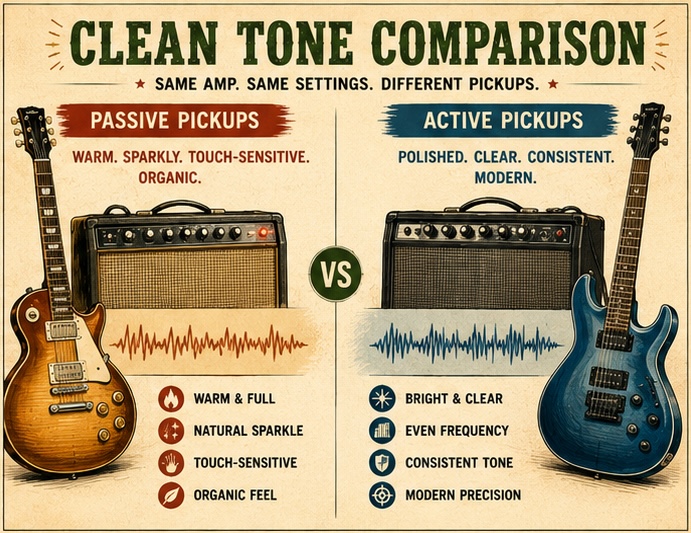
Clean Tone Comparison
Passive pickups usually have a more natural clean tone. They can sound warm, sparkly, glassy, woody, or vintage depending on the model.
For clean playing, passive pickups often feel more dynamic and expressive. They are great for chord detail, blues cleans, jazz warmth, funk rhythm, country twang, and indie textures.
Active pickups can also sound clean and clear, but their clean tone may feel more polished, compressed, or modern. Some players love this consistency, while others feel it lacks the organic character of passive pickups.
For clean tones:
- Choose passive if you want warmth, sparkle, and touch sensitivity.
- Choose active if you want clean consistency, low noise, and a modern polished sound.

Distortion and High-Gain Comparison
This is where active pickups are especially strong.
When using heavy distortion, noise becomes a bigger problem. Passive pickups can sound excellent with distortion, but they may create more hum, feedback, or uncontrolled low end depending on the guitar and amp.
Active pickups usually handle high gain more easily. They provide a strong signal, tight bass response, and reduced noise. Palm-muted riffs often sound clearer and more aggressive.
For distortion:
- Choose passive if you want rawness, openness, and classic rock character.
- Choose active if you want tightness, power, lower noise, and modern metal precision.

Output and Compression
Active pickups usually have more consistent output. This helps solos, riffs, and heavy rhythm parts sound even and controlled.
However, this also means they can feel more compressed. Compression reduces the difference between soft and hard playing. For some players, this makes the guitar feel easier and more powerful. For others, it makes the tone feel less natural.
Passive pickups usually preserve more playing dynamics. If you want the guitar to respond strongly to your fingers, passive pickups may feel better.

Noise and Hum
Active pickups are usually quieter than passive pickups. This is a major advantage for players who use high-gain amps, distortion pedals, or noisy stage setups.
Passive single coils are usually the noisiest. Passive humbuckers are quieter than single coils, but they can still produce some noise depending on the environment.
If low noise is very important, active pickups are often the easier choice.

Battery and Maintenance
Passive pickups do not need a battery. This makes them simple and reliable.
Active pickups require a battery. If the battery is weak, the guitar may sound distorted, weak, or stop producing signal properly.
For active pickups, you should remember:
- Unplug the guitar when not playing
- Replace the battery regularly
- Keep a spare battery in your case
- Check battery condition before recording or performing
This is not difficult, but it is an extra maintenance step.

Which Pickups Are Better for Different Styles?
Rock
Both active and passive pickups work well. Passive humbuckers are great for classic rock and blues rock. Active pickups are better for tighter modern rock.
Metal
Active pickups are very popular for metal because they offer high output, tight low end, and low noise. However, high-output passive humbuckers can also work very well.
Blues
Passive pickups are usually the better choice because blues depends heavily on touch, dynamics, volume control, and expressive response.
Jazz
Passive pickups, especially warm humbuckers, are usually preferred for jazz because they sound natural, smooth, and rounded.
Funk and Country
Passive single coils are usually best because these styles need brightness, snap, and clear note separation.
Modern High-Gain
Active pickups are often the stronger choice if you want precision, consistency, and tight distortion.

Which Is Better for Beginners?
For most beginners, passive pickups are usually the safer choice.
They are simple, do not require batteries, and help beginners learn how picking strength affects tone. Passive pickups are also available in many affordable guitars.
However, if a beginner mainly wants to play metal or modern hard rock, active pickups can be a good option. They make high-gain tones easier to control and reduce noise.
Best beginner choice:
- Passive pickups for versatility and simplicity
- Active pickups for metal-focused players

Which Is Better for Custom Guitars?
For a custom guitar, choose pickups based on the guitar’s purpose.
Choose passive pickups if you want:
- Natural dynamics
- Classic tone
- Warm clean sounds
- Expressive volume control
- Blues, rock, jazz, funk, indie, or country tones
- A traditional playing feel
Choose active pickups if you want:
- High output
- Low noise
- Tight low end
- Modern metal tone
- Consistent signal
- Smooth sustain
- Clear high-gain performance
If your custom guitar is designed for versatility, passive pickups or coil-splittable passive humbuckers may be better. If it is designed for aggressive modern music, active pickups can be a strong choice.
Common Myths About Active and Passive Pickups
Myth 1: Active pickups are always better for metal
Active pickups are great for metal, but many metal players also use passive humbuckers. The amp, pedals, tuning, strings, and playing technique matter too.
Myth 2: Passive pickups are weak
Not all passive pickups are low output. Many passive humbuckers are powerful enough for hard rock and metal.
Myth 3: Active pickups have no feel
Active pickups are more compressed, but that does not mean they have no expression. They simply respond differently.
Myth 4: Passive pickups are always vintage sounding
Passive pickups can sound vintage, modern, bright, dark, low-output, or high-output depending on the design.
Active or Passive Pickups?
Active and passive pickups are both useful, but they serve different players.
Passive pickups are best if you want natural dynamics, traditional tone, strong touch response, and expressive control. They are excellent for blues, rock, jazz, funk, country, indie, and classic electric guitar sounds.
Active pickups are best if you want power, low noise, tight response, and modern high-gain performance. They are especially useful for metal, hard rock, progressive music, and stage situations where consistency matters.
There is no universal winner.
Choose passive pickups if you want the guitar to feel more open and organic. Choose active pickups if you want the guitar to feel more powerful and controlled.
The best pickup is the one that matches your music, your playing style, and the sound you want to hear when you plug in.