

Guitar Buying Guide, Tonewoods & Materials
Hollow Body vs Semi-Hollow vs Solid Body Guitar: Complete Comparison Guide
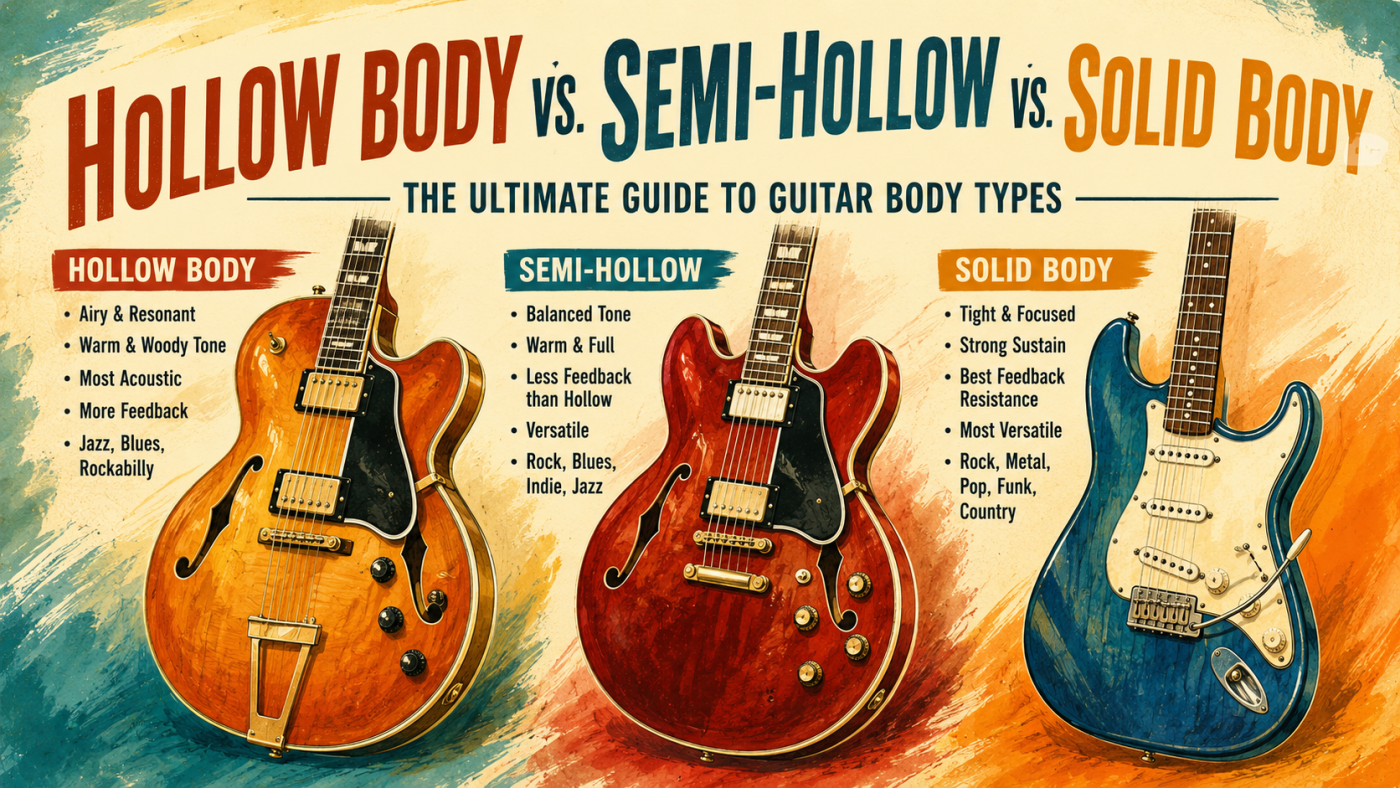
When choosing an electric guitar, body construction is one of the most important design choices. It affects the guitar’s weight, resonance, feedback resistance, sustain, playing comfort, and overall sound character.
The three main electric guitar body types are:
Solid Body
Semi-Hollow Body
Hollow Body
Each one has a different construction style and a different playing personality. Solid body guitars are the most common and versatile. Semi-hollow guitars offer a balance between electric guitar stability and acoustic-like resonance. Hollow body guitars provide the most open and airy response, but they can be more sensitive to feedback.
There is no single best body type for every player. The right choice depends on your music style, tone preference, volume level, stage needs, and how you want the guitar to feel in your hands.
This guide explains the differences between hollow body, semi-hollow, and solid body guitars, including construction, tone, feedback, sustain, weight, common music styles, and which one you should choose.
What Is a Solid Body Guitar?
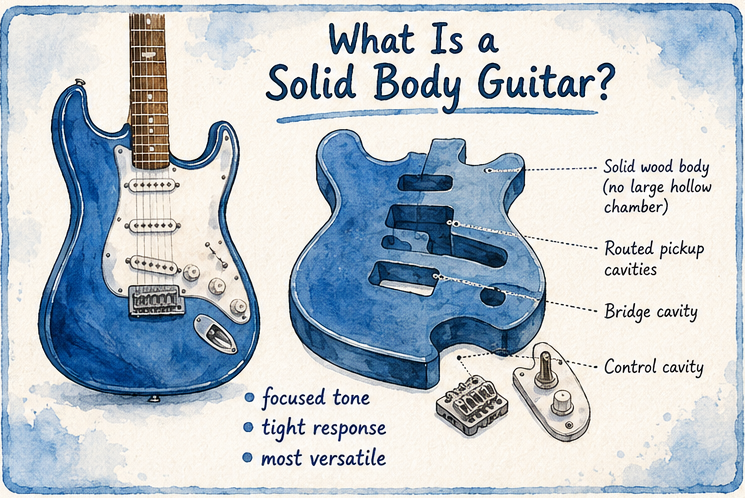
A solid body guitar is made from a solid piece or joined pieces of wood. Unlike hollow or semi-hollow guitars, it does not have a large internal air chamber designed to resonate acoustically.
Most electric guitars are solid body guitars.
Common examples include S-style, T-style, LP-style, superstrat, offset, and many modern custom guitars.
A solid body guitar relies mainly on its pickups, strings, bridge, body wood, neck construction, scale length, and electronics to shape its amplified sound.
Solid body construction
A solid body guitar usually includes:
- A solid wooden body
- Routed pickup cavities
- Bridge and control cavities
- Bolt-on, set neck, or neck-through construction
- No large hollow acoustic chamber
- Optional weight relief or chambering in some models
Some solid body guitars may have small weight-relief chambers, but they are still generally considered solid body guitars if the body is not built like a true semi-hollow or hollow instrument.
Solid Body Guitar Tone and Feel
Solid body guitars are known for their focused, controlled, and versatile tone.
Because the body is solid, it usually produces less acoustic resonance than hollow designs. This can make the guitar sound tighter, more direct, and more resistant to feedback at high volume.
Solid body guitars often feel:
- Focused
- Tight
- Stable
- Controlled
- Sustaining
- Less feedback-prone
- Suitable for high gain
- Versatile across many genres
A solid body guitar can sound bright, warm, aggressive, smooth, or modern depending on pickups, wood, bridge, and amp settings.
This is one reason solid body guitars are the standard choice for many players.
Advantages of Solid Body Guitars
Solid body guitars are popular because they are practical and flexible.
Excellent feedback resistance
Solid body guitars handle high volume and distortion better than hollow designs. Because there is less acoustic resonance inside the body, they are less likely to produce uncontrollable feedback.
This makes them ideal for rock, metal, punk, modern worship, fusion, and loud stage playing.
Strong sustain
Many solid body guitars offer strong sustain, especially when paired with a stable bridge, good fretwork, proper setup, and quality hardware.
Versatility
A solid body guitar can work for almost any style depending on pickup configuration.
Single coils can give bright clean tones. Humbuckers can give thick rock and metal tones. P90s can give raw vintage character.
Easier to control
Solid body guitars usually feel predictable under stage conditions. They respond well to pedals, high-gain amps, and modern effects.
More durable for live use
Solid body guitars are usually less fragile than hollow body guitars. They are easier to transport and often more resistant to stage abuse.
Disadvantages of Solid Body Guitars
Solid body guitars are not perfect for every player.
Less acoustic resonance
Compared with hollow and semi-hollow guitars, solid body guitars usually feel less airy and less acoustically responsive when unplugged.
Can feel heavier
Some solid body guitars can be heavy, especially models with dense woods or thick bodies.
Less natural “open” character
Players looking for woody, airy, acoustic-like electric tones may prefer a semi-hollow or hollow body guitar.
Best Uses for Solid Body Guitars
Solid body guitars are best for players who want control, sustain, reliability, and versatility.
Solid body guitars are especially good for:
- Rock
- Metal
- Punk
- Pop
- Funk
- Country
- Blues
- Fusion
- Modern worship
- High-gain playing
- Live performance
- Recording with pedals and effects
- Players who want maximum versatility
If you need one guitar that can handle many styles and stage situations, a solid body guitar is usually the safest choice.
What Is a Semi-Hollow Guitar?
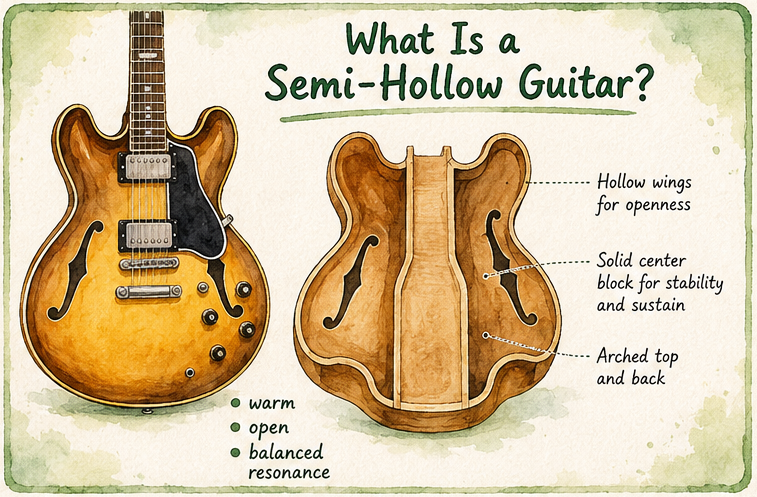
A semi-hollow guitar has a partially hollow body, usually with internal chambers and a solid center block running through the middle.
The center block helps support the pickups and bridge while reducing feedback. The hollow wings on the sides add resonance, air, and a more open feel.
Semi-hollow guitars are often recognized by their f-holes, although not every semi-hollow guitar has visible f-holes.
Semi-hollow construction
A semi-hollow guitar usually includes:
- Hollow chambers inside the body
- A solid center block
- Top and back plates
- Often one or two f-holes
- Pickups mounted into the body or center block
- Bridge mounted over the center block
- Set neck construction in many traditional designs
The center block is the key feature that separates many semi-hollow guitars from fully hollow guitars.
Semi-Hollow Guitar Tone and Feel
Semi-hollow guitars are known for their warm, resonant, open, and balanced sound.
They usually have more acoustic character than solid body guitars but better feedback control than full hollow body guitars.
Semi-hollow guitars often feel:
- Warm
- Open
- Resonant
- Airy
- Dynamic
- Slightly woody
- More alive against the body
- More feedback-resistant than hollow bodies
A semi-hollow guitar can still work well with overdrive, blues tones, classic rock, indie textures, and warm clean sounds.
It sits between the focused control of a solid body and the acoustic openness of a hollow body.
Advantages of Semi-Hollow Guitars
Semi-hollow guitars are popular because they offer a useful balance.
More resonance than a solid body
The hollow chambers add air and warmth to the guitar’s feel. Many players describe semi-hollow guitars as more “alive” or more responsive.
Better feedback control than hollow body guitars
The center block helps reduce feedback, making semi-hollow guitars more stage-friendly than full hollow body guitars.
Great for clean and overdriven tones
Semi-hollow guitars sound excellent clean, but they can also handle moderate gain very well.
They are especially loved for blues, classic rock, jazz fusion, indie, and alternative music.
Comfortable weight
Many semi-hollow guitars are lighter than comparable solid body guitars, depending on construction and wood choice.
Visually elegant
Semi-hollow guitars often have a classic and premium appearance, especially with f-holes, binding, figured tops, and transparent finishes.
Disadvantages of Semi-Hollow Guitars
Semi-hollow guitars also have some limitations.
More feedback than solid body guitars
Although they control feedback better than hollow bodies, semi-hollow guitars can still feed back at high volume or high gain.
Less tight for metal
Semi-hollow guitars can work for some heavier music, but they are generally not the first choice for tight modern metal tones.
Larger body size
Many traditional semi-hollow guitars have larger bodies, which may feel less comfortable for some players.
More delicate construction
Semi-hollow guitars can be more complex to build and sometimes more fragile than solid body guitars.
Best Uses for Semi-Hollow Guitars
Semi-hollow guitars are excellent for players who want warmth, resonance, and versatility without giving up too much control.
Semi-hollow guitars are especially good for:
- Blues
- Jazz fusion
- Classic rock
- Indie
- Alternative
- Soul
- R&B
- Worship
- Roots rock
- Clean tones
- Edge-of-breakup tones
- Players who want warmth with definition
If you want a guitar that feels more open than a solid body but still works well on stage, a semi-hollow guitar is a great choice.
What Is a Hollow Body Guitar?
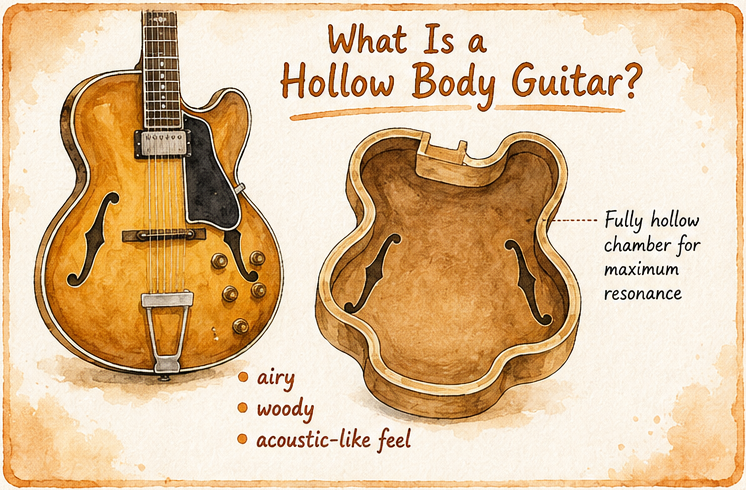
A hollow body guitar has a fully hollow body with no solid center block running through the middle.
It is closer in construction to an acoustic guitar than a solid body electric guitar. The body chamber allows the guitar to resonate more naturally and produce a fuller acoustic character.
Hollow body guitars are commonly associated with jazz, swing, blues, rockabilly, and vintage electric guitar tones.
Hollow body construction
A hollow body guitar usually includes:
- A fully hollow internal body chamber
- Arched or laminated top and back
- F-holes or soundholes
- Floating or fixed bridge design
- Pickups mounted to the top, pickguard, or body
- Larger body size in many traditional models
- Usually set neck construction
A hollow body guitar can often produce a louder unplugged sound than a solid body or semi-hollow guitar.
Hollow Body Guitar Tone and Feel
Hollow body guitars are known for their warm, airy, woody, and acoustic-like tone.
They have the most natural body resonance of the three main electric guitar types. Notes can feel softer, rounder, and more open.
Hollow body guitars often feel:
- Warm
- Airy
- Woody
- Open
- Resonant
- Smooth
- Dynamic
- Acoustic-like
- Responsive to touch
A hollow body guitar is excellent when you want a natural, rich, and expressive electric tone.
However, this extra resonance also makes hollow body guitars more prone to feedback.
Advantages of Hollow Body Guitars
Hollow body guitars have a unique voice that many players love.
Rich acoustic resonance
Hollow bodies have the most natural acoustic character among electric guitars. They feel alive and responsive.
Warm clean tone
A hollow body guitar can produce a beautiful clean tone, especially with humbuckers or P90s.
Excellent for jazz
Hollow body guitars are strongly associated with jazz because of their warm, rounded tone and smooth response.
Great vintage character
For swing, rockabilly, blues, roots music, and old-school rock and roll, hollow body guitars provide a distinctive classic sound.
Lightweight feel
Many hollow body guitars are physically large but relatively light because of the hollow chamber.
Disadvantages of Hollow Body Guitars
Hollow body guitars are expressive, but they require more control.
More feedback-prone
The biggest disadvantage is feedback. At high volume or with heavy gain, the hollow chamber can resonate uncontrollably.
This is why hollow bodies are less common in metal and high-gain rock.
Less sustain and tightness than solid bodies
Hollow bodies often have a softer attack and more acoustic decay. Some players love this, but others may prefer the tighter sustain of a solid body.
Larger body size
Many hollow body guitars are large, which may feel uncomfortable for smaller players or players used to compact solid bodies.
More delicate
Hollow body guitars can be more sensitive to impact, humidity, and construction issues than solid body guitars.
Best Uses for Hollow Body Guitars
Hollow body guitars are best for players who want warmth, openness, and vintage acoustic-like electric tone.
Hollow body guitars are especially good for:
- Jazz
- Swing
- Blues
- Rockabilly
- Roots music
- Vintage rock and roll
- Warm clean tones
- Low-gain playing
- Players who want acoustic-like resonance
- Studio tones with natural warmth
If you play mostly clean or low-gain music and want a rich, open sound, a hollow body guitar can be inspiring.
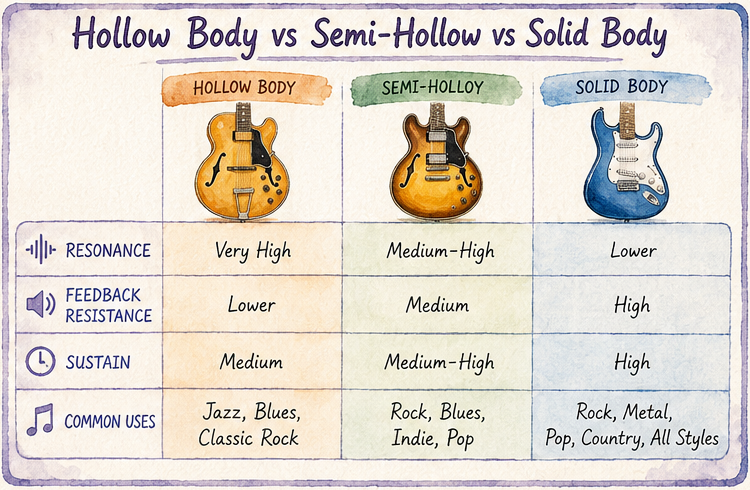
Hollow Body vs Semi-Hollow vs Solid Body: Main Differences
The biggest difference between these guitars is how much of the body is hollow and how much resonance the body produces.
Feature | Solid Body | Semi-Hollow | Hollow Body |
|---|---|---|---|
Body construction | Solid wood body | Hollow wings with center block | Fully hollow body |
Resonance | Focused and controlled | Warm and open | Airy and acoustic-like |
Feedback resistance | Best | Medium | Lowest |
Sustain | Strong and controlled | Balanced | Softer, more acoustic decay |
Weight | Can be heavier | Often moderate/light | Often light but large |
Best for high gain | Excellent | Moderate | Limited |
Clean tone | Clear and direct | Warm and lively | Warm and woody |
Common styles | Rock, metal, pop, blues | Blues, jazz fusion, indie, classic rock | Jazz, swing, blues, rockabilly |
Stage reliability | Highest | Good | Needs more control |
Simple summary:
Solid Body = control, sustain, high-gain stability
Semi-Hollow = resonance, warmth, balanced versatility
Hollow Body = openness, acoustic character, vintage warmth
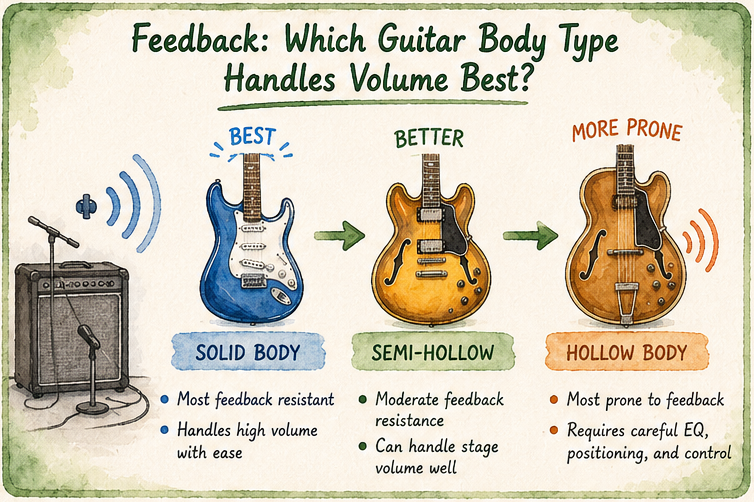
Feedback: Which Guitar Body Type Handles Volume Best?
Feedback is one of the biggest practical differences between solid, semi-hollow, and hollow body guitars.
Solid body feedback resistance
Solid body guitars are the best for high volume and high gain. They are the least likely to produce uncontrolled body feedback.
Semi-hollow feedback resistance
Semi-hollow guitars can handle moderate volume and gain well, especially because of the center block. However, they may still feed back earlier than solid bodies.
Hollow body feedback resistance
Hollow body guitars are the most feedback-prone. At loud stage volume or with distortion, the body chamber can resonate strongly and create feedback.
Feedback resistance ranking
Best to lowest:
Solid Body → Semi-Hollow → Hollow Body
If you play loud rock or metal, solid body is usually the safest choice.
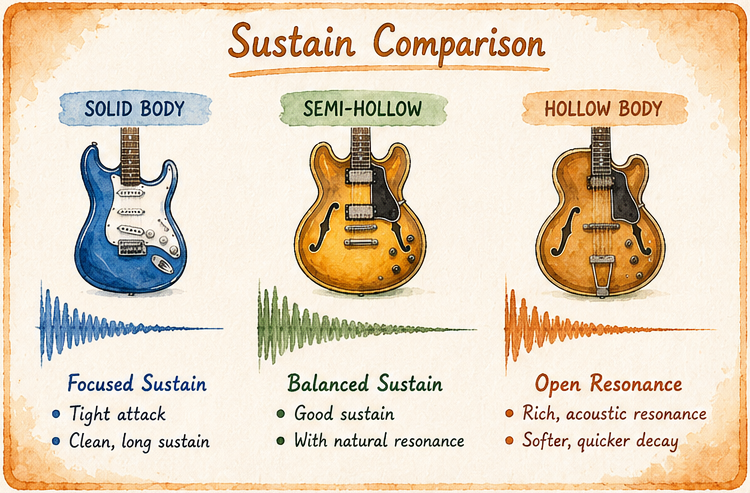
Sustain Comparison
Sustain depends on many factors, but body construction can influence the feel of note decay.
Solid body sustain
Solid body guitars often provide strong, focused sustain. Notes can feel stable and controlled.
Semi-hollow sustain
Semi-hollow guitars offer a balance between sustain and resonance. Notes may feel lively and open while still retaining decent sustain.
Hollow body sustain
Hollow body guitars often have a more acoustic-style decay. Notes may bloom and resonate, but they may not feel as tight or sustaining as solid body guitars.
Sustain summary
Solid Body = focused sustain
Semi-Hollow = balanced sustain and resonance
Hollow Body = open resonance with softer decay
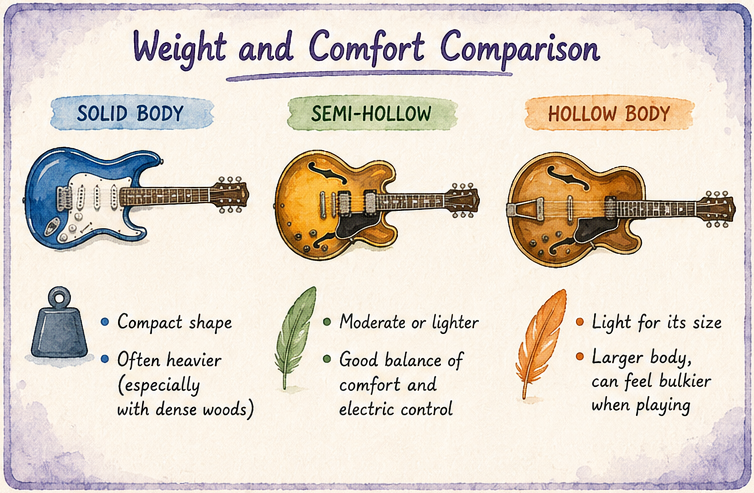
Weight and Comfort Comparison
Body construction also affects weight and comfort.
Solid body weight
Solid body guitars can range from light to heavy depending on body wood and thickness. Some are very comfortable, while others can be tiring during long performances.
Semi-hollow weight
Semi-hollow guitars are often lighter than solid bodies because of the internal chambers. However, some semi-hollow models have larger bodies.
Hollow body weight
Hollow body guitars are often light for their size, but their large body shape may feel bulky to some players.
Comfort summary
- Choose solid body for compact body options
- Choose semi-hollow for lighter weight with electric control
- Choose hollow body for large, resonant, lightweight feel
Comfort depends on both weight and body size.
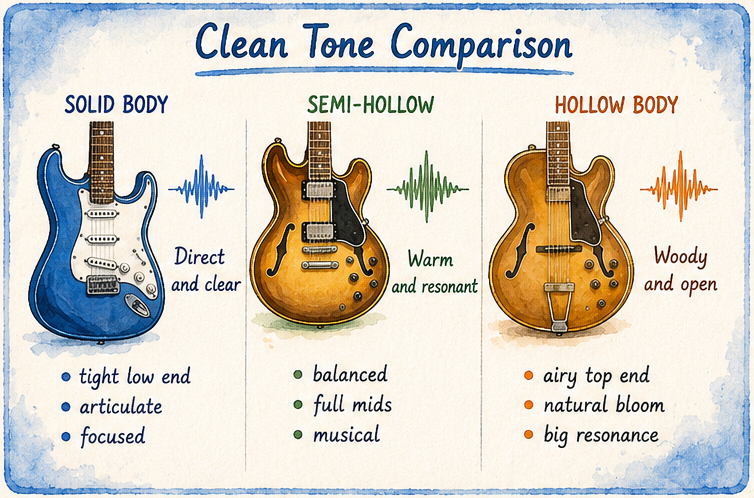
Clean Tone Comparison
Clean tones reveal the body type differences clearly.
Solid body clean tone
Solid body clean tones are usually focused, direct, and controlled. They work well for pop, funk, country, blues, and modern clean sounds.
Semi-hollow clean tone
Semi-hollow clean tones are warm, lively, and slightly airy. They can sound more dimensional than many solid bodies.
Hollow body clean tone
Hollow body clean tones are warm, woody, and open. They can feel the most acoustic-like and natural.
Clean tone summary
Solid Body = direct and clear
Semi-Hollow = warm and resonant
Hollow Body = woody and open
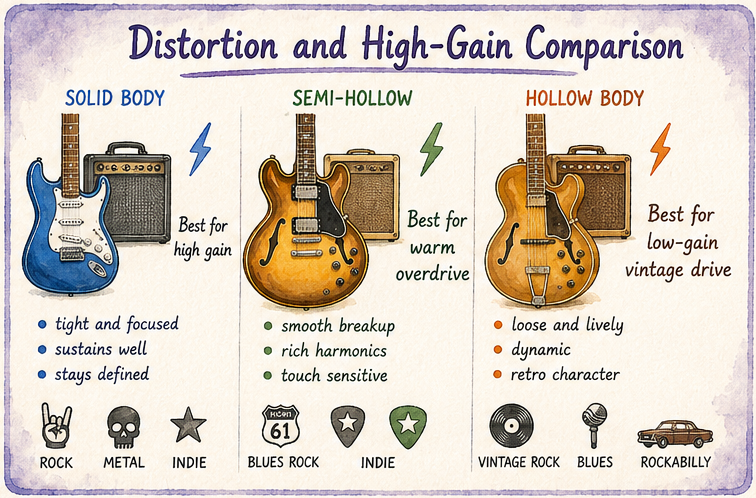
Distortion and High-Gain Comparison
With overdrive or distortion, body type becomes very important.
Solid body with distortion
Solid body guitars usually handle distortion the best. They stay tight, controlled, and feedback-resistant.
Best for:
- Rock
- Metal
- Punk
- Hard rock
- Modern high-gain tones
Semi-hollow with distortion
Semi-hollow guitars can sound excellent with overdrive. They are especially good for blues rock, classic rock, indie, and alternative.
They may become harder to control with heavy distortion.
Best for:
- Blues rock
- Classic rock
- Indie rock
- Alternative
- Edge-of-breakup tones
Hollow body with distortion
Hollow body guitars can sound amazing with light overdrive, but high gain can create feedback quickly.
Best for:
- Vintage blues
- Rockabilly
- Roots rock
- Low-gain drive
- Warm lead tones
Distortion summary
Solid Body = best for high gain
Semi-Hollow = best for warm overdrive
Hollow Body = best for low-gain vintage drive
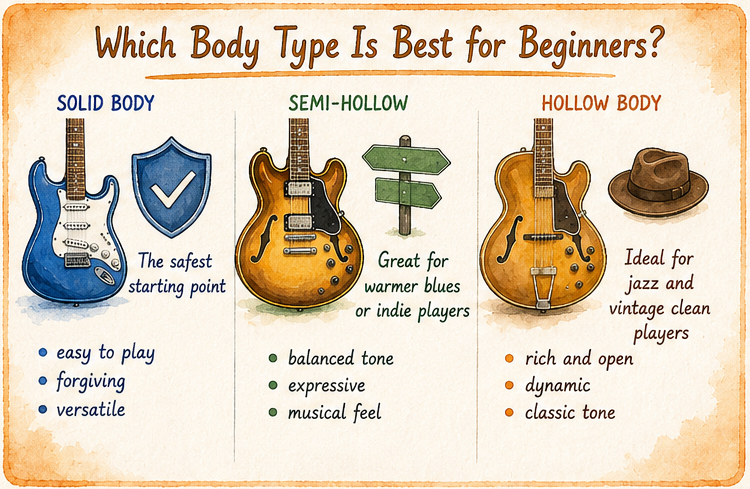
Which Body Type Is Best for Beginners?
For most beginners, a solid body guitar is usually the most practical choice.
Solid body guitars are more common, easier to control, less feedback-prone, and available in many affordable models.
However, beginners who love jazz, blues, or vintage tones may enjoy a semi-hollow or hollow body guitar.
Best beginner choice
Choose solid body if:
- You want maximum versatility
- You play rock, pop, metal, blues, or funk
- You want easy feedback control
- You want many affordable options
Choose semi-hollow if:
- You like blues, indie, jazz fusion, or classic rock
- You want warmer resonance
- You do not use heavy distortion often
Choose hollow body if:
- You mainly want jazz, swing, rockabilly, or warm clean tones
- You are comfortable with a larger body
- You do not need high-gain distortion
For most first electric guitars, solid body is the safest starting point.
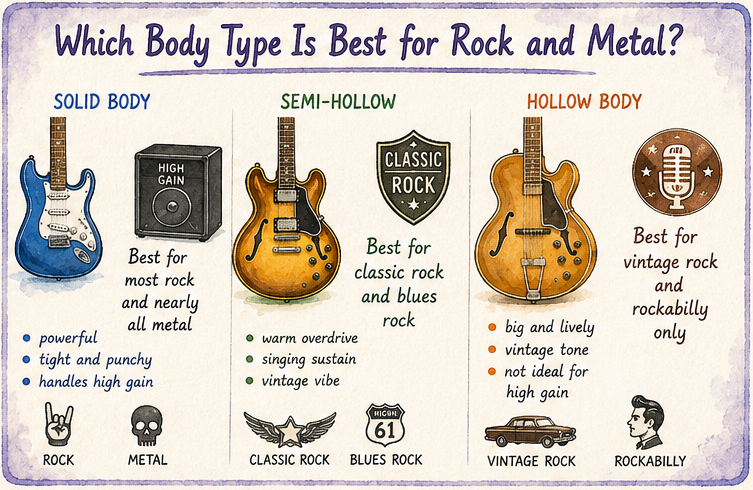
Which Body Type Is Best for Rock?
Rock can work with all three body types, but each gives a different flavor.
Solid body for rock
Solid body guitars are the most versatile rock choice. They handle distortion, power chords, high volume, and pedals very well.
Semi-hollow for rock
Semi-hollow guitars are excellent for classic rock, blues rock, indie rock, and alternative rock. They add warmth and resonance.
Hollow body for rock
Hollow bodies can work for vintage rock, rockabilly, and roots rock, but they are harder to control at high volume.
Best rock choice
For most rock players:
Solid Body or Semi-Hollow
Choose solid body for tighter, heavier rock. Choose semi-hollow for warmer, more open classic rock tones.
Which Body Type Is Best for Metal?
For metal, solid body guitars are usually the best choice.
Metal often requires tight low end, high-gain distortion, tuning stability, sustain, and feedback control. Solid body guitars handle these demands better than semi-hollow or hollow guitars.
Best metal choice
Choose solid body if you play:
- Metal
- Modern metal
- Progressive metal
- Djent
- Hard rock
- Drop tunings
- High-gain rhythm parts
Semi-hollow guitars can work for some experimental heavy styles, but they are not the standard choice. Hollow body guitars are usually not ideal for metal because of feedback.
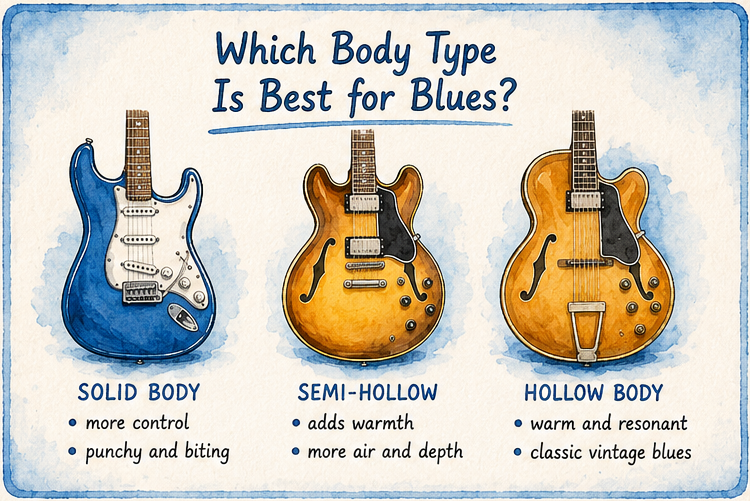
Which Body Type Is Best for Blues?
Blues works beautifully with all three body types.
Solid body for blues
Solid body guitars provide clear attack, sustain, and control. They work well for modern blues, Texas blues, and blues rock.
Semi-hollow for blues
Semi-hollow guitars are one of the best choices for blues. They offer warmth, resonance, and expressive response while still controlling feedback better than hollow bodies.
Hollow body for blues
Hollow body guitars are excellent for warm, vintage blues and low-gain expressive playing.
Best blues choice
For most blues players:
Semi-Hollow or Solid Body
Choose semi-hollow for warmth and air. Choose solid body for control and bite.
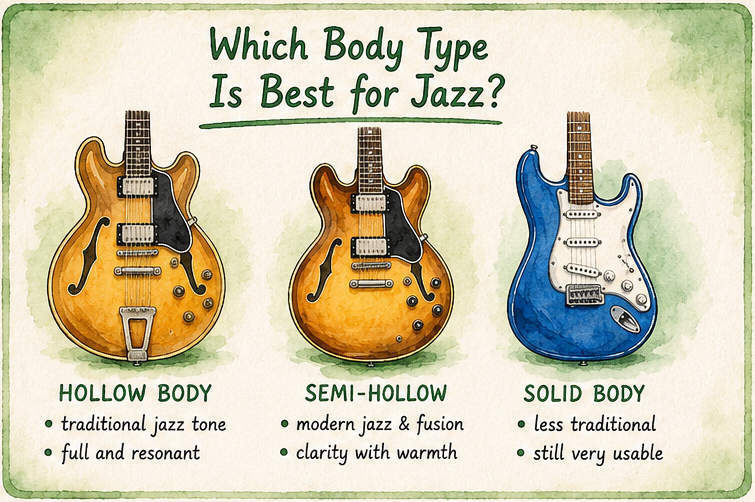
Which Body Type Is Best for Jazz?
Jazz players often prefer hollow body or semi-hollow guitars.
Hollow body for jazz
Hollow body guitars are the classic jazz choice. They provide warm, rounded, acoustic-like clean tones.
Semi-hollow for jazz
Semi-hollow guitars are great for jazz players who want warmth but also need better feedback control and more versatility.
Solid body for jazz
Solid bodies can work for jazz, especially with warm humbuckers, but they are less traditional.
Best jazz choice
For traditional jazz:
Hollow Body
For modern jazz, fusion, or stage flexibility:
Semi-Hollow
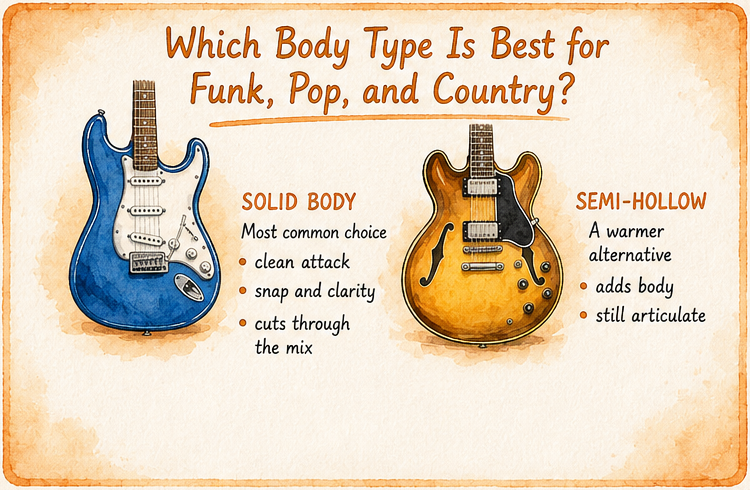
Which Body Type Is Best for Funk, Pop, and Country?
For funk, pop, and country, solid body guitars are usually the most common choice.
These styles often need clean attack, clarity, snap, and strong note separation.
Solid body
Best for:
- Funk rhythm
- Country twang
- Pop clean parts
- Tight rhythm playing
- Studio versatility
Semi-hollow
Can work well if you want more warmth and resonance, especially for soul, R&B, and roots pop.
Hollow body
Less common for modern funk and pop, but useful for vintage-style tones.
Best choice
For most funk, pop, and country players:
Solid Body
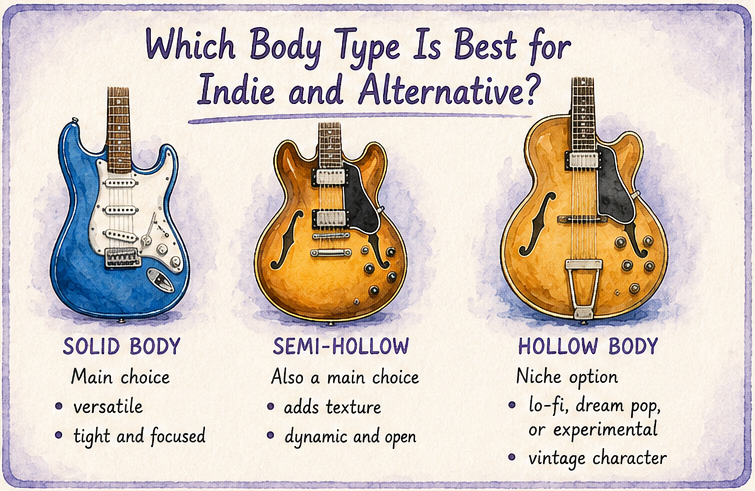
Which Body Type Is Best for Indie and Alternative?
Indie and alternative players often use both solid body and semi-hollow guitars.
Solid body for indie
Solid bodies are great for jangly clean tones, effects-heavy sounds, and flexible stage use.
Semi-hollow for indie
Semi-hollow guitars are popular for indie because they add warmth, character, and visual style.
Hollow body for indie
Hollow bodies can work for lo-fi, vintage, dream pop, and experimental sounds, but feedback must be controlled.
Best choice
For indie and alternative:
Solid Body or Semi-Hollow
Semi-hollow guitars are especially good if you want a more atmospheric and character-rich sound.
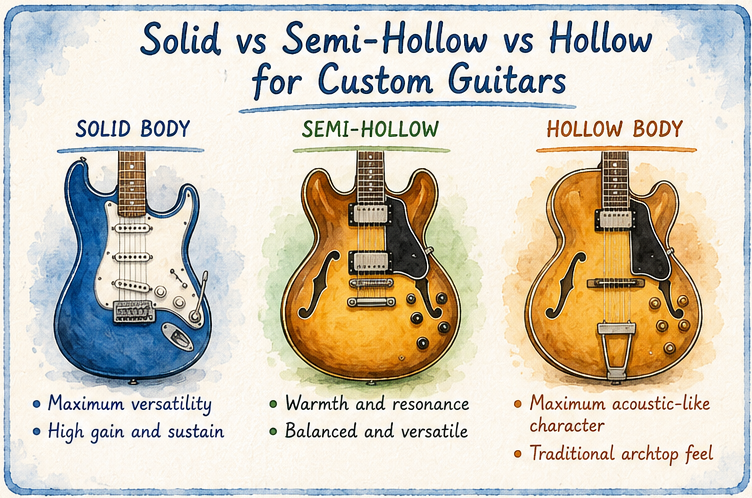
Hollow Body vs Semi-Hollow vs Solid Body for Custom Guitars
If you are designing a custom guitar, body construction should match the purpose of the instrument.
Choose solid body for a custom guitar if:
- You want maximum versatility
- You use high gain
- You want strong feedback resistance
- You play rock, metal, pop, funk, or modern styles
- You want a compact and durable design
- You want more pickup and bridge flexibility
Choose semi-hollow for a custom guitar if:
- You want warmth and resonance
- You want a lighter body
- You play blues, indie, jazz fusion, or classic rock
- You want f-holes or chambered visual style
- You want a balance between acoustic character and electric control
Choose hollow body for a custom guitar if:
- You want maximum acoustic-like resonance
- You play jazz, swing, rockabilly, or vintage blues
- You mostly use clean or low-gain tones
- You want a traditional archtop-inspired design
- You are comfortable managing feedback
Custom guitars allow you to choose the body type that fits your real playing needs, not just the appearance.
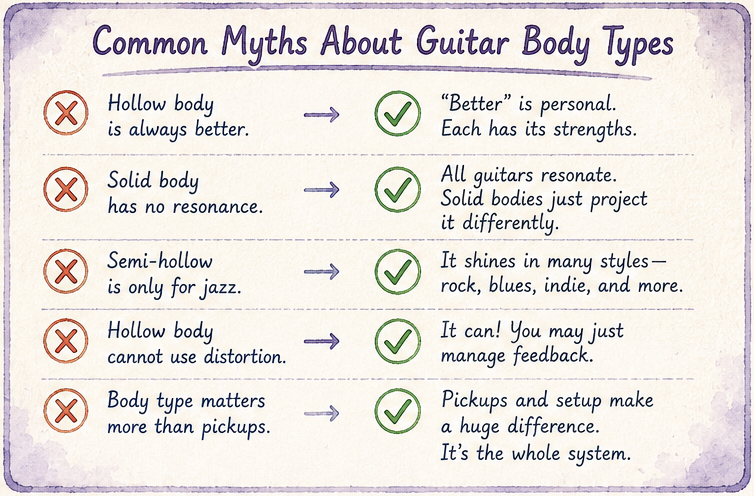
Common Myths About Guitar Body Types
Myth 1: Hollow body guitars are always better for tone
Hollow body guitars have a beautiful resonant sound, but they are not better for every style. For high-gain rock or metal, solid body guitars are usually more practical.
Myth 2: Solid body guitars have no resonance
Solid body guitars still resonate. They simply resonate differently and are more controlled than hollow designs.
Myth 3: Semi-hollow guitars are only for jazz
Semi-hollow guitars are used in blues, rock, indie, alternative, worship, soul, and many other styles.
Myth 4: Hollow body guitars cannot use distortion
They can use overdrive and distortion, but feedback control becomes more important.
Myth 5: Body type matters more than pickups
Body type matters, but pickups have a huge effect on amplified tone. A hollow body with bright pickups can sound very different from a hollow body with warm humbuckers.
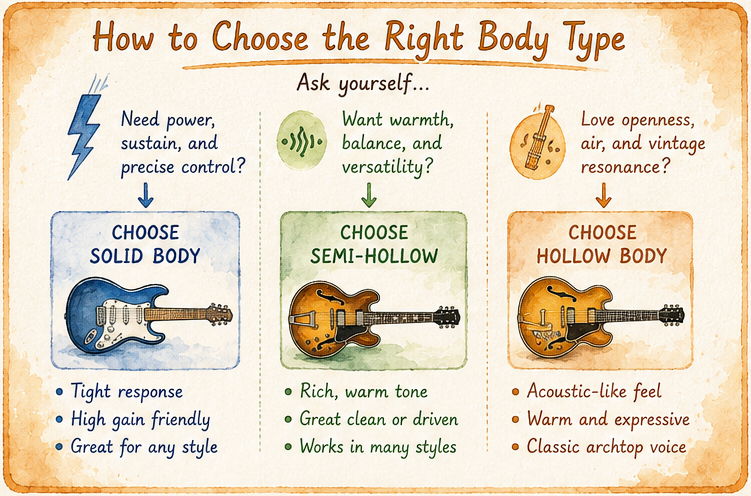
How to Choose the Right Body Type
Choose based on your music, volume level, and preferred feel.
Choose Solid Body if you want:
- Maximum versatility
- High-gain compatibility
- Feedback resistance
- Strong sustain
- Compact body options
- Rock, metal, pop, funk, country, or modern tones
- Easy live performance control
Choose Semi-Hollow if you want:
- More resonance
- Warm clean tones
- Balanced feedback control
- Classic rock, blues, indie, jazz fusion, or alternative tones
- Lighter body feel
- A more open response than solid body
Choose Hollow Body if you want:
- Warm acoustic-like resonance
- Traditional jazz tone
- Vintage blues or rockabilly character
- Open and woody clean sounds
- A large resonant body feel
- Low-gain expressive playing
Simple summary:
Need power and control? Choose solid body.
Want warmth and versatility? Choose semi-hollow.
Want openness and vintage resonance? Choose hollow body.
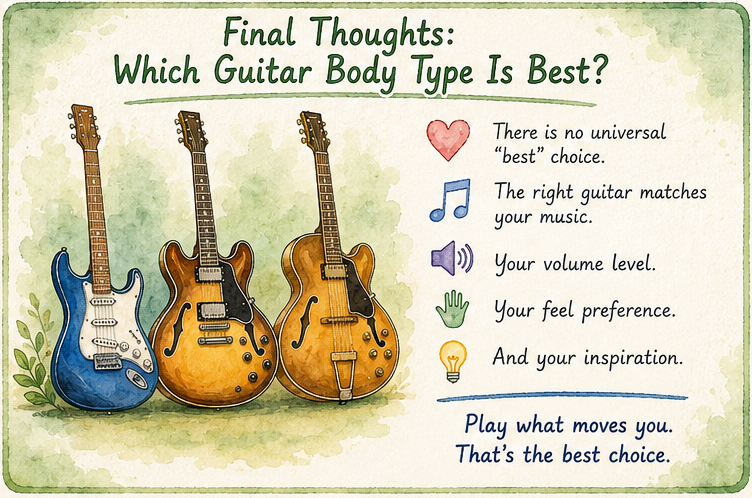
Which Guitar Body Type Is Best?
Solid body, semi-hollow, and hollow body guitars each offer a different playing experience.
A solid body guitar is focused, controlled, durable, and versatile. It is the best choice for high gain, modern playing, rock, metal, funk, pop, country, and players who need reliability.
A semi-hollow guitar is warm, resonant, expressive, and balanced. It is ideal for blues, classic rock, indie, jazz fusion, and players who want more acoustic character without losing too much control.
A hollow body guitar is open, woody, airy, and vintage-inspired. It is perfect for jazz, swing, rockabilly, warm blues, and players who love natural resonance and clean tones.
There is no universal best choice. The right guitar is the one that supports your music, feels comfortable in your hands, and inspires you to play more.
If you want one guitar for almost everything, choose a solid body. If you want character and warmth with stage usability, choose a semi-hollow. If you want classic resonance and expressive clean tone, choose a hollow body.