

Guitar Care & Maintenance
How Humidity Affects Guitars: A Complete Guide to Guitar Humidity Control

Humidity is one of the most important environmental factors that affects guitars. Many players think guitar care is only about changing strings, cleaning the body, or keeping the instrument in tune. However, the air around your guitar can slowly change how it feels, plays, and sounds.
Because guitars are made largely from wood, they naturally react to moisture in the air. When the air is too dry, wood can shrink. When the air is too humid, wood can swell. These changes may affect the neck, fretboard, body, finish, action, tuning stability, fret ends, glue joints, and overall playability.
Humidity problems are especially important for acoustic guitars, hollow body guitars, semi-hollow guitars, and guitars with thin finishes. But electric guitars can also be affected, especially if they have wooden necks, unfinished fretboards, natural finishes, or are stored in unstable conditions.
Understanding how humidity affects guitars can help you prevent serious damage and keep your instrument playing its best.
What Is Humidity?
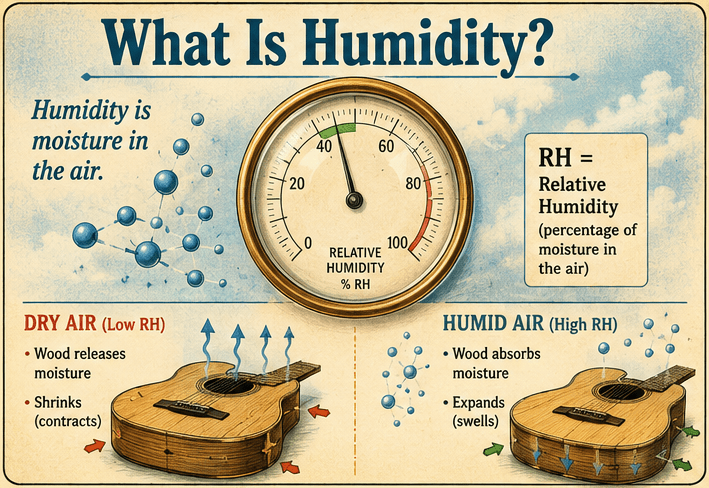
Humidity refers to the amount of moisture in the air. When people talk about guitar care, they usually refer to relative humidity, often written as RH.
Relative humidity tells you how much moisture is in the air compared with how much moisture the air can hold at a specific temperature.
For guitars, humidity matters because wood absorbs and releases moisture depending on the surrounding air.
If the air is dry, wood releases moisture and shrinks.
If the air is humid, wood absorbs moisture and expands.
This movement may be very small, but guitars are precise instruments. Even a small change in wood shape can affect the way the guitar plays.
Why Guitars React to Humidity
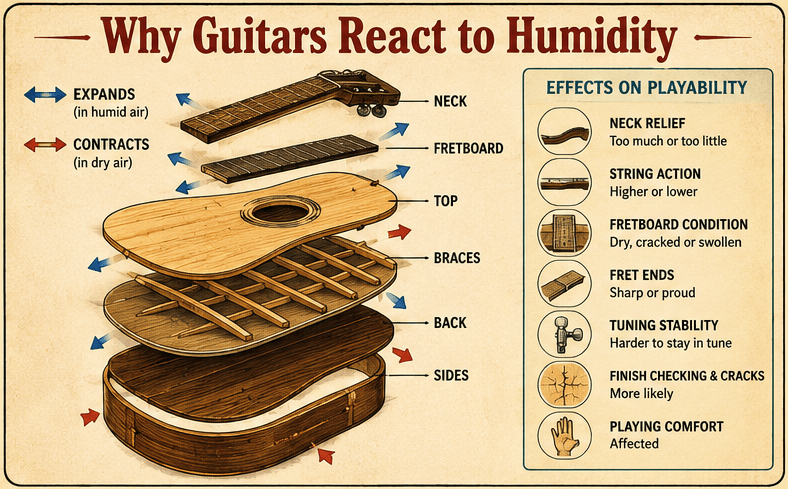
Wood is a natural material. Even after it has been cut, dried, shaped, finished, and turned into a guitar, it still reacts to environmental changes.
A guitar neck, body, fretboard, top, back, sides, and braces can all expand or contract depending on moisture levels.
Humidity can affect:
- Neck relief
- String action
- Fretboard condition
- Fret ends
- Tuning stability
- Acoustic top movement
- Finish checking
- Glue joints
- Body resonance
- Bridge stability
- Cracks in the wood
- Overall playing comfort
Solid body electric guitars are usually more stable than acoustic guitars, but they are not immune. The neck and fretboard can still move, and unfinished wood can still dry out or swell.
The Ideal Humidity Range for Guitars
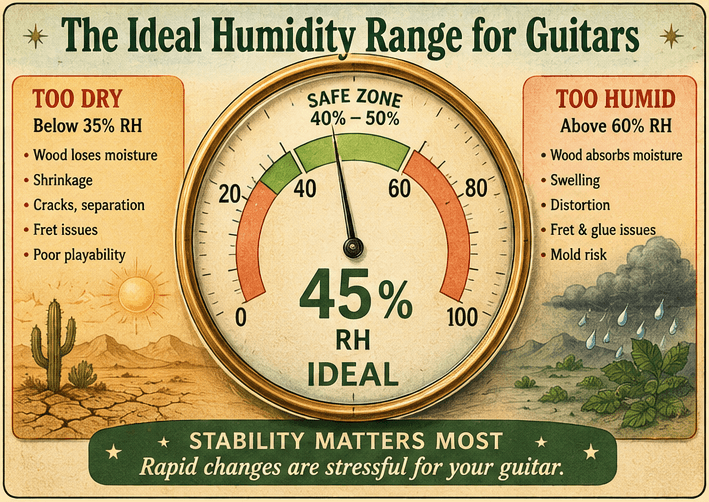
A safe general humidity range for most guitars is around:
40% to 50% relative humidity
Some guitars may tolerate slightly wider conditions, such as 45% to 55%, but extreme dryness or extreme humidity should be avoided.
A good practical target is:
45% RH
This is a balanced range where wood is usually stable, comfortable, and less likely to shrink or swell too much.
If humidity regularly drops below 35%, your guitar may become too dry.
If humidity regularly rises above 60%, your guitar may become too humid.
The key is not only the number itself, but also stability. Rapid changes can be more stressful than slow seasonal changes.
What Happens When a Guitar Gets Too Dry?
Dry air can cause the wood to lose moisture and shrink. This is one of the most common causes of guitar damage, especially in cold climates, air-conditioned rooms, heated rooms, or very dry environments.
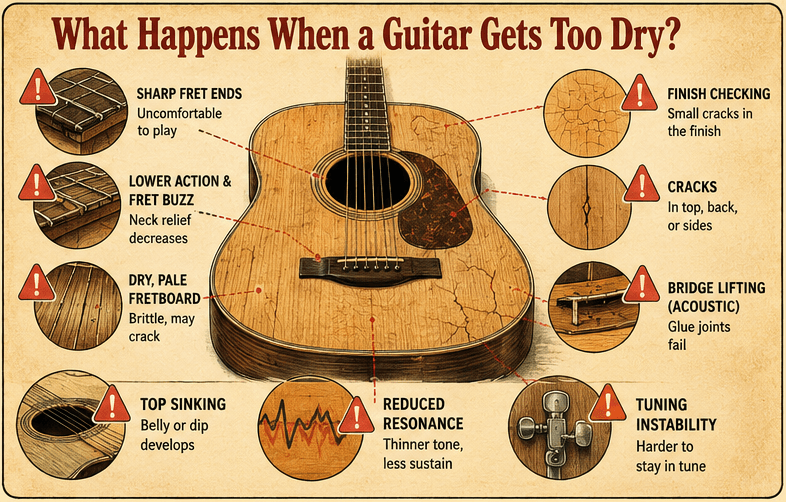
When a guitar becomes too dry, you may notice:
- Sharp fret ends
- Lower action
- Fret buzz
- Neck movement
- Dry or pale fretboard
- Cracks in the wood
- Finish checking
- Bridge lifting on acoustic guitars
- Top sinking on acoustic guitars
- Reduced resonance
- Tuning instability
Dryness can be especially dangerous because it may cause cracks that are difficult or expensive to repair.
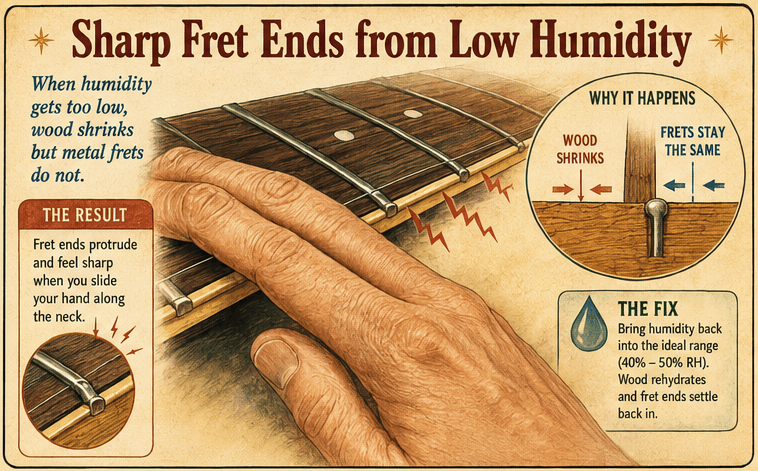
Sharp Fret Ends from Low Humidity
One of the most common signs of dryness is sharp fret ends.
When the fretboard wood loses moisture, it can shrink slightly. Metal frets do not shrink the same way wood does. As the fretboard becomes narrower, the fret ends may begin to stick out from the sides of the neck.
This can make the neck feel rough or uncomfortable when your hand slides along it.
Sharp fret ends are common in dry climates or during winter when indoor heating reduces humidity.
If the fret ends are only slightly sharp, humidifying the guitar may help the wood recover. If they remain sharp, a guitar technician may need to file and dress the fret ends.
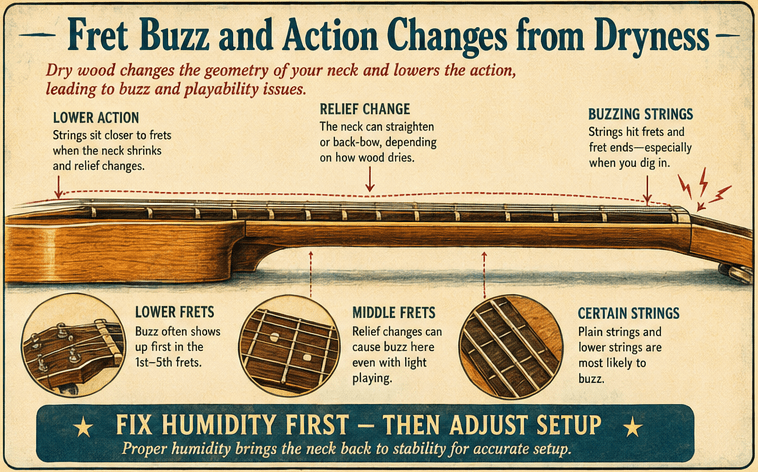
Fret Buzz and Action Changes from Dryness
Low humidity can also affect string action.
When the neck or body changes shape, the distance between strings and frets may change. On some guitars, dry conditions can cause the action to become lower, leading to fret buzz.
You may notice buzzing:
- Around the lower frets
- Around the middle frets
- On certain strings
- When playing harder
- After moving the guitar to a dry room
Sometimes the problem is not the frets themselves, but the neck relief changing due to dryness.
A setup adjustment may help, but if the guitar is too dry, correcting the humidity should come first.
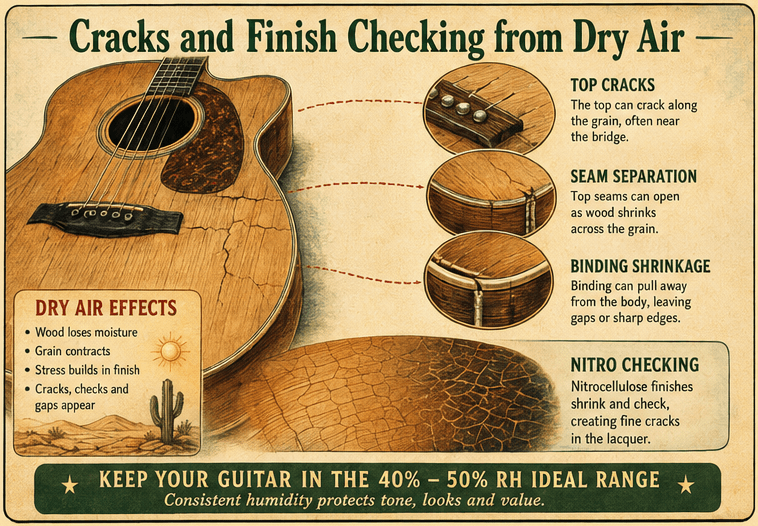
Cracks and Finish Checking from Dry Air
Serious dryness can cause wood cracks. This is especially common on acoustic guitars because the top, back, and sides are thinner and more responsive to humidity changes.
However, electric guitars can also develop finish cracks or checking if exposed to sudden temperature and humidity changes.
Dryness may cause:
- Small cracks near the bridge
- Cracks along the grain
- Finish checking lines
- Separation at seams
- Shrinking around binding
- Loose braces on acoustic guitars
Finish checking is especially common on nitrocellulose lacquer finishes. Some players like the vintage look of natural checking, but sudden checking caused by environmental shock is still a sign that the guitar experienced stress.
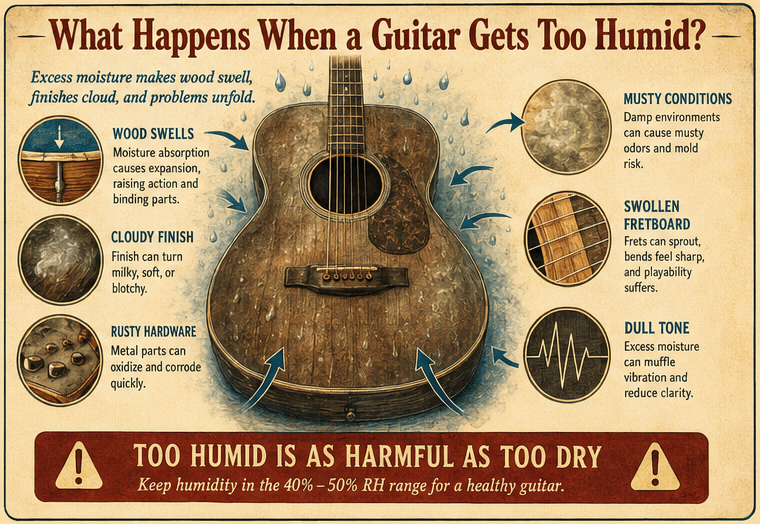
What Happens When a Guitar Gets Too Humid?
High humidity causes wood to absorb moisture and swell. This can make the guitar feel different and sometimes harder to play.
When a guitar becomes too humid, you may notice:
- Higher action
- Swollen neck or fretboard
- Dull or muted tone
- Sticky feel
- Tuning instability
- Cloudy finish
- Mold or musty smell
- Rust on strings and hardware
- Loose glue joints in extreme cases
- Acoustic top swelling
Humidity can also make metal parts corrode faster. Strings may rust quickly, screws may tarnish, and hardware may develop oxidation.
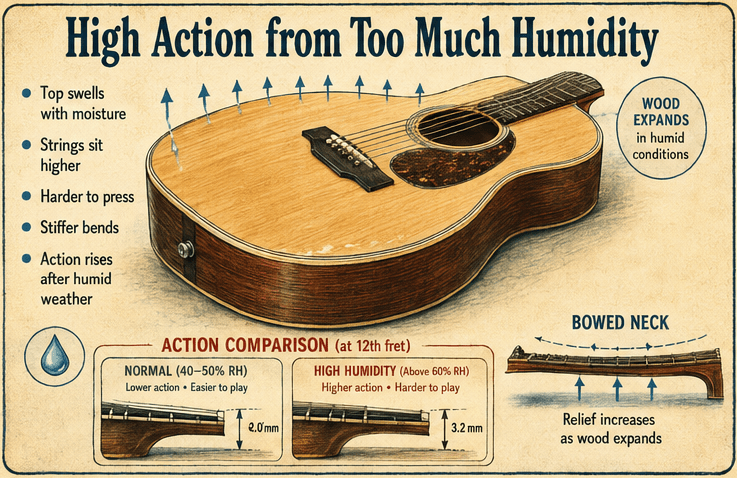
High Action from Too Much Humidity
One of the most common effects of high humidity is higher string action.
When wood absorbs moisture, the neck and body may expand or shift slightly. On acoustic guitars, the top can swell upward, raising the bridge and increasing string height.
On electric guitars, the neck relief may change, making the guitar feel harder to play.
Signs of humidity-related high action include:
- Strings feel harder to press
- Barre chords feel more difficult
- Bends feel stiffer
- The guitar feels different than usual
- Action rises after humid weather
- The neck looks more bowed than before
A setup can help, but if the guitar is overly humid, drying it to a stable range should come first.
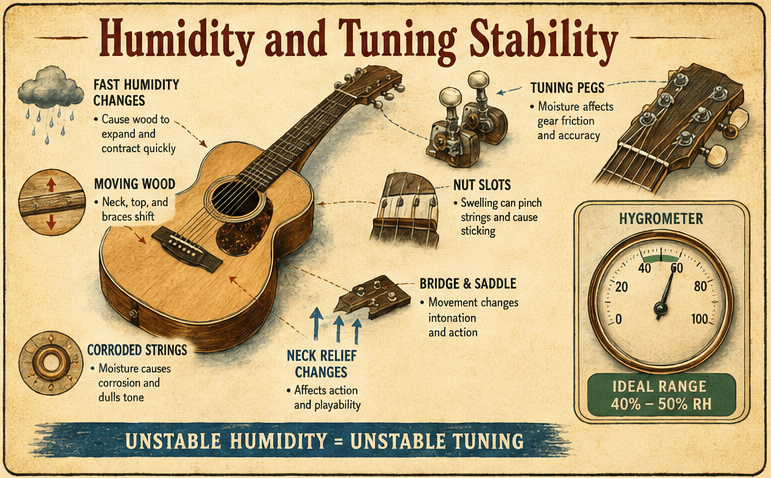
Humidity and Tuning Stability
Humidity changes can affect tuning stability because wood movement changes string tension, neck relief, and contact points.
Your guitar may go out of tune more often if:
- Humidity changes quickly
- The neck is moving
- The body is expanding or shrinking
- The fretboard is swelling or drying
- The bridge or nut is affected
- Strings are corroding faster
High humidity can also make strings age more quickly, which can make tuning less stable.
If your guitar suddenly refuses to stay in tune, check not only the tuners and strings, but also the environment.
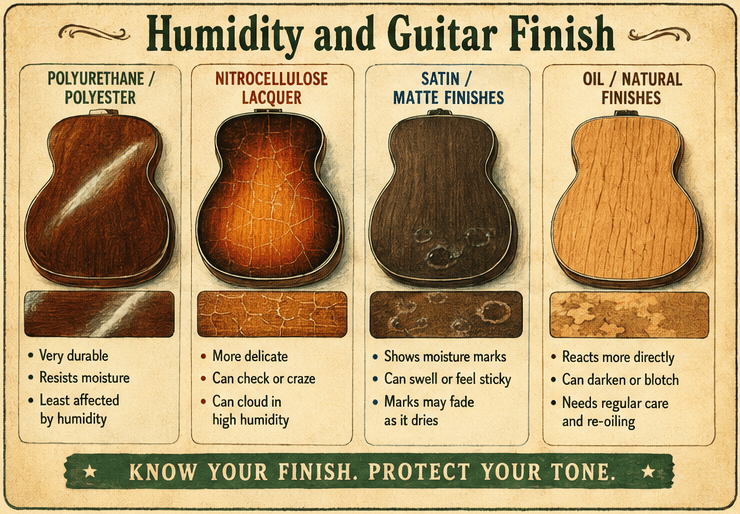
Humidity and Guitar Finish
The guitar finish protects the wood, but it does not make the instrument completely immune to humidity.
Different finishes react differently.
Polyurethane and polyester finishes
Poly finishes are durable and resistant to moisture. They protect the wood well, but the neck, fretboard, and unfinished areas can still react to humidity.
Nitrocellulose lacquer finishes
Nitro finishes are thinner and more delicate. They can show checking, clouding, or aging more easily when exposed to environmental changes.
Satin and matte finishes
Satin and matte finishes may show moisture marks, polishing changes, or uneven wear more easily than gloss finishes.
Oil and natural finishes
Natural finishes often provide less protection than thick gloss finishes. These guitars may react more directly to humidity changes.
Even with a strong finish, humidity control still matters.

Humidity and Acoustic Guitars
Acoustic guitars are usually more sensitive to humidity than solid body electric guitars.
This is because acoustic guitars have thin wooden tops, backs, sides, and internal braces. These parts are designed to vibrate, which also makes them more responsive to moisture changes.
Low humidity can cause:
- Top sinking
- Sharp fret ends
- Cracks
- Bridge lifting
- Lower action
- Buzzing
- Weak tone
High humidity can cause:
- Top swelling
- High action
- Dull tone
- Loose braces
- Mold or musty smell
- Finish clouding
If you own an acoustic guitar, humidity control is especially important.
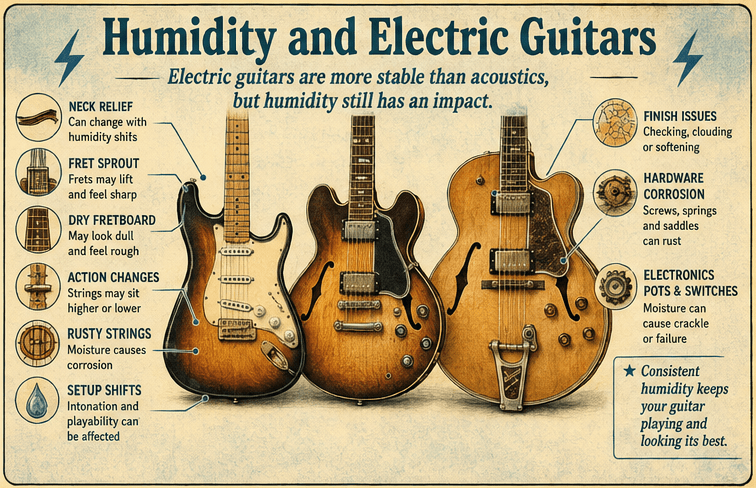
Humidity and Electric Guitars
Electric guitars are generally more stable than acoustic guitars, especially solid body models. However, they still have wooden necks, fretboards, and bodies.
Humidity can affect electric guitars by causing:
- Neck relief changes
- Fret sprout
- Fretboard dryness
- Action changes
- Tuning instability
- Rusty strings
- Corroded hardware
- Finish issues
- Setup changes
Semi-hollow and hollow body electric guitars may be more sensitive than solid body guitars because their bodies are thinner and more resonant.
If you own a custom guitar with natural wood, thin finish, ebony fretboard, rosewood fretboard, or figured wood top, stable humidity is still important.
How to Measure Humidity
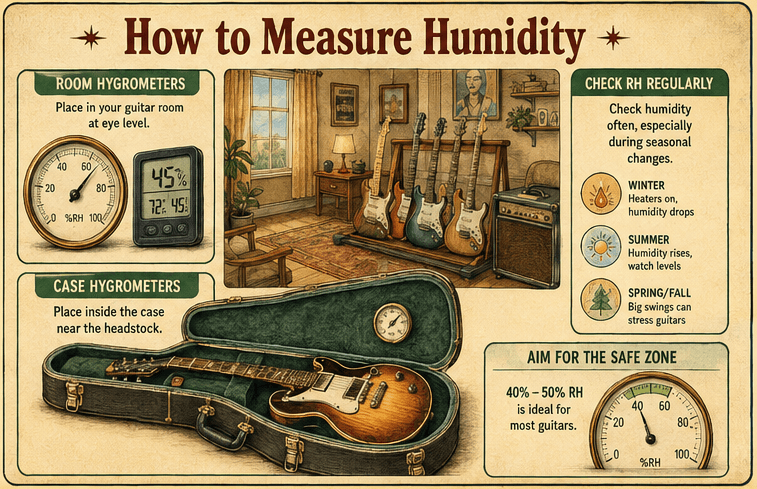
The easiest way to monitor humidity is with a hygrometer.
A hygrometer measures relative humidity. You can place one in your guitar room, inside your case, or near your guitar storage area.
There are two common options:
- Room hygrometer
- Case hygrometer
A room hygrometer is useful if you store multiple guitars in one space. A case hygrometer is useful if you keep a valuable guitar inside a hard case.
Check humidity regularly, especially during seasonal changes.
How to Protect Your Guitar from Low Humidity
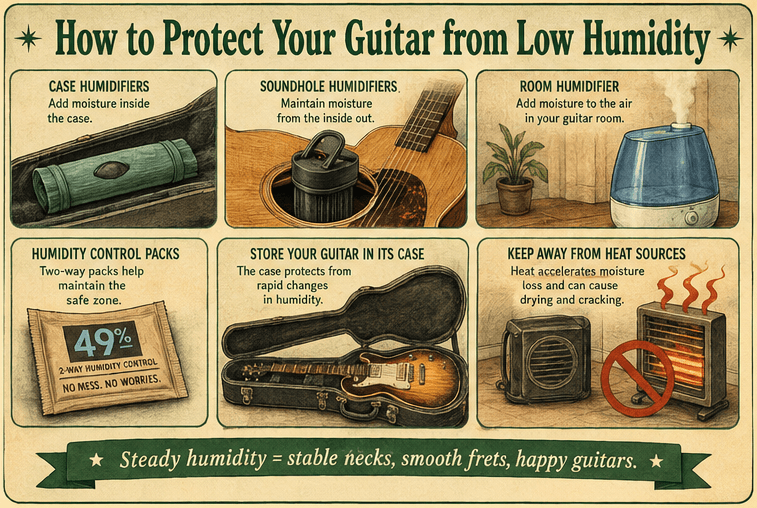
If your room is too dry, you need to add moisture carefully.
Useful options include:
- Case humidifier
- Soundhole humidifier for acoustic guitars
- Room humidifier
- Humidity control packs
- Storing the guitar in its case
- Avoiding heaters and air vents
- Monitoring with a hygrometer
For acoustic guitars, a case humidifier is often very helpful. For multiple guitars, a room humidifier may be more practical.
Do not over-humidify. Too much moisture can create a different set of problems.
How to Protect Your Guitar from High Humidity
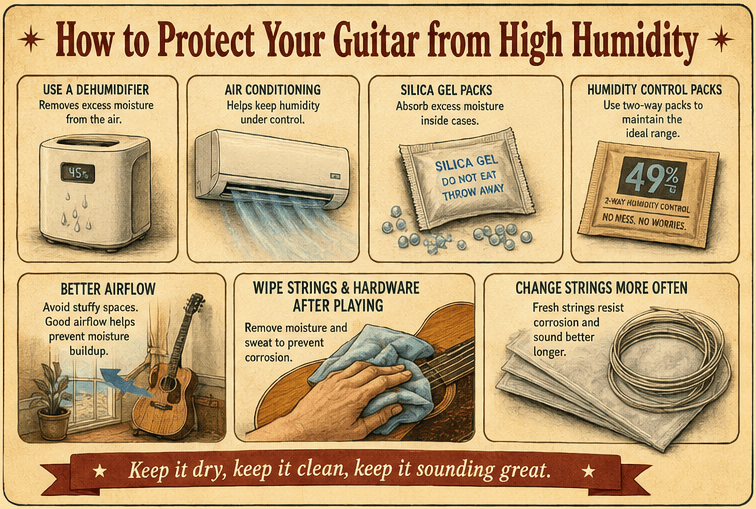
If your environment is too humid, you need to reduce moisture exposure.
Useful options include:
- Air conditioning
- Dehumidifier
- Silica gel packs
- Humidity control packs
- Keeping the guitar in a case
- Avoiding damp rooms
- Improving air circulation
- Wiping the guitar after playing
- Changing strings more often
In humid climates, hardware corrosion is also a major concern. Wipe strings, bridge, pickups, and tuners after playing to reduce sweat and moisture damage.

Should You Store Your Guitar in a Case or on a Stand?
A guitar stand is convenient, but a case provides better environmental protection.
A stand is good if:
- The room humidity is stable
- You play the guitar daily
- The guitar is not exposed to sunlight
- The stand is safe for the finish
- The room is clean and controlled
A case is better if:
- Humidity changes often
- The guitar is valuable
- The room is dry or humid
- You have pets or children
- The guitar has a nitro finish
- You will not play it for a while
For humidity control, a hard case with humidity packs is usually safer than leaving the guitar exposed.
Seasonal Humidity Changes
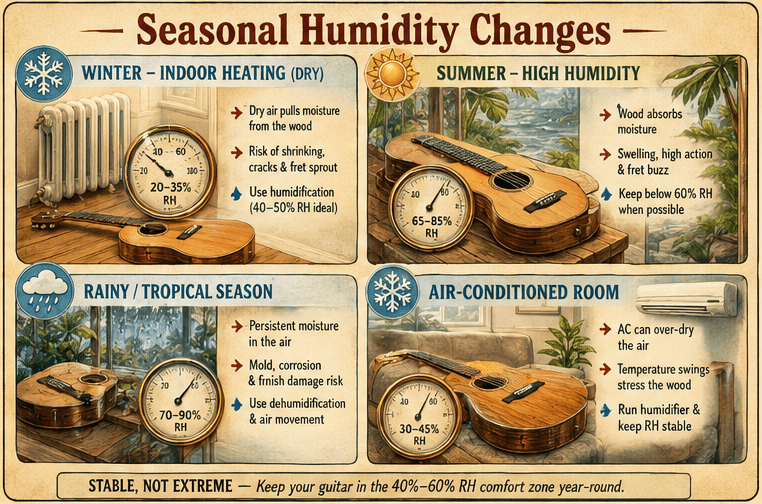
Many guitar issues happen during seasonal changes.
Winter
Indoor heating can make air very dry. This can cause fret sprout, cracks, buzzing, and dry fretboards.
Summer
Warm air can hold more moisture, and humidity may rise. This can cause swelling, high action, sticky feel, and corrosion.
Rainy season or tropical climates
High humidity can remain constant for long periods. Guitars may need dehumidification, frequent wiping, and careful storage.
Air-conditioned rooms
Air conditioning can reduce humidity, but depending on the environment, it may also create dryness or sudden temperature shifts.
The best approach is to monitor the actual humidity rather than guessing.

Humidity Control for Custom Guitars
Custom guitars often use selected woods, figured tops, natural finishes, exotic fretboards, and carefully shaped necks. Because of this, stable humidity is important for preserving both appearance and playability.
If you own a custom guitar, pay extra attention to:
- Figured maple tops
- Veneer or cap tops
- Ebony fretboards
- Rosewood fretboards
- Natural finishes
- Thin finishes
- Set neck or neck-through construction
- Hollow or semi-hollow construction
- Binding and inlays
A custom guitar is built with precision. Humidity control helps keep that precision stable.

Common Myths About Guitar Humidity
Myth 1: Electric guitars do not need humidity control
Electric guitars are usually more stable than acoustics, but they can still suffer from fret sprout, neck movement, dry fretboards, and finish issues.
Myth 2: A guitar finish completely seals the wood
A finish helps protect wood, but it does not make the guitar completely immune to environmental changes.
Myth 3: Humidity only matters in winter
Winter dryness is common, but summer humidity and tropical climates can also cause problems.
Myth 4: More humidity is always better than dryness
Too much humidity can cause swelling, high action, dull tone, corrosion, and mold.
Myth 5: A setup fixes all humidity problems
A setup can correct playability, but if the guitar is too dry or too humid, the problem may return until the environment is controlled.
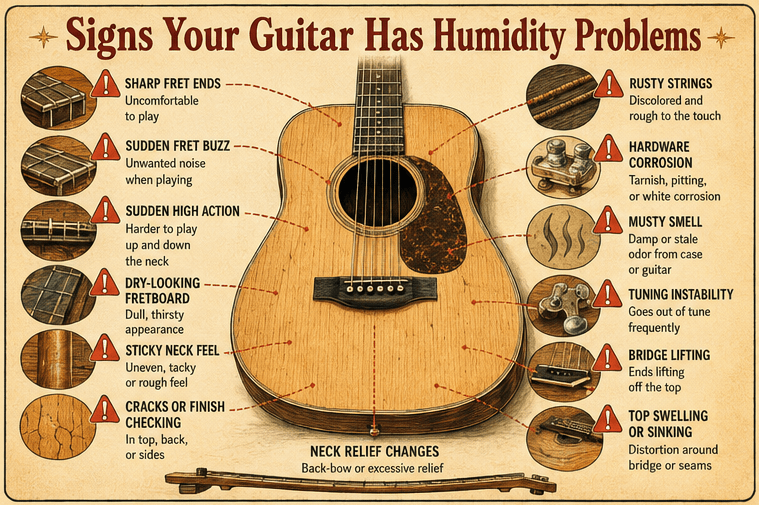
Signs Your Guitar Has Humidity Problems
Your guitar may have humidity problems if you notice:
- Sharp fret ends
- Sudden fret buzz
- Sudden high action
- Dry-looking fretboard
- Sticky neck feel
- Cracks or finish checking
- Rusty strings
- Hardware corrosion
- Musty smell
- Tuning instability
- Bridge lifting on an acoustic guitar
- Top swelling or sinking
- Neck relief changes
- The guitar feels different after weather changes
If several of these signs appear at the same time, check the humidity before making major adjustments.
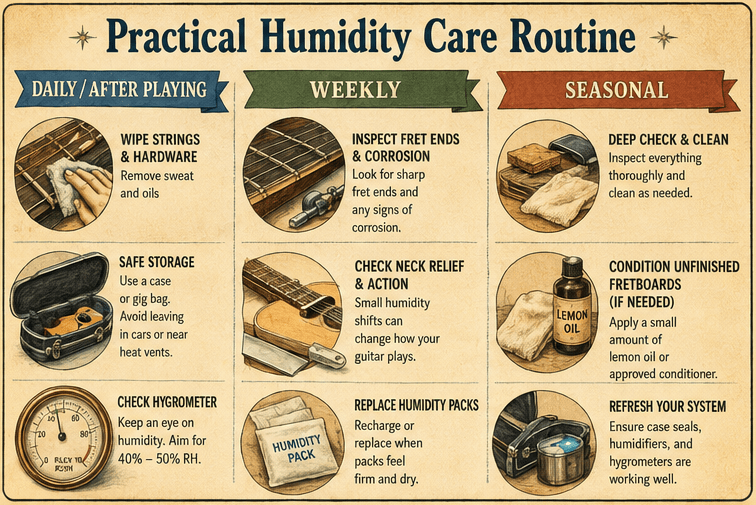
Practical Humidity Care Routine
A simple routine can prevent most humidity-related guitar problems.
Daily or after playing
- Wipe strings and hardware
- Wipe sweat from the body and neck
- Store the guitar safely
- Keep it away from direct sunlight and vents
Weekly
- Check room or case humidity
- Inspect fret ends and fretboard dryness
- Look for corrosion on strings and hardware
- Make sure the guitar is not stored in a damp area
Seasonally
- Check neck relief and action
- Use humidifier or dehumidifier if needed
- Replace humidity packs
- Inspect acoustic tops and bridges
- Clean and condition unfinished fretboards if needed
Good humidity care is mostly about consistency.
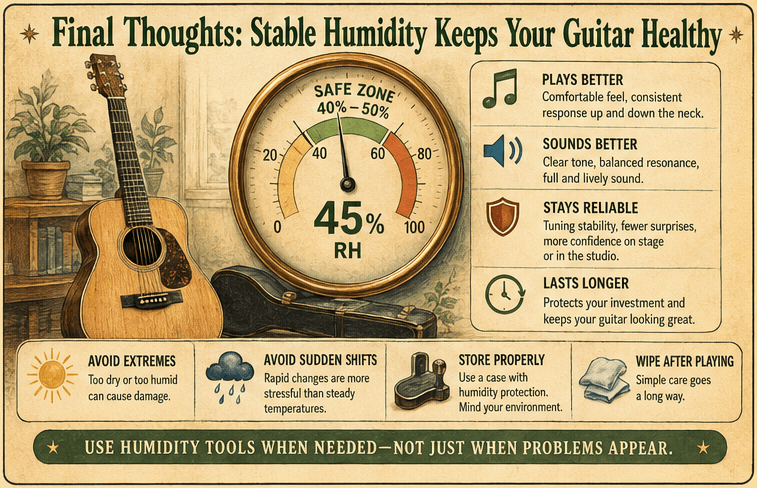
Final Thoughts: Stable Humidity Keeps Your Guitar Healthy
Humidity affects guitars because guitars are made from wood, and wood reacts to moisture in the air. When conditions are too dry, wood can shrink, fret ends can become sharp, action can change, and cracks may appear. When conditions are too humid, wood can swell, action can rise, tone can become dull, and hardware may corrode more quickly.
The safest general humidity range for most guitars is around 40% to 50% relative humidity, with a practical target around 45%.
You do not need to obsess over every small change, but you should avoid extremes and sudden shifts. Use a hygrometer, store your guitar properly, wipe it after playing, and use humidity control tools when needed.
A guitar kept in stable humidity will usually play better, sound better, stay more reliable, and last longer. Whether you own a beginner electric guitar, a vintage acoustic, a semi-hollow jazz guitar, or a custom-built instrument, proper humidity care helps protect your investment and keeps the guitar inspiring every time you play.