

Tonewoods & Materials
Bone Nut vs Graphite Nut: Complete Guitar Nut Comparison Guide

When choosing or upgrading an electric guitar, many players focus on pickups, wood, bridge type, neck profile, fretboard material, or tuners. But one small part can make a big difference in tuning stability, string feel, sustain, and overall performance:
the guitar nut.
The nut sits at the top of the fretboard, near the headstock. It holds the strings in place, controls string spacing, and helps determine how smoothly the strings move when tuning, bending, or using a tremolo.
Two of the most common nut materials are bone and graphite.
Bone nuts are traditional, hard, resonant, and widely used on acoustic guitars, electric guitars, and premium instruments. Graphite nuts are modern, self-lubricating, and especially useful for players who need better tuning stability.
Neither one is automatically better. The right choice depends on your guitar, playing style, bridge type, tuning habits, and whether you care more about traditional tone or tuning performance.
In this guide, we will compare bone nut vs graphite nut, including tone, tuning stability, durability, feel, maintenance, cost, and which one you should choose for your guitar.

What Is a Guitar Nut?
A guitar nut is the small strip of material located at the end of the fretboard, between the fretboard and the headstock.
The strings pass through small grooves called nut slots. These slots guide each string from the fretboard toward the tuners.
A guitar nut affects:
- String spacing
- Open-string height
- Tuning stability
- String movement
- Open-string tone
- Sustain
- Intonation near the first fret
- Playing comfort in lower positions
Even though the nut is small, it is very important. A poorly cut nut can make a good guitar feel bad. A well-cut nut can make tuning smoother, chords easier, and the guitar more reliable.
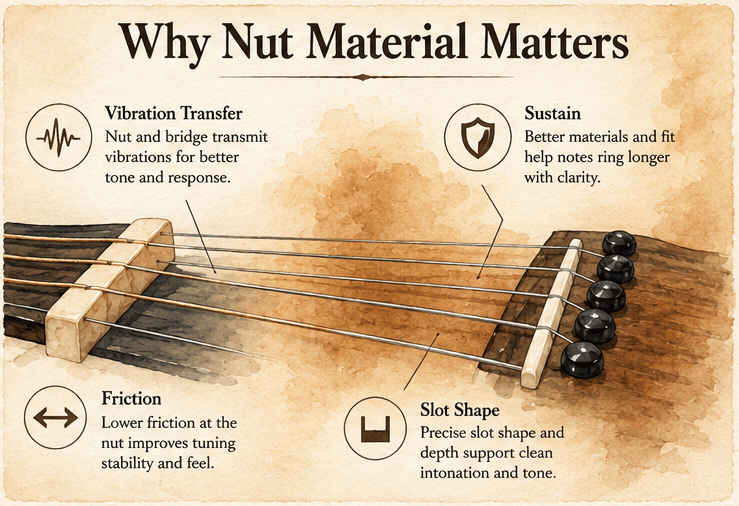
Why Nut Material Matters
Nut material matters because it affects how the string contacts the guitar at the end of the fretboard.
When you play an open string, the nut acts like a fret. The string vibrates between the nut and the bridge saddle. This means the nut can influence the sound and sustain of open strings.
When you fret a note, the nut becomes less involved in the vibrating length of the string. However, it still affects tuning stability because the string must move smoothly through the nut slot when you tune, bend strings, or use a tremolo.
A good nut material should be:
- Hard enough to transfer vibration well
- Smooth enough to reduce friction
- Durable enough to resist wear
- Stable enough to hold accurate slot shape
- Easy enough to cut precisely
- Suitable for the guitar’s playing style
Bone and graphite approach these needs differently.
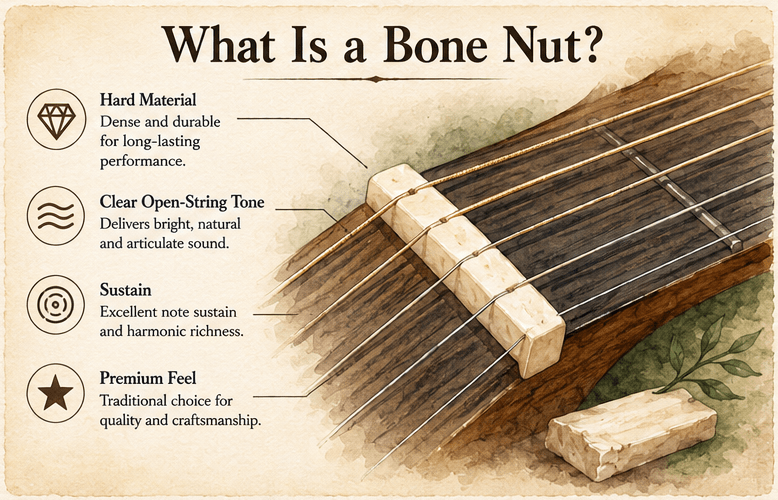
What Is a Bone Nut?
A bone nut is made from animal bone, usually cattle bone. It has been used on guitars for a long time and is still one of the most respected nut materials.
Bone is hard, dense, and naturally resonant. It is commonly found on acoustic guitars, vintage-style electric guitars, boutique guitars, and many higher-quality instruments.
Bone nuts are often chosen because they offer a traditional feel, strong sustain, and clear open-string tone.
Bone nut characteristics
Bone nuts are usually known for:
- Hard material
- Clear open-string tone
- Good sustain
- Traditional construction
- Natural appearance
- Strong durability
- Premium feel
- Good vibration transfer
A well-made bone nut can make a guitar feel more responsive and refined, especially when compared with cheap plastic nuts.

What Is a Graphite Nut?
A graphite nut is made from graphite or a graphite-based synthetic material. Graphite is often used because it has natural lubricating properties.
The main advantage of graphite is low friction. Strings can slide more smoothly through the nut slots, which helps improve tuning stability.
Graphite nuts are common on electric guitars, especially guitars with tremolo systems, modern performance guitars, and guitars used for frequent bending or alternate tunings.
Graphite nut characteristics
Graphite nuts are usually known for:
- Smooth string movement
- Better tuning stability
- Self-lubricating feel
- Dark black appearance
- Good for tremolo use
- Consistent synthetic material
- Lower friction than many traditional materials
- Practical modern performance
A graphite nut is often chosen when tuning stability is the main priority.
Bone Nut vs Graphite Nut: Quick Comparison
Here is the simple version:
Feature | Bone Nut | Graphite Nut |
|---|---|---|
Material type | Natural bone | Graphite or graphite-based synthetic |
Tone | Clear, bright, resonant | Slightly warmer or neutral |
Sustain | Strong | Good |
Tuning stability | Good if cut well | Excellent due to low friction |
Friction | Medium unless lubricated | Low, self-lubricating |
Best for | Traditional tone, sustain, premium builds | Tremolo guitars, tuning stability, modern playing |
Appearance | White, cream, natural | Black or dark gray |
Maintenance | May need lubrication | Usually lower maintenance |
Durability | Very good | Good to very good |
Common use | Acoustic, vintage-style, premium guitars | Electric, tremolo, modern performance guitars |
Simple summary:
Bone nut = traditional tone, clarity, sustain
Graphite nut = smoother tuning, lower friction, better stability
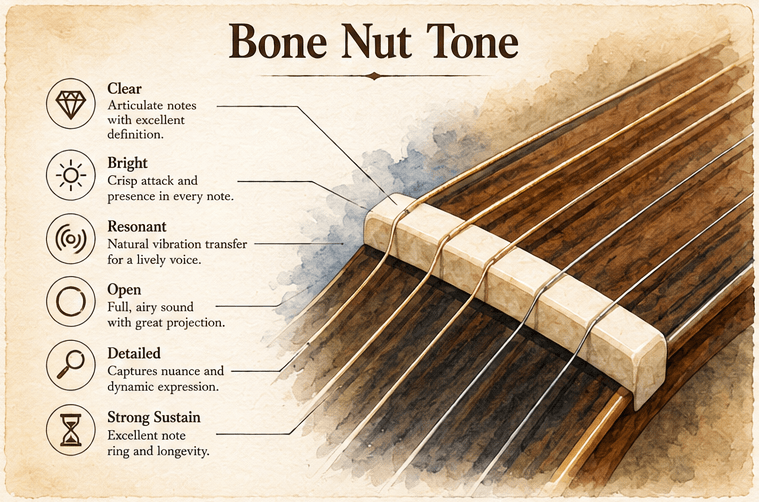
Bone Nut Tone
Bone is often praised for its clear, lively, and resonant sound.
Because bone is hard and dense, it transfers vibration well. This can make open strings sound more defined compared with softer nut materials.
Bone nut tone is often described as:
- Clear
- Bright
- Resonant
- Open
- Detailed
- Strong in attack
- Good sustain
The difference is usually most noticeable on open strings. Once you fret a note, the fret becomes the string’s contact point instead of the nut, so the nut material matters less directly for that note.
Still, many players feel that a good bone nut contributes to a more refined and responsive instrument overall.
Best tonal use for bone nuts
Bone nuts are especially popular for:
- Acoustic guitars
- Vintage-style electric guitars
- Clean tone players
- Blues and classic rock
- Players who value open-string clarity
- Premium traditional builds
If you care about traditional tone and strong open-string response, bone is a great choice.
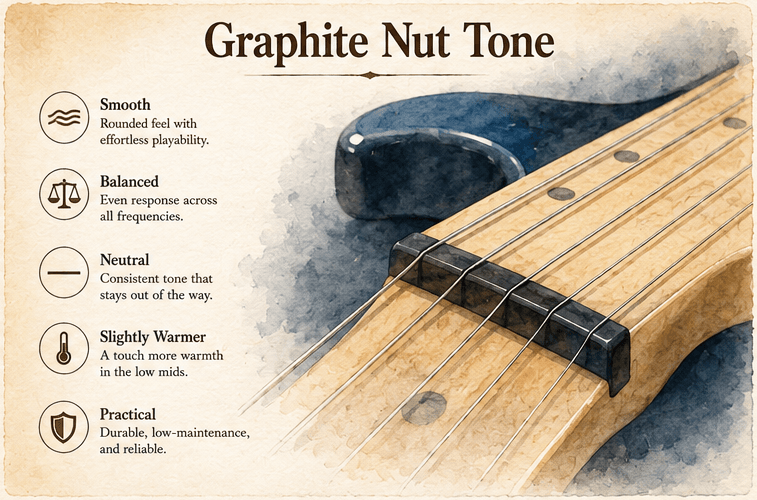
Graphite Nut Tone
Graphite nuts are usually chosen more for tuning stability than tonal character.
Compared with bone, graphite may sound slightly smoother, warmer, or more neutral. It usually does not have the same bright natural character that many players associate with bone.
Graphite nut tone is often described as:
- Smooth
- Balanced
- Neutral
- Slightly warmer
- Less bright than bone
- Practical and consistent
On electric guitars, the tonal difference between bone and graphite can be subtle, especially through pickups, pedals, and amps. Many players choose graphite because the tuning benefits matter more than any small tonal difference.
Best tonal use for graphite nuts
Graphite nuts are especially useful for:
- Electric guitars
- Tremolo-equipped guitars
- High-performance guitars
- Players who bend a lot
- Players who change tunings often
- Modern rock, metal, fusion, and stage use
If you prioritize tuning stability over traditional material character, graphite is a strong option.

Tuning Stability: Bone vs Graphite
Tuning stability is one of the biggest differences between bone and graphite.
Many tuning problems happen when the string does not slide smoothly through the nut slot. If the string binds in the slot, it may catch and release suddenly. This can make the guitar go sharp or flat after bending, tuning, or using a tremolo.
Bone nut tuning stability
A bone nut can have excellent tuning stability if it is cut properly. The nut slots must be the right width, depth, and angle. They should also be smooth.
However, bone is not naturally as slippery as graphite. Some players use nut lubricant to help strings move more smoothly.
Bone tuning stability depends heavily on:
- Slot quality
- Correct slot width
- Smooth polishing
- String gauge
- Headstock angle
- Tuner quality
- Bridge type
- Lubrication
A poorly cut bone nut can cause tuning problems. A well-cut bone nut can work very well.
Graphite nut tuning stability
Graphite has a natural advantage because it is self-lubricating.
Strings usually move more easily through graphite nut slots, which helps reduce tuning issues. This makes graphite especially useful for guitars with tremolo bridges or players who do a lot of string bending.
Graphite is often better for:
- Tremolo use
- Heavy bending
- Frequent tuning changes
- Live performance stability
- Players who dislike nut lubrication
- Modern electric guitars
If your guitar often goes out of tune because strings catch at the nut, graphite may help.
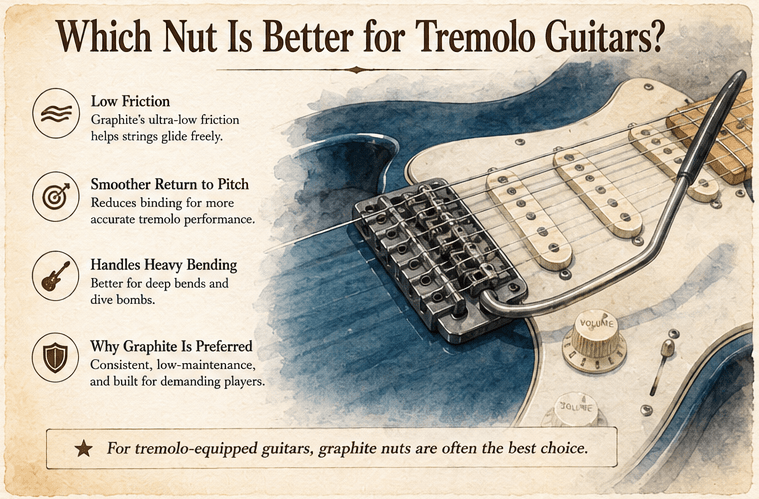
Which Nut Is Better for Tremolo Guitars?
For guitars with tremolo systems, graphite is often the better choice.
A tremolo bridge moves the strings back and forth. Every time the bridge moves, the strings need to slide through the nut slots. If the nut creates too much friction, the strings may not return to pitch accurately.
Graphite helps because it reduces friction.
Choose graphite for tremolo if:
- You use a vintage-style tremolo
- You use a floating tremolo
- You bend strings heavily
- Your strings ping or catch at the nut
- Your tuning changes after tremolo use
- You want low-maintenance tuning stability
Bone can still work on tremolo guitars, but it must be cut and lubricated very well.
For non-locking tremolo systems, graphite is usually one of the most practical choices.

Which Nut Is Better for Fixed Bridge Guitars?
For fixed bridge guitars, both bone and graphite can work very well.
A fixed bridge does not move like a tremolo bridge, so the nut does not experience as much string movement. This means friction is less of a problem.
Bone on fixed bridge guitars
Bone is an excellent choice if you want traditional tone, clear open strings, and a premium feel.
It works well on:
- LP-style guitars
- T-style guitars
- Hardtail S-style guitars
- Semi-hollow guitars
- Acoustic guitars
- Vintage-inspired builds
Graphite on fixed bridge guitars
Graphite is still useful if you bend a lot, change tunings often, or have tuning issues caused by string binding.
It works well on:
- Modern electric guitars
- Hardtail guitars used live
- Guitars with angled headstocks
- Players who need stable tuning under heavy bends
For fixed bridge guitars, the choice depends more on personal preference.

Durability: Bone Nut vs Graphite Nut
Both bone and graphite can be durable when made and installed properly.
Bone durability
Bone is hard and long-lasting. A good bone nut can last for many years. However, because bone is a natural material, density and quality can vary.
Bone can also chip if handled poorly during cutting or installation.
Graphite durability
Graphite nuts are also durable, but they may wear differently depending on the exact material blend. Some graphite-based nuts are softer than bone, which can lead to slot wear over time, especially with heavy string use.
However, many modern graphite or graphite-composite nuts are very reliable.
Durability summary
Bone is generally harder and may last longer in terms of slot wear. Graphite offers better low-friction performance but may vary depending on quality.
The quality of the nut material and the accuracy of the slot cutting matter more than the name alone.

Maintenance: Bone Nut vs Graphite Nut
Nut maintenance is mostly about keeping the string slots clean and smooth.
Bone nut maintenance
Bone may benefit from occasional lubrication, especially if you hear a “ping” sound while tuning or if strings return sharp or flat after bending.
Common bone nut maintenance includes:
- Keeping slots clean
- Using proper nut lubricant if needed
- Avoiding excessive force during string changes
- Making sure string gauge matches slot width
- Having slots polished if they bind
Graphite nut maintenance
Graphite usually needs less lubrication because the material itself is slippery.
Common graphite nut maintenance includes:
- Keeping slots clean
- Checking for slot wear over time
- Making sure slots match string gauge
- Avoiding rough filing unless necessary
If you want lower maintenance, graphite usually has the advantage.
Cost Comparison
Bone nuts are often more expensive than basic plastic nuts, but not necessarily extremely expensive. The cost mostly comes from the labor required to cut and fit the nut properly.
Graphite nuts are often available as pre-shaped or pre-slotted parts, which can make installation easier. However, they still may require final fitting.
Cost factors include:
- Material quality
- Pre-slotted or custom-cut design
- Labor for installation
- Guitar type
- String spacing
- Nut width
- Slot depth adjustment
- Final polishing
A perfectly installed affordable nut is better than an expensive nut that is poorly cut.

Installation: Why Nut Slot Cutting Matters Most
The nut material is important, but the nut slot work is even more important.
A poorly cut bone nut can perform worse than a well-cut graphite nut. A poorly cut graphite nut can still cause tuning problems if the slots are too narrow, too deep, or angled incorrectly.
A good nut slot should:
- Match the string gauge
- Hold the string at the correct height
- Allow smooth string movement
- Angle correctly toward the tuner
- Avoid pinching the string
- Avoid being too deep
- Avoid buzzing on open strings
Nut work requires precision. If you file too deep, the string may buzz and the nut may need repair or replacement.
For many players, professional installation is worth it.
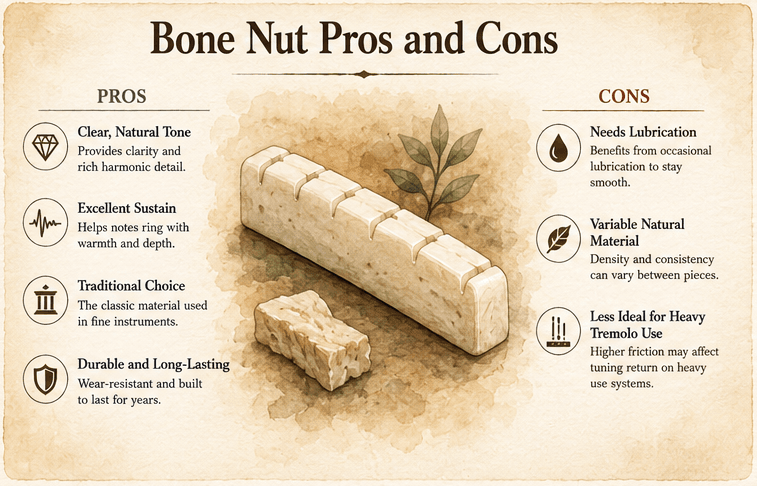
Bone Nut Pros and Cons
Pros of a bone nut
Bone is traditional, hard, and resonant. It is a great choice for players who want clarity, sustain, and a premium natural material.
Bone nut advantages:
- Clear open-string tone
- Strong sustain
- Traditional material
- Hard and durable
- Premium feel
- Great for acoustic guitars
- Great for vintage-style builds
- Works well on fixed bridge guitars
Cons of a bone nut
Bone is not as naturally slippery as graphite, so tuning stability depends heavily on slot quality and lubrication.
Bone nut disadvantages:
- May need lubrication
- Natural material can vary
- Can bind if slots are poorly cut
- More labor-intensive to shape properly
- Less ideal for heavy tremolo use unless well prepared

Graphite Nut Pros and Cons
Pros of a graphite nut
Graphite is smooth, practical, and tuning-stable. It is a great choice for players who want reliable performance.
Graphite nut advantages:
- Low friction
- Self-lubricating
- Excellent tuning stability
- Great for tremolo guitars
- Good for heavy bending
- Consistent material
- Usually lower maintenance
- Practical for modern electric guitars
Cons of a graphite nut
Graphite may not have the same traditional tone or appearance as bone. Some versions may also be softer than bone.
Graphite nut disadvantages:
- Usually only available in dark color
- May look less traditional
- Tone may be less bright than bone
- Some types may wear faster
- Less common on acoustic guitars
- May not suit vintage-style aesthetics
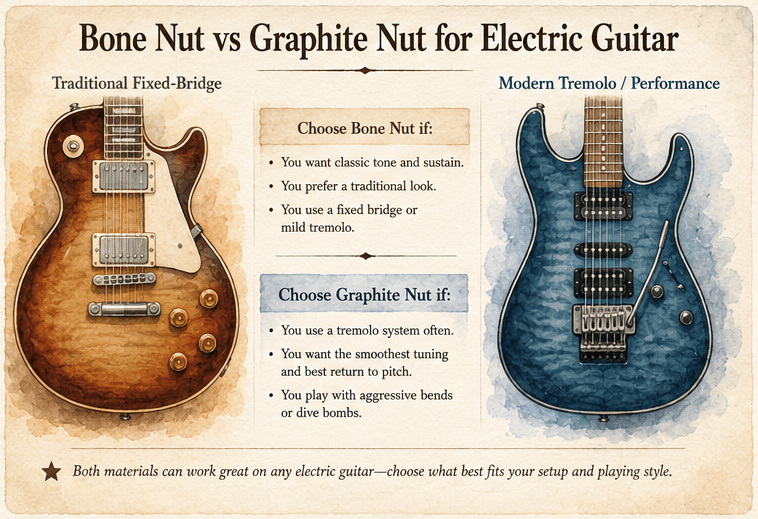
Bone Nut vs Graphite Nut for Electric Guitar
For electric guitars, the choice depends mostly on bridge type and playing style.
Choose bone for electric guitar if:
- You want a traditional upgrade
- You play mostly fixed bridge guitars
- You value clear open strings
- You like vintage-style guitars
- You want a natural premium material
- You do not use tremolo heavily
Choose graphite for electric guitar if:
- You use a tremolo bridge
- You bend strings aggressively
- Your guitar has tuning stability issues
- You play live often
- You change tunings frequently
- You want smoother string movement
For many modern electric players, graphite is the more practical choice. For traditional or vintage-style electric guitars, bone remains a very strong option.
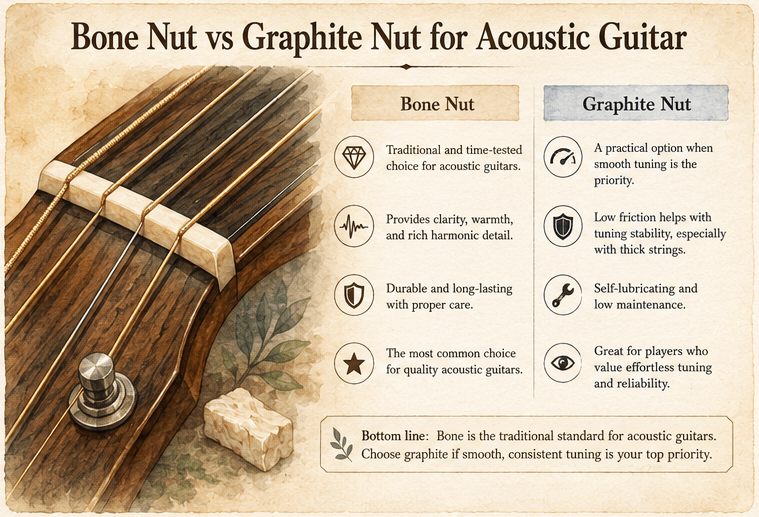
Bone Nut vs Graphite Nut for Acoustic Guitar
For acoustic guitars, bone is usually the more popular choice.
Because acoustic guitars rely more heavily on direct string vibration, nut and saddle material can have a more noticeable effect. Bone is widely used for both nuts and saddles on acoustic guitars because of its hardness, clarity, and sustain.
Graphite can still be used on acoustic guitars, but it is less common.
Choose bone for acoustic guitar if:
- You want clear open strings
- You want traditional acoustic tone
- You want strong sustain
- You want a premium material
- You are replacing a cheap plastic nut
Choose graphite for acoustic guitar if:
- You have persistent tuning issues
- You bend strings often
- You prioritize smooth tuning over traditional tone
- You prefer lower friction
For most acoustic guitars, bone is usually the safer and more traditional choice.
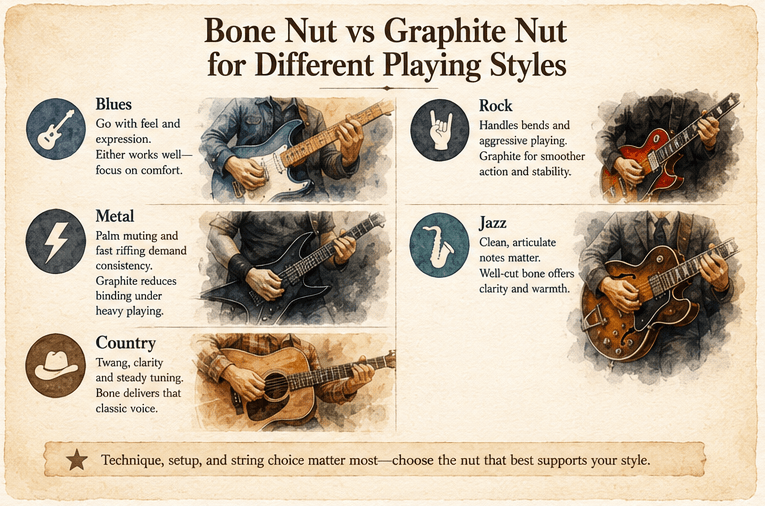
Bone Nut vs Graphite Nut for Different Playing Styles
Blues
Bone and graphite can both work well for blues.
Bone gives clarity and traditional character. Graphite helps tuning stability during bends.
Best choice:
- Bone for vintage blues tone
- Graphite for heavy bending stability
Rock
Rock players can use either material.
Bone works well for fixed bridge guitars and classic tones. Graphite is useful for tremolo guitars or aggressive bending.
Best choice:
- Bone for classic rock
- Graphite for modern rock or tremolo use
Metal
Metal players often value tuning stability, especially with aggressive playing, tremolo systems, and lower tunings.
Best choice:
- Graphite for tuning stability
- Bone for fixed bridge guitars if cut well
Jazz
Jazz players often use fixed bridge guitars and warmer tones, so bone is a traditional and reliable choice.
Best choice:
- Bone for traditional jazz guitars
- Graphite if tuning stability is a concern
Country
Country players often use bends, hybrid picking, and bright clean tones.
Best choice:
- Bone for snap and clarity
- Graphite for smoother bending and tuning stability

Which Nut Is Better for Tuning Stability?
For tuning stability, graphite usually wins.
Its low-friction nature helps strings slide through the nut slots more smoothly. This is especially useful for tremolo systems, string bending, and frequent tuning changes.
However, a well-cut bone nut can also stay in tune very well.
The most important factor is not only the material, but also:
- Proper slot width
- Proper slot angle
- Smooth slot surface
- Correct string height
- Correct string gauge match
- Good tuner installation
- Stable bridge setup
If your guitar has tuning issues, do not assume material alone will solve the problem. The nut must be cut correctly.
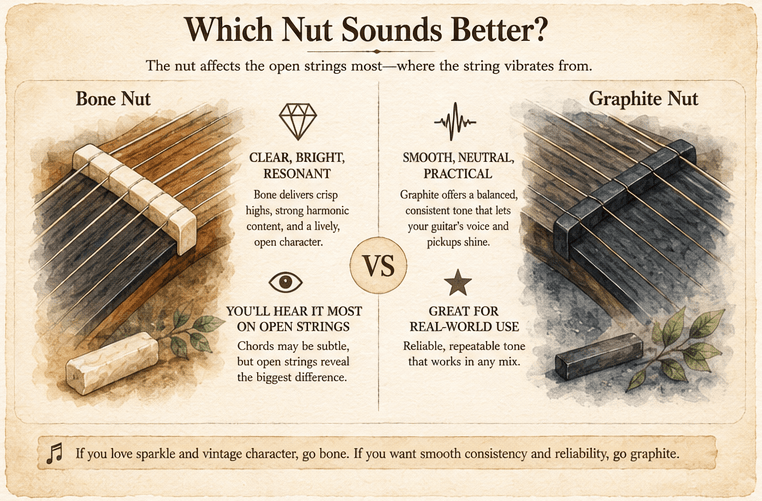
Which Nut Sounds Better?
For traditional tone, many players prefer bone.
Bone is often described as clearer, brighter, and more resonant, especially on open strings. This makes it popular on acoustic guitars and vintage-style electrics.
Graphite is usually more neutral and practical. It may not sound as bright as bone, but the difference can be subtle on electric guitars.
Simple tone summary
Bone = clear, bright, resonant
Graphite = smooth, neutral, practical
If tone is your main priority, bone is usually the better choice. If tuning stability is your main priority, graphite is usually better.

Which Nut Is Better for Custom Guitars?
For custom guitars, the best nut depends on the design goal.
Choose bone if your custom guitar is:
- Vintage-inspired
- Acoustic or semi-acoustic
- Fixed bridge
- Traditional-looking
- Designed for open-string clarity
- Built with premium natural materials
Choose graphite if your custom guitar is:
- Modern
- Tremolo-equipped
- High-performance
- Used for heavy bending
- Designed for stage reliability
- Focused on tuning stability
For a luxury vintage-style build, bone feels more classic. For a modern performance build, graphite is often more practical.
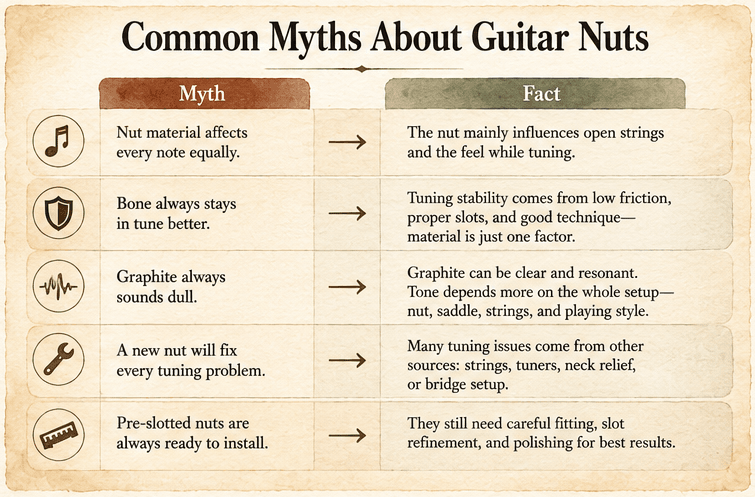
Common Myths About Guitar Nuts
Myth 1: Nut material affects every note equally
Nut material affects open strings most directly. Once you fret a note, the fret becomes the contact point. However, the nut still affects tuning stability and string movement.
Myth 2: Bone always stays in tune better
Bone can stay in tune very well if cut properly, but graphite usually has lower friction.
Myth 3: Graphite always sounds dull
Graphite may sound less bright than bone, but on electric guitars the difference may be subtle, especially through pickups and amps.
Myth 4: A new nut will fix all tuning problems
Tuning problems can also come from tuners, bridge, string winding, string stretching, tremolo setup, or poor technique.
Myth 5: Pre-slotted nuts are always ready to install
Most pre-slotted nuts still need final fitting. Slot depth, width, and height must match the guitar.

How to Choose Between Bone and Graphite
Choose a bone nut if you want:
- Traditional tone
- Clear open strings
- Strong sustain
- Natural material
- Vintage-style appearance
- Acoustic guitar upgrade
- Fixed bridge guitar upgrade
- Premium classic feel
Choose a graphite nut if you want:
- Better tuning stability
- Lower friction
- Smooth string movement
- Tremolo-friendly performance
- Less maintenance
- Modern electric guitar function
- Better stability for bends
- Practical stage reliability
The easiest way to decide:
If you care more about tone and tradition, choose bone.
If you care more about tuning stability and smooth string movement, choose graphite.
Bone Nut or Graphite Nut?
Bone and graphite are both excellent nut materials, but they serve slightly different purposes.
A bone nut is traditional, hard, resonant, and clear. It is a great choice for acoustic guitars, fixed bridge electric guitars, vintage-style builds, and players who care about open-string tone and classic craftsmanship.
A graphite nut is smooth, low-friction, and tuning-stable. It is a great choice for tremolo guitars, modern electric guitars, heavy bending, live performance, and players who want fewer tuning problems.
The best nut is not just about material. It must also be cut and installed correctly. A perfectly cut nut made from a simple material will often perform better than an expensive nut that is poorly fitted.
For most traditional guitars, bone is a premium classic choice. For modern performance guitars, graphite is often the more practical choice.
In the end, choose the nut material that matches your guitar’s design, your playing style, and your biggest priority: tone, stability, or both.